DOW-UAP-D168
BAASS Project Management Plan, December 2008
- Agency
- Department of War
- Format
- Document, 49 pages
- Incident date
- 12/2/08
- Place
- Las Vegas, Nevada
- Released
- Release 07, October 23, 2026
- Source
- war.gov
- Topics
- Project Blue Book, AAWSAP / AATIP, Nuclear sites
Description from war.gov
Redactions war.gov lists this record as redacted. Withheld material is blacked out in the file itself.
Page 1
BAASS BIGELOW AEROSPACE ADVANCED SPACE STUDIES® Contract HHM402-08-C-0072 Project Management Plan (Overview Paper) December 2, 2008Page 2
Bigelow Aerospace Advanced Space Studies Contract HHM402-08-C-0072 Project Management Plan (Overview Paper) December 2, 2008 This information is proprietary and confidential and cannot be disseminated or used without prior written consent from the Operating Manager of BAASS®.Page 3
BIGELOW AEROSPACE ADVANCED SPACE STUDIES Staff AAP Person 4 AAP Person 7 Administrator Deputy Administrator Advisors AAP Person 57 AAP Person 8 Page i This information is proprietary and confidential and cannot be disseminated or used without prior written consent from the Operating Manager of BAASS®.Page 4
PREFACE Importance of the Work There has been over six decades of intensive activity of advanced aerospace craft in the skies over North America and around the world. These have been witnessed, photographed and chased by military pilots, witnessed by ground crews, by commercial airline pilots and by thousands of military and civilian ground based personnel. The importance of this study lies in the possibility that some of these advanced aerospace craft may represent a threat to the security of the United States including its airspace and nuclear facilities. It is thus a very high priority to further our understanding of the physics and engineering feasibility of advanced aerospace weapon systems applications as they apply to the potential future capabilities of foreign threat systems out to the far term, i.e. from now out through the year 2050. Appreciation BAASS appreciates the high level of trust that has been bestowed on the organization by the sponsors/DIA in assigning us with the responsibility of furthering our understanding of the physics and engineering feasibility of advanced aerospace weapons system applications. BAASS understands the sobering importance and the long term implications of this project. Page ii This information is proprietary and confidential and cannot be disseminated or used without prior written consent from the Operating Manager of BAASS®.Page 5
ACKNOWLEDGEMENTS BAASS acknowledges the receipt of three sets of documents that were AAP Person submitted in fulfillment of contracts 081006-1 to the Mutual UFO Network 8 (MUFON), 080930-1 to Earthtech International and an assignment to BAP Person a BAASS employee. These reports that were separately authored by: (1) MUFON, (2) Earthtech Internationa AAP Person 57 Jand (3) AAP Person 8 were prepared and delivered to BAASS under serious time constraints. We appreciate the service of these people. Page iii This information is proprietary and confidential and cannot be disseminated or used without prior written consent from the Operating Manager of BAASS®.Page 6
TABLE OF CONTENTS BAASS Staff and Advisors... Preface.... Acknowledgements. Table of Contents .........i .........i .. ii iv Summary Key Recommendations Introduction (scope of work). Plans of Action and Milestones Concluding Comments 1 .8 ..10 ... 34 Page iv This information is proprietary and confidential and cannot be disseminated or used without prior written consent from the Operating Manager of BAASS®.Page 7
SUMMARY This Project Manager Report (PMR) fulfills the requirement to submit a report as part of the Advanced Aerospace Weapon System Application contract HHM402-08-C-0072. The report comprises overview projects that are focused on and include the scope of the final report (due in September 2009) for the twelve following areas: (1) Lift, (2) Propulsion, (3) control, (4) Power Generation, (5) Spatial/Temporal Translation, (6) Materials, (7) Configuration/Structure, (8) Signature Reduction (Optical/IR/RF/Acoustic), (9)Human Interface, (10) Human effects, (11) Armament (RF and DEW), and (12) Other areas in support of 1-11. The PMR addresses a Plan of Action, Milestones and the composition of BAASS analytical teams for these twelve technical areas. In numerous places throughout the EarthTech report previously mentioned, AAP Person 57 and others refer to the need for "examining more exotic possibilities that might account for reports of truly anomalous characteristics of high- performance craft of unknown origin whose mode of operation appears to be well advanced beyond that presently known." With that in mind, we present the Plans of Action and Milestones in this report comprising nine separate major projects which collectively address all twelve of the technical areas. It should be emphasized that for each of the nine projects, we envisage extension and expansion into 2010 and 2011. Accordingly, the milestones for each of the nine projects described herein should include extensions into 2010, 2011 and beyond. Page 1 This information is proprietary and confidential and cannot be disseminated or used without prior written consent from the Operating Manager of BAASS®.Page 8
The nine major projects are: Project Physics was mandated by the DIA to study the current research on all twelve technical areas. Earthtech and its subcontractors will deliver approximately 24 in depth position papers targeted to twelve technical areas by July 31, 2009. Project Engagement will locate and secure small geographic areas that experience very frequent displays of advanced aerospace vehicles. The purpose is to directly observe and measure advanced aerospace vehicle performance. Project Cooperation requires the full cooperation between the DIA and BAASS and lays out the expected frameworks and specifics of this cooperation. This necessitates the help and cooperation from the DIA in assisting BAASS to obtain the high value film, hardware, relevant materials and information that are essential to the successful completion of this project. Project Campus will seek to stimulate, motivate and encourage the senior levels of the academic community in the United States to seriously study advanced aerospace vehicles and their performances. Project Database will bring together all existing data from multiple separate databases on advanced aerospace vehicle performances in the United States, and ultimately in other countries for the past 60 years. This new database will be searchable by keywords that address all twelve technical areas. Page 2 This information is proprietary and confidential and cannot be disseminated or used without prior written consent from the Operating Manager of BAASS®.Page 9
Project Oral History will contact and record interviews with dozens of highly placed individuals from industry and the military who have had direct knowledge of film evidence, physical material evidence, hardware itself, biological tissue and other material as they pertain to advanced aerial technology in the United States over the past several decades. Project Blue Book Materials will obtain the case files and associated trace materials with the help of DIA of multiple high value cases involving advanced aerospace vehicles that were never included in Project Blue Book presumably because they were deemed too sensitive. Project Northern Tier will obtain all the information and case files pertaining to dozens of cases in which advanced aerospace vehicles flew over restricted air force bases containing nuclear weapons, hovered over weapon storage depots and interfered with functional integrity of ICBM missile systems during the 1960s and 1970s. All of these cases potentially provide evidence of a threat to the national security of the United States. Project Colares will obtain materials and case files, with help from the DIA, from an extensive series of advanced aerospace incidents, many of which caused death and injury to indigenous inhabitants, occurring on Colares Island in the Northern area of Brazil in 1977. The Brazilian Air Force conducted an investigation and obtained multiple photographs, instrumented detection and eyewitness testimony, much of which pointed to potentially hostile activity by the advanced aerospace vehicles. In summary, we believe that combined, these nine projects will comprehensively address the twelve technical areas outlined in contract # HHM402-08-C-0072. Page 3 - This information is proprietary and confidential and cannot be disseminated or used without prior written consent from the Operating Manager of BAASS®.Page 10
KEY RECOMMENDATIONS 1) In order for BAASS to provide the optimum result, it is essential that various BAASS staff acquire the necessary clearances as soon as possible. It is our understanding that vital information that is germane to all of the contractor recommendations already resides in government hands. Without these clearances, BAASS will not be able to access this vital information relevant to very advanced spacecraft. Without access to this quality information, BAASS would be handicapped to more of a parochial study of the twelve technical areas. We would like to see at least the clearances approved for the BAASS Administrator by the end of January, if at all possible. We would hope that other clearances for which the names have already been submitted would be forthcoming relatively soon thereafter. 2) One example of acquiring quality information through Agency help is from access to high quality film as soon as possible. Whether the film is from gun cameras, ground base sources or satellites, all of our scientists and analytical sources agree, this information has significant inherent value. We believe this single type of resource can influence data gathering on technical areas 1,2,3,4,5, 7,8, and 11 as will be explained later. 3) Other "low hanging fruit" in which the Agency can play a central role could include the obtaining of the best Blue Book files that were kept separate due to their "high sensitivity" from the more routine incident reports that were investigated. Project Blue Book (active in the 1960's) was a US Airforce/US government program assessing among other things the performance of very advanced spacecraft. What wasn't publically known was that a significant Page 4 This information is proprietary and confidential and cannot be disseminated -or used without prior written consent from the Operating Manager of BAASS®.Page 11
amount of information and trace material never reached the small "official" investigation office. We believe we may know exactly where some of that information currently resides. For DIA, the acquisition of the data files known to be excluded from Project Bluebook, on advanced aerospace technology that presently resides at LANL (BAASS affiliated personnel have the precise files numbers and locations of these files at LANL) will be of great importance in meeting the timelines for about 8/12 of the technical tasks. Another example involving data already in government hands, which the Agency can help us retrieve, concerns the effects upon humans (#10) who were in close proximity to the functioning of very advanced spacecraft in the Colares Island, Brazil incidents. In line with project Colares: it is recommended that the DIA contact the Brazilian Air Force by February 1, 2009 in order to secure an entire set of files, including medical records, pertaining to the three month "invasion" by advanced aerospace vehicles in 1977 off the North coast of Brazil. These files include photographs and instrumented recordings made by the Brazilian air force. 5) Other important data for Agency acquisition pertain to effects upon nuclear facilities where anomalous spacecraft were in close proximity: such as those incidences at RAF Bentwaters, England, Malmstrom AFB in Montana and several others over the years. These would apply to #11, Armaments, #8, Signature Reduction, and #10, Human Effects. 6) Additional possibilities of benefit from accessing government sources through Agency help pertain to the matter of #3, Control, as in the operators of these very advanced spacecraft and possibly the source or sources of these craft. Page 5 This information is proprietary and confidential and cannot be disseminated er used without prior written consent from the Operating Manager of BAASS®.Page 12
7) Agency officials should make efforts to be officially available to accompany BAASS senior management during the process of interviewing key participants. The oral history program will be the extraction of information from people about exotic spacecraft who were highly placed within government. In order for many of these people to talk, it is necessary for them to know they won't get into trouble and it is officially okay for them to speak up regarding novel spacecraft that were not "black" government programs. We are speaking here of government employees. These oral histories would relate to probably all twelve technical areas. Since many of these people are in advanced age, time is of the essence. BAASS affiliated personnel have a list of about ten individuals who have worked in various parts or have been affiliated with the programs involving retrieval of advanced aerospace hardware or of associated biological material. It will be of great importance for DIA to contact these individuals and to obtain the maximum information from them. BAASS can supply the names and contact information for each person. Agency should assist BAASS wherever, whenever possible in the long term program of outreaching and collaboration with select foreign sources including governments. Various foreign contact relationships already exist among several BAASS senior personnel and other outside associates. It is substantiated with testimony that several "crashes" of novel spacecraft have occurred outside of the United States. Our concern addresses the level to which other countries have already succeeded in understanding the technical aspects of these craft. Even more impressive, would be any successes concerning back-engineering of various components. In so far as this "crash" information is decades old, we have no idea what progress has been accomplished to date. However, we do know that various heads of state in other countries have a different view toward this subject of novel spacecraft than do American heads of state. While "official" American Page 6 This information is proprietary and confidential and cannot be disseminated or used without prior written consent from the Operating Manager of BAASS®.Page 13
behavior has taken the "head in the sand" approach, we know that has not been the universal reaction in other countries. Our military future could be seriously influenced. Under the premise that biological material of potentially non-human origin has been recovered, at the earliest available opportunity DIA will lobby via interagency connections for access to medical samples for evaluation by BAASS affiliated forensic personnel with such laboratories as the Armed Forces Institute of Pathology (AFIP); the various commands housed at Fort Detrick, e.g., U.S. Army Medical Research and Materiel Command (USAMRMC) with its Bio-defense Agency, and the U.S. Army Medical Research Institute of Infectious Diseases (USAMRIID); Dugway Proving Ground's U.S. Army Test and Evaluation Command (ATEC). 10) Via DIA contact with NORAD by February 15, 2009, with data on trajectory and speed from uncorrelated targets having been made available to BAASS analysts, we will conduct a detailed evaluation on said data to mine it for information pertaining to Lift, Propulsion, Control, Power Generation, Spatial Temporal Translation, Materials, Configuration/Structure, Signature reduction, or Armaments. Page 7 This information is proprietary and confidential and cannot be disseminated -or used without prior written consent from the Operating Manager of BAASS®.Page 14
INTRODUCTION Scope of Final Report Incorporating each Technical Area This Program Manager Report (PMR) accomplishes the requirement to submit a report as part of the Advanced Aerospace Weapon System Application contract HHM402-08-C-0072. This report comprises overview papers identifying the scope of the final report (due in September 2009) for each of the 12 following areas: (1) Lift, (2) Propulsion, (3) Control, (4) Power Generation, (5) Spatial Temporal Translation, (6) Materials, (7) Configuration/Structure, (8) Signature Reduction (Optical/IR/RF/Acoustic), (9) Human Interface, (10) Human Effects, (11) Armament (RF and DEW) and (12) Other areas in Support of 1-11. Secondly this PMR addresses a Plan of Action and Milestones that encompasses the 12 areas. Finally, the PMR addresses the intended composition of the BAASS analytical teams that will work on these areas. The objective of the overall program is to understand the physics and engineering of advanced aerospace weapon system applications as they apply to potential foreign threats out to the far term, e.g., from now through the year 2050. Underlining the gravitas of the anomalous aerospace vehicle subject, according to Earthtech Report #7, page 2: "With regard to yet more exotic possibilities for craft configurations and flight performance, it would be remiss to overlook observations of apparently advanced unconventional craft reported by credible observers (e.g. military and civilian pilots) for several decades [9,10]. The so-called UFO phenomenon. Despite the overreaction and sensationalism of the public which led to the CIA initiated policy via the 1843(a)(2) to debunk the subject as a safeguard against clogging of communication channels [11], the subject has been treated seriously in a congressional hearing-1968 (1843(a)(2) 1843(a)(2) [12]- and in a document prepared for Page 8 - This information is proprietary and confidential and cannot be disseminated or used without prior written consent from the Operating Manager of BAASS®.Page 15
congressional briefings by the Congressional Research Service [13]." Note: numbers inside parentheses refer to references in the Earthtech report #7. In order to meaningfully tackle the subject areas outlined in the above 12 technical topics, BAASS has been compelled to focus on those projects that are feasible given the current timelines and budget allocations for this contract. The three sets of papers that have been submitted to the agency by MUFON, Earthtech and by AAP Person 8 covered an enormous number of possible directions as they sought to address the above 12 technical areas. BAASS personnel judged it impossible logistically to embrace all of the recommendations in these technical papers as reasonable achievables. Many of the projects could take greater than several decades to accomplish and possibly billions of dollars. Accordingly, BAASS has chosen eight specific projects to focus on during the first and second years of this contract. We consider that the probability of success of these nine projects within a 12 or 24 month time frame and within the allocated budgets is maximized. Therefore, the objectives, methodologies, milestones and team compositions for each of the nine projects are laid out in detail in the next section of this Project management Report. Very recently, DIA has mandated the creation of a ninth project, that we call Project Physics (see page 11), in which the current research in universities and research institutes on all twelve technical areas will be studied. It should be stated at the outset that we deliberately adopted the stance that the most productive way to learn the maximum about the twelve technical areas was to study craft that are already displaying novel behavior in the twelve technical areas. Hence, with the exception of the DIA mandated Project Physics (see page 11) BAASS's resources will not be devoted to studying the current "state of the art" of technology in our university system and research institutes. This latter approach could prove fruitless and waste significant time and money. Page 9 This information is proprietary and confidential and cannot be disseminated or used without prior written consent from the Operating Manager of BAASS®.Page 16
PLANS OF ACTION WITH MILESTONES AND TEAM COMPOSITIONS PROJECT PHYSICS This project will cover all twelve technical areas. Objectives In November 2008, Earthtech delivered 12 Technical Studies that recommended a wide ranging array of approaches to address the physics and engineering feasibility of advanced aerospace weapons system application as they apply to the potential future capabilities of foreign threat systems out to the far term i.e. from now through 2050. The 12 Technical Studies addressed: Lift, Propulsion, Control, Power Generation, Spatial/Temporal Translation, Materials, Configuration/Structure, Signature Reduction, Human Interface, Human Effects, Armament and Other Areas. Many of the approaches recommended in the 12 Earthtech Technical Studies are highly theoretical. Even with virtually unlimited buckets of time and money it is impossible to predict which, if any, of these approaches might yield a physical demonstration that parallels the behavior of novel spacecraft already known to exist. However, through recent consultations between the DIA and BAASS, it has been decided that a new series of position papers shall focus on an in-depth treatment of subsets of each of the twelve technical areas. For the sake of thoroughness, the Agency and BAASS have decided that on the remote chance a six month exploratory effort may reveal significant progress in one or more of the twelve technical areas, BAASS shall proceed with Project Physics. Perhaps this Page 10 This information is proprietary and confidential and cannot be disseminated or used without prior written consent from the Operating Manager of BAASS®.Page 17
research could explain some aspect of behavior over the last six decades of very advanced spacecraft already known to exist. BAASS is contracting with Earthtech for an in-depth six month study to locate through any sources at Earthtech's disposal any information on these more prosaic approaches that have been kicked about for some period of years. Accordingly, the objective of Project Physics is for Earthtech and its subcontractors to produce approximately 24 position papers that are comprehensive treatments of more than one approach for each of the 12 technical areas. Methodology Earthtech will choose the precise nature and scope of the approximately 24 position papers that will encompass the 12 technical areas (Lift, Propulsion, Control, Power Generation, Spatial/Temporal Translation, Materials, Configuration/Structure, Signature Reduction, Human Interface, Human Effects, Armament and Other Areas). Either through in-house physicists or external physics/engineering contractors, Earthtech will deliver the approximately 24 position papers that will be based on expanding and focusing on strategically important sub-projects from the 12 position papers that Earthtech already has delivered. Milestones Earthtech will deliver approximately 24 position papers to BAASS on or before July 31, 2009. Page 11 This information is proprietary and confidential and cannot be disseminated or used without prior written consent from the Operating Manager of BAASS®.Page 18
Team Composition AAP Person 57 AAP Person 58 Select Earthtech Subcontractors Page 12 This information is proprietary and confidential and cannot be disseminated or used without prior written consent from the Operating Manager of BAASS®.Page 19
PROJECT ENGAGEMENT This program shall endeavor to locate possible small geographical areas where novel spacecraft seem to frequent. This program would specifically relate to technical area #9 with possible collateral involvement of other technical areas. Objectives In spite of having confirmation that a significant menu of very novel spacecraft have existed for over 60 years and travel anywhere, anytime, there is no officially reliable data as to who pilot these craft, how they are made, where is their place of origin and why they are here. Until actual materials are obtained, we must rely on more indirect means. However, on the slim chance that some geographic areas could be found where "regular" flights of these craft were occurring, it might be possible to implement a pro-active program, actually seeking some form of engagement. Members of BAASS have some previous experience in this regard. This will be a very unpredictable program. It also could be risky for the participants. And it could be financially expensive. However, the potential gain could be unlimited and that is why we are offering this plan. The first objective would be to locate, choose and secure possible sites. Concurrent with this activity would be the engagement of BAASS staff and outside contractors to properly strategize various approach scenarios. As new site opportunities were recognized by BAASS staff, possibly due to the immediate nature of the spacecraft performances, expansion of this program would occur domestically and to foreign locations over time. The second objective is to gather as much data as possible through observation of the craft. This is not as easy as it sounds. The authors of this Page 13 This information is proprietary and confidential and cannot be disseminated or used without prior written consent from the Operating Manager of BAASS®..Page 20
overview paper can ratify this point. To successfully gather useful data from observations requires cooperation from the spacecraft. Performances must necessarily be continued. The acquisition and implementation of very sophisticated equipment is a challenge. Having the right people and enough human resources in vital. The entire effort requires flexibility, inventiveness and patience. But the rewards lead to the possibility of a successful third objective. The third objective would be Communication and or Contact. (This is not, by the way, a novel idea. It is our understanding that select communications and contact between the operators of these spacecraft and interested parties within this country started many years ago.) The authors of this paper would suggest approaches that would encompass diverse methods. Methodology Some previous efforts produced effects that could be interpreted as marginal but with positive results. Multiple human witnesses were involved in many dozens of successful efforts. These intensified in 2007 and 2008. Hundreds of photographs, indoors and outdoors using multiple digital cameras, were taken showing anomalistic features. With most of this activity, we were not the initiators of these contacts. Our function was more catalytic in nature. In the vast majority of contacts, we were acted upon. That is to say, having placed ourselves in residency at the location for a substantial period of time, we began to "participate" in what we considered games and demonstrations, but, usually we were caught by surprise. The methods of communication or contact could encompass a wide variety of approaches. From the use of various hardware to engaging people as cognitive interactive subjects. We have previously tried both. Page 14 This information is proprietary and confidential and cannot be disseminated or used without prior written consent from the Operating Manager of BAASS®.Page 21
Milestones We shall initiate the process of identifying possible geographic locations of current or recent past activity during the first quarter of 2009. Also at that time, we shall convene one of several workshops as an ongoing process to plan and strategize approaches and program structure. Of necessity, it is anticipated that project engagement will require multiple years of focused resources and funding, potentially extending into and beyond 2011. Also, we shall engage outside contractors during this time to conduct specific tasks. Team Composition Finding and fitting the appropriate type of people to this assignment will be most difficult for many reasons. Fortunately, BAASS's sister company Bigelow Aerospace (in addition to BAASS) currently has in its employ a few people that already have some experience and can help initiate the program. However, numerous other people will be needed to augment BA's and BAASS's small force in addition to the BAASS Administrator and Deputy Administrator. Supplemental to eventually having several in house teams, contracting for outside assistance will be necessary. The BAASS Administrator and Deputy Administrator have had previous experience in contracting for this type of observation activity. This type of field work, while very awkward for the Agency to say the least, is something well suited for BAASS. Page 15 This information is proprietary and confidential and cannot be disseminated or used without prior written consent from the Operating Manager of BAASS®.Page 22
PROJECT COOPERATION Project Cooperation is the program that could be the most important of all Plans of Action. As previously listed under Key Recommendations, in order to not waste time, in order to not waste money, in order to make this overall program the most productive for which the RFP was constructed and paid for by the Sponsors, the Agency needs to be successful in its ability to assist BAASS in the acquisition of film, hardware, relevant materials and information currently under Government and Agency influence and control. This should include other relationships the Agency has with other organizations. We acknowledge that we have been told several times this effort will be forthcoming with our help and look to this with great expectation. Objectives Since proper clearance activity has been initiated for the BAASS Administrator and others, the first step is something the Agency can take now. According to the schedule BAASS has been given, there is no time to waste. Concurrent with the clearance approval process, the Agency can begin to make inquiries within itself as the Agency has already said is the first logical place to begin. By the time the Agency has dug down to discover its own the quality sources, clearance should be approved at least for the BAASS Administrator. The second step would be for a meeting between the Agency and the Administrator for discussion and creation of strategy purposes. The third objective is for BAASS to marshal human and financial resources into this Cooperation Program. Page 16 This information is proprietary and confidential and cannot be disseminated or used without prior written consent from the Operating Manager of BAASS®.Page 23
Methodology Project Cooperation will initiate with the receipt of clearances by the BAASS Administrator. However, while the clearance process is underway, the agency will be focused on uncovering the many sources of information and leads on the topic of anomalous aerospace vehicle performance that reside within its own data archives. This internal agency dataset could provide a very rich source of pertinent information. Next, the agency, the BAASS Administrator and other appropriately cleared BAASS personnel will cooperate in (a) seeking out and securing the materials that avoided Project Bluebook, (b) the high value people with valuable information for interviews, (c) the location and content of the files pertaining to the Northern Tier-missile AFB sightings, (d) the ground-based, satellite based and gun camera film/imagery residing at multiple locations and (e) the files from the Brazilian Colares Island incidents involving multiple injuries/deaths from anomalous aerospace vehicles in 1977. All of these directions are discussed in more detail in the subsequent sections of this report. Milestones The first milestone is identified as the joint efforts of the Administrator acquiring needed clearance, hopefully by January 2009 and the Agency obtaining relevant substantive information etc. to share that requires SCl or Top Secret Clearance. The second milestone would encompass the meeting previously mentioned. This meeting needs to occur as soon as possible after the first milestone is accomplished. Prior to this meeting there will be the necessity to develop a satisfactory procedure/process for the delivery of materials, information etc. to BAASS. Page 17 This information is proprietary and confidential and cannot be disseminated or used without prior written consent from the Operating Manager of BAASS®.Page 24
This program phase called Project Cooperation cannot be over emphasized in its importance. A thorough data-mining of potential information location needs to begin immediately. If successful this project would substantially contribute to all twelve technical areas. Depending on the speed of cooperation between DIA and BAASS, it is anticipated that this project will extend beyond 2009 and into 2010 and 2011. Team Composition The lead for this project shall be the BAASS Administrator as this may represent the most important Plan of Action. Supporting the Administrator in the beginning will be key individuals such as: Deputy BAASS Administrator AAP Person 57 AAP Person 58 AAP Person 5 Select BAASS Staff Page 18 This information is proprietary and confidential and cannot be disseminated or used without prior written consent from the Operating Manager of BAASS®.Page 25
PROJECT CAMPUS This program will seek to involve all twelve technical areas (Lift, Propulsion, Control, Power generation, Spatial/Temporal Translation, Materials, Configuration/Structure, Signature Reduction (Optical/IR/RF/Acoustic), Human Interface, Human Effects, Armament (RF and DEW), Other Areas. Objectives The first objective is to stimulate, motivate and encourage the senior levels of the academic community within the United States to involve themselves in study and research of very advanced aerial spacecraft that is presently considered phenomenological. In this effort, it is this program's intention to lay the seeds for serious exploration of this topic within the national academic community at its highest levels. After six decades of overt, blatant conspicuous and obtrusive global performance by very advanced anomalously behaving spacecraft, the academic community is still successful in maintaining the posture that these spacecraft either don't exist or are not worthy of serious research and study. Foundationally, there still remains a giggle factor which has been instrumental in squashing serious consideration and thought. The second objective is to extract from this large untapped body of resource information not previously obtained. The third objective is to stay ahead, or worse, catch up to the similar efforts that may already be underway in foreign countries. It is our opinion that such research efforts conducted on a significant scale in foreign countries could/would Page 19 This information is proprietary and confidential and cannot be disseminated er used without prior written consent from the Operating Manager of BAASS®.Page 26
eventually pose a threat to US national security. Such a significant program would/could provide a serious positive stimulus to academic research in science and math thus furthering the military capabilities of those countries. Our concern is that the top universities/technical institutes in some foreign countries MAY take this subject more seriously than we do in the United States and hence MAY already have devoted significant resources to their study. Project Campus will seek to help ameliorate this putative technological gap. Methodology The first priority is for BAASS to create a sophisticated program of grants that is designed to stimulate the academic community to take the subject of advanced aerospace vehicles seriously. BAASS will engineer a series of RFPs that are directed at universities in the United States. The RFPs will unambiguously emphasize the urgent need to study unconventional advanced aircraft with respect to aerospace engineering, theoretical and applied physics, advanced materials science etc. All prospective applicants will file a statement of intent that will comprise a brief overview of what they intend to do. In this way, research that is proposed that is judged by BAASS to be insufficiently ground breaking, advanced or breakthrough will be quickly terminated without the need to waste precious resources in grant allocation. BAASS will appoint a grant monitors who will work with the Pl to ensure that the submitted proposal is of the highest quality and importantly is on target to address one of the twelve criteria. Milestones The first milestone, approximate delivery date February 28, 2009, will be for AAP Person 100 AAP and team to formulate and present to the BAASS Person 99 Page 20 This information is proprietary and confidential and cannot be disseminated or used without prior written consent from the Operating Manager of BAASS®.Page 27
Administrator, the comprehensive detailed strategy for reaching out to the academic community in the United States. This will take the form of design of RFPs and design of Letter of Intent (LOl) solicitations. A realistic projection from BAASS is that the milestones in the project should encompass at least three years of effort. Academic turnaround is demonstrably slow. Team Composition AAP Person 99 AAP Person 100 Select BAASS Staff Timeline Long Term Page 21 -This information is proprietary and confidential and cannot be disseminated or used without prior written consent from the Operating Manager of BAASS®.Page 28
PROJECT DATABASE This program will address all twelve technical areas. Objectives For six decades there have been displays of advanced aerospace vehicles in the skies of North America and around the world that have been witnessed by thousands of people, including military pilots and ground crews, civil aviation pilots, law enforcement officers and members of the public. Because these displays have not been taken seriously, few significant resources have been allocated to gathering the data into a single place from all of these sightings. Instead, data is scattered through over twenty smaller databases in the United States and over a dozen more internationally. Because of a lack of resources (a) these data have never been brought into a single storage site and (b) consequently have never been analyzed using sophisticated search parameters. This BAASS project seeks to eliminate this shortcoming. The objective is to create the world's first comprehensive high quality searchable database of advanced aerial technology maneuvers. Methodology For BAASS, the establishment of a "meta-database" of advanced aerospace technology interactions with humans, comprising a subset from over twenty known datasets from the public domain will be in place in the first year of operations. The BAASS database will include the highest quality, calibrated, close encounter datasets already merged and searchable by keywords from a subset of publicly available databases. It is anticipated that the end result of the worldwide database collection will results in thousands of different high quality aerospace Page 22 This information is proprietary and confidential and cannot be disseminated or used without prior written consent from the Operating Manager of BAASS®.Page 29
technology cases. The BAASS database will be searchable with keywords specifically designed to interrogate for: Lift, Propulsion, Control, Power Generation, Spatial temporal translation, Materials, Configuration/Structure, Signature Reduction (Optical/IR/RF/Acoustic), Human Interface, Human Effects, Armament, Other areas. Extending into 2010, BAASS will create a series of liaisons to obtain the highest quality cases of advanced aerospace vehicle activity from the Ministry of Defense (MoD) in the UK (release of some files into the public domain was initiated by the UK MoD in 2008), from high level officials in France, from military liaisons in Belgium. Secondly, we will establish contacts with high level individuals/ in the Brazilian, Peruvian, Chilean and Argentine air forces, all four of which have had multiple reports of activity in their air spaces, some of which have leaked into the public domain. Thirdly, BAASS will purchase, download, or otherwise acquire databases pertaining to advanced aerospace activity from Australia, Scandinavia, Germany and other countries. Milestones By June 30 2009, BAASS will purchase, download or initiate negotiations to acquire a subset of the approximately 20 databases, including those created by NIDS, MUFON, UFOCAT, GEIPAN and NARCAP. Initially, these databases will be purged of all cases that do not conform to BAASS requirements. The objective is to use only the close encounter cases with multiple witnesses as starting points for database analysis. The milestones as a part of the international outreach in this project will likely extend into 2010 and 2011. Page 23 This information is proprietary and confidential and cannot be disseminated or used without prior written consent from the Operating Manager of BAASS®.Page 30
Team Composition BAASS Deputy Administrator AAP Person 5 AAP Person 8 AAP Person 56 Select BAASS Staff Page 24 This information is proprietary and confidential and cannot be disseminated or used without prior written consent from the Operating Manager of BAASS®.Page 31
ORAL HISTORY PROJECT This program will involve all twelve technical areas. Objectives Important information regarding the performance, properties, and even composition of advanced aerospace technology resides in the minds and memories of dozens of highly placed retired individuals, many of whom are known to BAASS affiliated personnel. These individuals because of their work places and special projects collectively have an in depth specific knowledge of the properties of advanced aerospace technology. Many of these individuals are currently at an advanced age and under the appropriate circumstances will be willing to transfer their information to BAASS affiliated personnel as a part of the oral history project. Methodology A rigorous protocol for interviewing these high value people will be created by BAASS staff. The purpose of the protocol is to extract the maximum amount of relevant information from these individuals. Since these interviewees may be relatively unwilling to divulge all information in their possession, a great deal of care will be taken in broaching the subject with these individuals. Milestones By the end of the first six months of operations, BAASS staff, BAASS affiliated staff and DIA personnel will have identified and connected with a cadre Page 25 This information is proprietary and confidential and cannot be disseminated or used without prior written consent from the Operating Manager of BAASS®.Page 32
of high value people and will have commenced recorded interviews with these individuals. As more and more high value individuals are identified, contracted and interviewed, we view the milestones in this project extending into 2010/ 2011 and beyond. Team Composition BAASS Administrator BAASS Deputy Administrator AAP Person 57 Select BAASS Staff BAASS affiliated personnel will accompany DIA personnel on these interview assignments. Wherever possible the interviews will be recorded/videotaped. Page 26 -This information is proprietary and confidential and cannot be disseminated or used without prior written consent from the Operating Manager of BAASS®.Page 33
PROJECT BLUE BOOK MATERIALS This project will cover all twelve technical areas. Objectives It is known to BAASS personnel that a comprehensive group of files of advanced aerospace activity, documented by several branches of the United States military, exists in a secure location at Los Alamos National Labs (LANL). These files are known to have been excluded from Project Blue Book (the official Air Force project that studied advanced aerospace vehicles in the 1960s), and likely represent that subset of cases that directly impacted United States military personnel, equipment, armaments, and thus these files may constitute evidence of a threat. Secondly, BAASS sources indicate that there may be physical trace evidence associated with some of these incidents and that these materials are also in the same location at LANL. Since some of these files are relevant to all twelve technical study areas as they pertain to advanced aerospace vehicles, as a first priority DIA will secure these files in total and transmit them to appropriately cleared BAASS personnel. Methodology DIA personnel will be apprised of (by BAASS staff) the exact file names, file numbers and precise locations of the documents in question. DIA personnel will then secure these files. Page 27 This information is proprietary and confidential and cannot be disseminated or used without prior written consent from the Operating Manager of BAASS®.Page 34
Milestones By February 1, 2009, DIA staff will have been apprised by BAASS affiliated personnel of the file numbers, exact locations of the advanced aerial phenomena cases that did not make it into Project Bluebook. It is difficult to estimate the length of time required for DIA staff to secure these materials and to pass them in a secure manner to appropriately cleared BAASS staff. Since we only know the precise locations of a portion of these files, it may take significant time, possibly extending past 2010/2011 to locate and secure the remainder. Team Composition BAASS Administrator BAASS Deputy Administrator DIA Staff AAP Person 57 AAP Person 8 Page 28 This information is proprietary and confidential and cannot be disseminated or used without prior written consent from the Operating Manager of BAASS®.Page 35
PROJECT NORTHERN TIER This project will cover technical study 11: Armament. Objectives Beginning in the 1960s, there were numerous well documented sightings by multiple AFB personnel and pilots of incursions into the airspace over the "Northern Tier" air force bases in the United States by advanced aerospace vehicles of unknown origin. Incursions into restricted air space, hovering over nuclear armament locations, interference with ICBM functional integrity or some combination occurred at Malmstrom AFB MT, Loring AFB ME, Wurtsmith AFB MI, Minot AFB ND, and Kirtland AFB NM during the 1960's and 1970s. Subsequently, a well known incursion event occurred at RAF Bentwaters under the jurisdiction of the USAF in December 1980 in which allegedly trace radioactivity was measured at the site. All of these incursions by aircraft displaying advanced aerospace technology could have represented a threat to the United States. Methodology With urgent effort, DIA will obtain the full set of Strategic Air Command (SAC)/other organization records from each of these AFB incursion incidents and will have transmitted them to appropriately cleared BAASS personnel. It should be noted that some of these incidents of incursions into Air Force bases were partially reported in Project Blue Book (for example an October 1968 incident involving a 300 foot long advanced aerospace vehicle at Minot AFB in North Dakota was reported to Project Blue Book however, by far the most Page 29 This information is proprietary and confidential and cannot be disseminated or used without prior written consent from the Operating Manager of BAASS®.Page 36
salient information regarding national security was absent from Project Blue Book files of the Minot AFB incident), but significant amounts of the important details were elided, omitted or obscured. Milestones By March 10, 2009 BAASS affiliated personnel in collaboration with DIA personnel will have located the files that pertain to the Northern Tier sightings. Since expurgated versions of some of these cases already exist in the Project Bluebook files, these cases will initially be used to identify the locations and accession numbers of the full datasets. BAASS personnel are already aware of over a dozen potential incidents involving over six AFB's. We anticipate that it will take over a year, potentially extending into 2010/2011 to locate, secure and transfer all pertinent data. Team Composition BAASS Administrator BAASS Deputy Administrator DIA Staff AAP Person 57 AAP Person 8 Select BAASS Staff This information is proprietary and confidential and cannot be disseminated or used without prior written consent from the Operating Manager of BAASS®. Page 30Page 37
PROJECT COLARES This project will cover technical area 10: Human effects objective. Objectives In 1977, the Brazilian island of Colares was the scene for some of the most aggressive close encounters ever recorded in the open literature. Only a minority of the Island's city of Colares' approximately 2,000 inhabitants would be spared the light beams shot to the ground by many various flying objects. A number of residents managed to take photographs of the flying aerospace vehicles, or "chupa-chupas," as the locals called them. From June - December 1977, scores of reports of unknown, flying objects with many different variations of shape and size were collected. There were sightings of small and large aerospace vehicles of advanced design, cigar-shaped, saucer-shaped, and more. Some of the objects were luminous, some were not, but all of them had lethal potential. One of the physicians who had treated the victims was 1843(a)(2) 1843(a)(2) wrote: "All of them had suffered lesions to the face or the thoracic area." The lesions, looking like radiation injuries, "began with intense reddening of the skin in the affected area. Later the hair would fall out and the skin would turn black. There was no pain, only a slight warmth. One also noticed small puncture marks in the skin. The victims were men and women of varying ages, without any pattern." Therefore, many of the interactions between humans and advanced aerospace vehicles in the Colares Brazil sightings in the 1970s resulted in deaths and injuries. The Colares events unquestionably constituted a threat, in some cases a lethal threat, both to Brazilian air space and to Brazilian citizens. During the several month period, representatives from the Brazilian Air Force were dispatched to the area and they took photographs of the objects and 1843(a)(2) Page 31 -This information is proprietary and confidential and cannot be disseminated or used without prior written consent from the Operating Manager of BAASS®,Page 38
recorded voluminous data on the nature of the objects that displayed advanced aerospace properties. The objective of the present study is to obtain the files on these incidents. Methodology Beginning in January 2009, an effort will be made through DIA sources to arrange for access from the Brazilian air force of the full set of classified files concerning the Colares Island events, including their translation from Portuguese into English. The set of files should include all of the medical records from the individuals who died during this period as a result of interactions with the beams of light. Secondly, the physiciar 1843(a)(2) Tat the time of the Colares Island incidents in 1977. Hence, she is 1843(a)(2) BAASS personnel can ascertain her whereabouts and interview her in depth regarding the events of 1977, including receiving from her any medical records that she might have in her possession. Thirdly, according to AAP Person 5 in "Confrontations" ', a portion of the extensive files from the Brazilian Air Force investigation may have been transferred to the United States. In collaboration with DIA people, BAASS researchers should elucidate the precise location and ownership of these files and determine whether they are transferable. If transferable, BAASS will arrange for the files to be translated from Portuguese to English. Page 32 This information is proprietary and confidential and cannot be disseminated or used without prior written consent from the Operating Manager of BAASS®.Page 39
Milestones By March 15, 2009 it is anticipated that DIA personnel in collaboration with BAASS staff will have located the files pertaining to the Colares events. As of December 2008, parts of the files are known to be in Brazil, and are the property of the Brazilian Air Force. Approximately 200 pages of these files, in Portuguese, have been posted on the Internet (http://www.ufo.com.br/documentop.php). BAASS staff will calibrate the chain of custody and provenance of these Internet files and if validated, they will be translated from Portuguese into English by BASS contract. This initial project will happen in the first quarter of 2009. Since these files are located in multiple areas, potentially in more than one country we anticipate that this process could extend into 2010/2011. Team Composition BAASS Administrator BAASS Deputy Administrator JAP Person 81 AP Person 5 AAP Person 8 Page 33 — This information is proprietary and confidential and cannot be disseminated or used without prior written consent from the Operating Manager of BAASS®.Page 40
CONCLUDING COMMENTS Countless numbers of very novel spacecraft of a wide variety of shapes and sizes have conducted intensive demonstration, exhibitions and interactions across this planet during the last sixty-five years. Therefore, we do not have to look too far to imagine what types of capabilities, and characteristics we would wish our own spacecraft possessed regarding the twelve technical areas: lift, propulsion, control, power generation, spatial/temporal translation, materials, configuration/structure, signature reduction, human interface, human effects, armament, and other peripheral areas in support that comprise the focus of this contract. If we wish to have spacecraft that emulate the performance characteristics of these unknown spacecraft already moving freely in our public and secure airspace, then this program must necessarily acquire the ability to have a closer look. It is imperative that physical access be obtained to actual hardware of the anomalous spacecraft that appear to be many decades or centuries beyond anything we have. Whatever country is able to reproduce first the type of spacecraft hardware that we see being exhibited in these "paranormal" spacecraft, shall secure its space explorations and military future. Our first concern is where on this planet has the most progress already been made in regard to efforts of reproduction. We expect to implement in this first year an aggressive start in establishing this new program through Bigelow Aerospace Advanced Space Studies. As you have already seen in just this short time, we move very quickly. Our domestic efforts will rapidly expand this fiscal year and position BAASS for an aggressive push into foreign countries. We will need the money Page 34 -This information is proprietary and confidential and cannot be disseminated or used without prior written consent from the Operating Manager of BAASS®.Page 41
necessary to make purchases of hardware that we think is in foreign hands and to position BAASS to have a global reach. Should we make the opportunities happen where we can obtain physical hardware, we expect to mount a very targeted effort toward back-engineering these materials and/or devices. Page 35 This information is proprietary and confidential and cannot be disseminated or used without prior written consent from the Operating Manager of BAASS*.Page 42
EXHIBITS 1843(a)(2), 1843(a)(1) (B) (1) (1843(a)(2), 1843(a)(1XB) memorandum (2) Affidavit (3) United Kingdom, Ministry of Defense, F-86D incident - May 20, 1957 Page 36 -This information is proprietary and confidential and cannot be disseminated or used without prior written consent from the Operating Manager of BAASS®.Page 43
RESEARCH MATERIAL FROM: AAP Person 8 015 40-760160.4-78 JEERE: NEADOUARTIRS AIR MATERIEL COMMAND SAVE TSDTN/101/32/6-4200 SEY 2 8 1947 SUBJECTI ANC Opiaion Concerning "flag Disoe" 1843(a)(2), 1843(a)(1)(B) TO La regestad by AC/AS-2 there sa presented belor tas cocsidere platon o thia Commad evocerning the so-called "Plylaz ilaca". Tal opiaton la based on interrogation report date furnished by As/LS-2 and preliainary studies by personal of 1~2 and Aireraft Laboratary, Begineer ing Division I3. Tola opinion was arrived at in a conference betaen persomel fron the Air Daatitute of Teonolozy, Intelligecce 1-2, Otfico, chier of Engineering Diviados, aod the Aireraft, Porer Plant and Progelle Laboratorias o: Enginesring Division I-3. 2. It la the opiaton thats the phenomason reported is sonathing real and not visdonary There ase objecte probably approsinating the abape of a diss, o° rach appreciable aise as to appear to-be as large as cao-zado alrenart. cases to dial go da po abill bet ecos or the looseste toy to be reported operatiog characterleties each as estre aten of ellas, manenterabllity (particularly da roll), and action aticl ust be conaddered erasive when sighted or contacted by friendly air oraft and radar, land ballet to the possibility that some of the objecto are controlled alter macually, autosatically or resotaly. • The appareat cocca dareription of the objecte 18 aa folloma,- (2) Motal21e or light reflacting rurtace. SECRET F-79552Page 44
Das1o Zer 57,00, 1NO, I to 00, MUT, Mash, D. O, 8abJ "AND Oplaton Con- oring Nya Diaos. (2) Abbance of trell, wept Sa a few Lastanosa when the object apparently we oparattag under high perfor mnes conditions. (3) Circles of elliptical La sapo, Mat on botton end doned on top. (l) goree do to a doll test formation debto raylos piloted afreraft unich bas the saneral deseription of the objeet sa mus paragraza (o) above whieh would be capable of an appreciato range al 1900 miles at rebaozie speeda. A. Dos ooosiárration mat be firea the followise- our domentio inowledge. 3• It 1a recommended thate Late sete of all availablo 1843(a)(2), 1843(a)(1)(B)Page 45
1843(a)(2), 1843(a)(1) (B) 1843(a)(2), 1843(a)(1) (B) 1843(a)(2), 1843(a)(1). (B) 1843(a)(2), 1843(a)(1) (B) 1843(a)(2), 1843(a)(1) (B) APPENDIX 2 2002 SEALED AFFIDAVIT OF (1843(a)(2), 1843(a)(1XB) (ROSWELL ARMY AIR FORCE BASE PUBLICINFORMATION OFFICER, 1947) DATE: December 26, 2002 WITNESS: 1843(a)(2) NOTARY: (1) My name is(1843(a)(2), 1843(a)(1)(B) (2) I was born on/1843(a)(2) (3) My address is 1843(a)(2) (4) I am retired. (5) In July, 1947, 1 was stationed at the Roswell Army Air Base in Roswell, New Mexico, serving as the base Public Information Officer. I had spent the 4th of July weekend (Saturday, the 5th, and Sunday, the 6th) at my private residence about 10 miles north of the base, which was located south of (6) I was aware that someone had reported the remains of a downed vehicle by midmorning after my return to duty at the base on Monday, July 7. 1 was aware that 1843(a)(2), 1843(a)(1)(B) was sent by the 1843(a)(2), 1843(a)(1)(B) to investigate. (7) By late in the afternoon that same day, I would learn that additional civilian reports came in regarding a second site just north of Roswell. I would spend the better part of the day attending to my regular duties hearing little if anything more. (8) On Tuesday morning, July 8, I would attend the regularly scheduled staff meeting at 7:30 a.m. Besides 1843(a)(2), 1843(a)(1)(B) 1843(a)(2), 1843(a)(1(B) were also in attendance. The main topic of discussion was reported by regarding an extensive debris field in Lincoln County approx. 75 miles NW of Roswell. A premminary briefing was provided by yo about the second site approx. 40 miles north of town. Samples of wreckage were passed around the table. It was unlike any material I had or have ever seen in my life. Pieces which resembled metal foil, paper thin yet extremely strong, and pieces with unusual markings along their length were handled from man to man, each voicing their opinion. No one was able to identify the crash debris. (9) One of the main concerns discussed at the meeting was whether we should go public or not with the discovery. proposed a plan, which I believe originated from his bosses at the entagon. Attention needed to be diverted from the more important site north of town b knowledging the other location. Too many civilians were already involved and the press alread was informed. I was not completely informed how this would be accomplished. (10) At approximately 9:30 a.m. phoned my office and dictated the press release of having in our possession a flying disc, coming from a ranch northwest of Roswell, andflying 10 1843(a)(2), 1843(a)(1) (B) 1843(a)(2), 1843(a)(1) (B)Page 46
the material to higher headquarters. I was to deliver the news release to radio stations KGFL and KSWS, and newspapers the Daily Record and the Morning Dispatch. (11) By the time the news release hit the wire services, my office was inundated with phone calls from around the world. Messages stacked up on my desk, and rather than deal with the media concern, suggested that I go home and "hide out." 1843(a)(2), 1843(a)(1) (B) 1843(a)(2), 1843(a)(1) (B) (12) Before leaving the base took me personally to Building 84 [AKA Hangar P-3], a B- 29 hangar located on the east side of the tarmac. Upon first approaching the building, I observed that it was under heavy guard both outside and inside. Once inside, I was permitted from a safe distance to first observe the object just recovered north of town. It was approx. 12 to 15 feet in length, not quite as wide, about 6 feet high, and more of an egg shape. Lighting was poor, but its surface did appear metallic. No windows, portholes, wings, tail section, or landing gear were visible. (13) Also from a distance, I was able to see a couple of bodies under a canvas tarpaulin. Only the heads extended beyond the covering, and I was not able to make out any features. The heads did 184342), 1843a pear larger than normal and the contour of the canvas sugested the size a 10 year old child. Ar height. office, he would extend his arm about 4 feet above the floor to indicate the (14) I was informed of a temporary morgue set up to accommodate the recovered bodies. (15) I was informed that the wreckage was not "hot" (radioactive). 1843(a)(2), 1843(a)(1) (B) 1843(a)(2), 1843(a)(1) (B) (16) Upon his return from Fort Worth, described to me taking pieces of the wreckage to l office and after returning from a map room, finding the remains of a weather balloon and radar kite substituted while he was out of the room. was very upset over this situation. We would not discuss it again. (17) I would be allowed to make at least one visit to one of the recovery sites during the military cleanup. I would return to the base with some of the wreckage which I would display in my office. (18) I was aware two separate teams would return to each site months later for periodic searches for any remaining evidence. (19) I am convinced that what I personally observed was some type of craft and its crew from outer space. (20) I have not been paid nor given anything of value to make this statement, and it is the truth to the best of my recollection. 1843(a)(2), 1843(a)(1) (B) Signed: L December 26, 2002 i43ta2 Witnessed by: 11 1843(a)(2), 1843(a)(1) (B)Page 47
Ministry of Defense - MOD From the Files of British Archives Actual case file copies as released by the British Archives [via UFO News ipping Service] Solicitor OUR REF: YOUR REF: HH/ JP Far the attention of • 20th July 1988. Secretariat. Air Staff (2), Ministry de Defence, Main Building, Whitehall, London, SWIA 2HB. хват Re: "Radar Blip" ("24/1 IRISTRY GE DEFENCE Sec.(AS)2 21 JUL 1988 FILE 12/3 Herewith copy of a narnitive which I have recen tly received from a former American Pilot for your consideration and comme PAGE ONE OF REPORT typical English (RAP) 40 1957, and l06th Fight s to malted HIL Continued On Next Page > > 03Page 48
< < Continued From Last Page * PAGE ONE OF REPORT CONTINUED ... The late come Can to o i to the lie To Catere the to prosed to c in the soup and it is impossible to see anything. but between bel are, a Note Sea, in hot tether, a rome of referee via via lie. dialogue describing the strange antics of the UFO. The exact turns and maneuvers they gave me were all predicated to for a lead collizion course type rocket reicase. I can remember eachin requesting to come out of afterburner only to be told to stay in afterl much later that I noticed my indicated mach number was about 52. It wasn't very ibou as fast as only suppose was as busy as I was made him vice to do al ten paying too much ODELETED TO PROTECT WITNESSES IDENTITY PAGE TWO OF REPORT. hic his dot 8 Continued On Next Page > > 04Page 49
< < Continued From Last Page 1 PAGE TWO OF REPORT CONTINUED ... PAGE THREE OF REPORT be sold chat te • took ones MODThe text is machine-read (OCR) from the scan and can contain errors. The scan is the record.
Machine summary
Written by Claude Sonnet 5.5 (Anthropic) on October 23, 2026, from the record's text and war.gov's description. It is not part of the record and can contain errors; check it against the document.
DOW-UAP-D168 is the Project Management Plan (Overview Paper) dated December 2, 2008, which Bigelow Aerospace Advanced Space Studies (BAASS) submitted to the Defense Intelligence Agency under contract HHM402-08-C-0072 (AAWSAP). The Department of War catalogs the incident location as Las Vegas, Nevada. The plan proposes nine projects to cover the contract's 12 technical areas: Physics, Engagement, Cooperation, Campus, Database, Oral History, Blue Book Materials, Northern Tier (nuclear-site incidents), and Colares (Brazil, 1977). It recommends that DIA obtain security clearances for BAASS staff, military film, files held at LANL, Brazilian Air Force records, and NORAD data on uncorrelated targets. It also proposes interviews with people who allegedly have knowledge of retrieved hardware and biological material.
The document shows how the contractor framed AAWSAP's scope early on. It chose to study craft it already considered anomalous rather than the academic state of the art, except for the DIA-mandated Project Physics. Project Engagement describes seeking sites for observation and contact. The plan asserts, without evidence in the text, that crashes and retrievals occurred. Names of staff, advisors and authors are redacted as "AAP Person" entries, and some citations are withheld under 1843(a)(2). The OCR text is truncated partway through Project Cooperation, so the remaining projects and the concluding comments are not visible here.
Most frequent words
Select one to highlight it in the text above.
Related records
Paired by war.gov 52
Records war.gov itself pairs with this one.
-
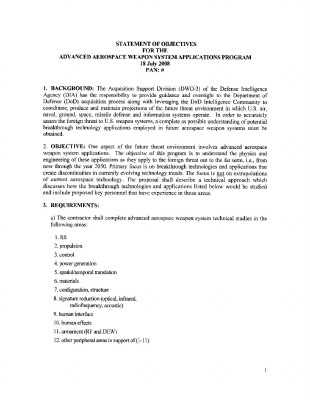 DOW-UAP-D110 AAWSAP Statement of Objectives, July 2008
7/18/08
-
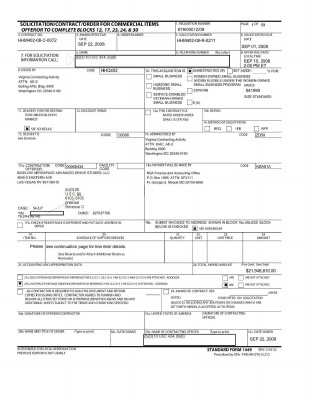 DOW-UAP-D111 AAWSAP Solicitation and Original Order, September 2008
9/22/08
-
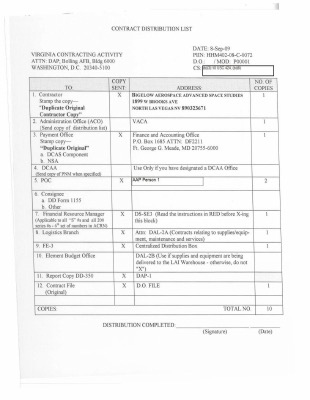 DOW-UAP-D112 AAWSAP Contract Modification P00001, September 2009
9/2/09
-
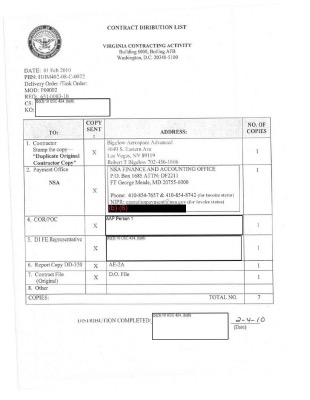 DOW-UAP-D113 AAWSAP Contract Modification P00002, February 2010
2/2/10
-
 DOW-UAP-D114 AAWSAP Contract Modification P00003, May 2010
5/18/10
-
 DOW-UAP-D115 AAWSAP Contract Modification P00004, May 2010
5/18/10
-
 DOW-UAP-D116 AAWSAP Contract Modification P00005, September 2010
9/28/10
-
 DOW-UAP-D117 AAWSAP DIRD, Metallic Glasses for Aerospace Applications, December 2009
12/14/09
-
 DOW-UAP-D118 AAWSAP DIRD, Aerospace Applications of Programmable Matter, December 2009
12/14/09
-
 DOW-UAP-D119 AAWSAP DIRD, Biomaterials, January 2010
1/7/10
-
 DOW-UAP-D120 AAWSAP DIRD, Materials for Advanced Aerospace Platforms, January 2010
1/12/10
-
 DOW-UAP-D121 AAWSAP DIRD, Pulsed High-Power Microwave Source Technology, January 2010
1/28/10
-
 DOW-UAP-D122 AAWSAP DIRD, Invisibility Cloaking Theory and Experiments, March 2010
3/2/10
-
 DOW-UAP-D123 AAWSAP DIRD, Positron Aerospace Propulsion, March 2010
3/2/10
-
 DOW-UAP-D124 AAWSAP DIRD, Space Access: Where We’ve Been and Where We Could Go, March 2010
3/8/10
-
 DOW-UAP-D125 AAWSAP DIRD, Inertial Electrostatic Confinement Fusion, March 2010
3/10/10
-
 DOW-UAP-D126 AAWSAP DIRD, Advanced Nuclear Propulsion for Manned Deep Space Missions, March 2010
3/11/10
-
 DOW-UAP-D127 AAWSAP DIRD, An Introduction to the Statistical Drake Equation, March 2010
3/11/10
-
 DOW-UAP-D128 AAWSAP DIRD, Anomalous Acute and Subacute Field Effects on Human Biological Tissues, March 2010
3/11/10
-
 DOW-UAP-D129 AAWSAP DIRD, Metallic Spintronics, March 2010
3/23/10
-
 DOW-UAP-D130 AAWSAP DIRD, Technological Approaches to Controlling External Devices, March 2010
3/23/10
-
 DOW-UAP-D131 AAWSAP DIRD, The Role of Superconductors in Gravity Research, March 2010
3/23/10
-
 DOW-UAP-D132 AAWSAP DIRD, Advanced Space Propulsion Based on Vacuum (Spacetime Metric) Engineering, March 2010
3/29/10
-
 DOW-UAP-D133 AAWSAP DIRD, The Space Communication Implications of Quantum Entanglement and Nonlocality, March 2010
3/30/10
-
 DOW-UAP-D134 AAWSAP DIRD, Maverick Inventor Versus Corporate Inventor: Where Will the Next Major Innovations Arise, March 2010
3/30/10
-
 DOW-UAP-D135 AAWSAP DIRD, Antigravity for Aerospace Applications, March 2010
3/30/10
-
 DOW-UAP-D136 AAWSAP DIRD, Biosensors and BioMEMS: A Survey of the Present Field, March 2010
3/31/10
-
 DOW-UAP-D137 AAWSAP DIRD, State of the Art and Evolution of High-Energy Lasers, March 2010
3/31/10
-
 DOW-UAP-D138 AAWSAP DIRD, Warp Drive, Dark Energy, and the Manipulation of Extra Dimensions, April 2010
4/2/10
-
 DOW-UAP-D139 AAWSAP DIRD, Traversable Wormholes, Stargates, and Negative Energy, April 2010
4/6/10
-
 DOW-UAP-D140 AAWSAP DIRD, High-Frequency Gravitational Wave Communications, April 2010
4/6/10
-
 DOW-UAP-D141 AAWSAP DIRD, Metamaterials for Aerospace Applications, April 2010
4/6/10
-
 DOW-UAP-D142 AAWSAP DIRD, Concepts for Extracting Energy from the Quantum Vacuum, April 2010
4/6/10
-
 DOW-UAP-D143 AAWSAP DIRD, Laser Lightcraft Nanosatellites, November 2010
11/1/10
-
 DOW-UAP-D144 AAWSAP DIRD, Cockpits in the Era of Breakthrough Flight, November 2010
11/1/10
-
 DOW-UAP-D145 AAWSAP DIRD, Aneutronic Fusion Propulsion I, November 2010
11/1/10
-
 DOW-UAP-D146 AAWSAP DIRD, Aneutronic Fusion Propulsion II, November 2010
11/1/10
-
 DOW-UAP-D147 AAWSAP DIRD, Ultracapacitors as Energy and Power Storage Devices, November 2010
11/1/10
-
 DOW-UAP-D148 AAWSAP DIRD, Detection and High-Resolution Tracking of Vehicles at Hypersonic Velocities, November 2010
11/20/10
-
 DOW-UAP-D149 AAWSAP DIRD, MHD Air Breathing Propulsion and Power for Aerospace Applications, November 2010
11/21/10
-
 DOW-UAP-D150 AAWSAP DIRD, Quantum Computing and Utilizing Organic Molecules in Automation Technology, December 2010
12/10/10
-
 DOW-UAP-D151 AAWSAP DIRD, Cognitive Limits on Simultaneous Control of Multiple Unmanned Spacecraft, December 2010
12/15/10
-
 DOW-UAP-D152 AAWSAP DIRD, Negative Mass Propulsion, January 2011
1/3/11
-
 DOW-UAP-D153 AAWSAP DIRD, Quantum Tomography of Negative Energy States in the Vacuum, January 2011
1/11/11
-
 DOW-UAP-D166 MUFON Reports Prepared for BAASS, November 2008
11/1/08
-
 DOW-UAP-D167 Project Capella, December 2008
12/10/08
-
 DOW-UAP-D169 BAASS Monthly Report, March 2009
4/10/09
-
 DOW-UAP-D170 BAASS Monthly Report, April 2009
4/1/09
-
 DOW-UAP-D171 BAASS Monthly Report, June 2009
7/9/09
-
 DOW-UAP-D173 BAASS Monthly Report, November 2009
11/1/09
-
 DOW-UAP-D174 Utah Ranch Investigation Report, April 2010
March, April 2010
-
 DOW-UAP-D175 BAASS Self-Assessment of UAP Analysis Capabilities, November 2010
11/23/10