USG-UAP-D002

Interagency Correspondence Concerning Space Fragments, 1962-1964, page 13

One page of a U.S. government record released under PURSUE, shown on its own with its text. The record page has the whole document, its catalog details and the scan.

Page
13 of 72
Agency
U.S. Government
Released
Release 07, October 23, 2026

Text of page 13

GE. MP 3 Downgrued at 12 yoar Intorvals; not automat ally • • declassified: 2 8. How many fragments may be expected to survive From SA-5 ~ About 30 From GT-I - About 55 any fragments come down, where are they most likely to impact? The small number of fragments surviving from any satellite will be dispersed over an area of thousands of square miles, most of which are likely to be oceans, seas, or other water surface. Can the fragment problem be further decreased by exploding the orbiting element? Explosion or destruct of the orbiting element could produce more fragments and, hence, increase the possibility of fragment impact. If one were to be hit by a fragment, would it be lethal? In the remote possibility that one were to be struck by a fragment, it might, depending upon area of body struck, be lethal. However, this is also true of being struck by a meteonite; and the possibility of being struck by a meteorite is greater than the possibility of being struck by a fragment from (satellite X). In fact, based on data provided through the Smithsonian Astrophysical Observatory, the average number of meteorites over 2.2 Ibs. which impact on the earth every year is estimated at 5628. This is many, many times greater than the total number of fragments to be expected from (satellite X). And, to date, there are no substantiated reports of injury from these meteorite impacts. Meteorites are natural phenomena. Do you consider NASA justified in increasing the possibilities of a lethal impact, no matter how improbable? Many human activities carry with them a demonstrable probability of casualty--flying, automobile driving, golfing, during an electrical storm. But we do not stop driving, flying or golf- ing. - SEGRET GROUP 3 Downgraded at 12 year intervals; not automatically declassified

Machine-read (OCR) from the scan by this archive; it can contain errors. The scan is the record.
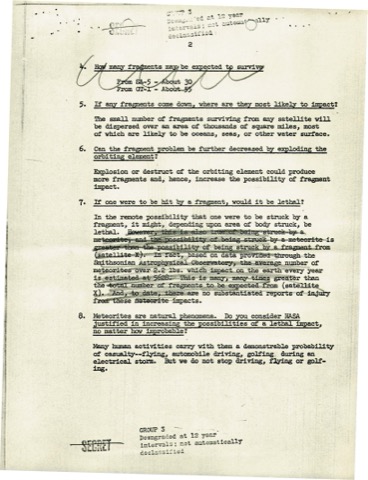
Image from page 13 of USG-UAP-D002, as released by war.gov
Image from page 13 of the PDF. Open the scan to see the whole page.

Cite this page

U.S. Government. "Interagency Correspondence Concerning Space Fragments, 1962-1964" (USG-UAP-D002). PURSUE Release 07, U.S. Department of War, October 23, 2026. https://www.war.gov/medialink/ufo/release-07/documents/USG-UAP-D002-Interagency_Correspondence_Concerning_Space_Fragments-1962_1964.pdf. Declassified UAP, page 13, https://declassifieduap.org/r/usg-uap-d002-interagency-correspondence-concerning-space-fragments-1962-1964/p/13. Accessed November 28, 2026.

This address shows page 13 on its own; /r/usg-uap-d002-interagency-correspondence-concerning-space-fragments-1962-1964?page=13 opens the same page in the full reader. Both stay. How to cite.