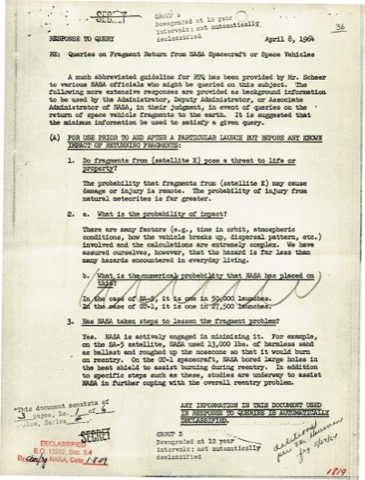
Text of page 12
RESPONSE TO QUERY
GROUP 3
Downgraded at 12 year
intervals; not automatically.
declassified
36
April 8, 1964
RE: Queries on Fragment Return from NASA Spacecraft or Space Vehicles
A much abbreviated guideline for RIQ has been provided by Mr. Scheer
to various NASA officials who might be queried on this subject. The
following more extensive responses are provided as background information
to be used by the Administrator, Deputy Administrator, or Associate
Administrator of NASA, in their judgment, in event of queries on the
return of space vehicle fragments to the earth. It is suggested that
the minimum information be used to satisfy a given query.
(A)
FOR USE PRIOR TO AND AFTER A PARTICULAR LAUNCH BUT BEFORE ANY KNOWN
IMPACT OF RETURNING FRAGMENTS:
1. Do fragments from (satellite X) pose a threat to life or
property?
The probability that fragments from (satellite X) may cause
damage or injury is remote. The probability of injury from
natural meteorites is far greater.
2. a. What is the probability of impact?
There are many factors (e•g•, time in orbit, atmospheric
conditions, how the vehicle breaks up, dispersal pattern, etc.)
involved and the calculations are extremely complex. We have
assured ourselves, however, that the hazard is far less than
many hazards encountered in everyday living•
b.
What is the numerical probability that NASA has placed on
this?
In the case of SA-5, it is one in 50,000 launches.
In the case of GT-], it is one in 27,500 launches.
3.
Has NASA taken steps to lessen the fragment problem?
Yes. NASA is actively engaged in minimizing it. For example,
on the SA-5 satellite, NASA used 13,000 Ibs. of harmless sand
as ballast and roughed up the nosecone so that it would burn
on reentry. On the GI-1 spacecraft, NASA bored large holes in
the heat shield to assist burning during reentry. In addition
to specific steps such as these, studies are underway to assist
NASA in further coping with the overall reentry problem.
"This document consists
3 pages. No. -
pios, Series
DECLASSIRE SEGRET
E.O. 13292, Sec. 3.4
By Com/y NARA, Date /-8.09
ANY INFORMATION IN THIS DOCUMENT USED
IN RESPONSE TO QUERIES IS AUTOMATICALLY
DECLASSIFIED.
GROUP 3
Downgraded at 12 year
intorvals; not automatically
declassified
deletiona
Noceman
321/41
per
1819