NASA-UAP-D018

Gemini 4 Experiment Debriefing, 1967, page 12

One page of a U.S. government record released under PURSUE, shown on its own with its text. The record page has the whole document, its catalog details and the scan.

Page
12 of 224
Agency
NASA
Released
Release 03, June 12, 2026

Archive note war.gov's title says 1967, the date of the transcription. Gemini 4 flew June 3-7, 1965, which is the date shown here. See all corrections

Text of page 12

M-913-65-04 • • • MSC-2, Proton Electron Spectrometer MSC-3, Tri-Axis Magnetometer MSC-10, Two-Color Earth's Limb Photos S-5, Synoptic Terrain Photography S-6, Synoptic Weather Photography UNUSUAL TASKS OF THIS MISSION One of the interesting tasks of this mission is the duration of the flight. It Mission Control Center (MCC) Houston. Some elements of the Mission Control Center at Cape Kennedy and the GSFC computing facility will be standing by as a backup during the launch phase. The computing facilities at GSFC will also be used as a backup to MCC-Houston during the orbital phase. Flight controllers will man the MCC in three shifts to give complete round-the-clock coverage of the four- day mission. Crew control of reentry will be accomplished by tracking the roll needle rather than nulling the down-range and cross-range needles as on GT-3. The experiments will, of course, contribute much information for the scientific and medical communities. The G4C suit which replaces the G3C suit used on GT-3 has the following new features: a triple overvisor, a redundant pressure closure seal (zipper), and thermal and meteoroid protection integrated in the outer cover layer. Abort procedures to be utilized by the astronauts in the unlikely event it becomes necessary for them to terminate a mission before orbital insertion are different from those used in the Mercury program. In that program, the fireball that would have been created had a conflagration occurred on the pad, would have been large enough to ABORT PROCEDURES engulf an ejecting astronaut, so it was necessary to add an escape rocket to lift the entire spacecraft free of the area. The GLV, on MODE II - SALVO RETROS AFTER SHUTDOWN MODE III - SHUTDOWN, SEPARATE, TURN AROUND, RETROFIRE the other hand, uses self-igniting fuels which, upon mixing, create a MODE IIII fireball small enough so that the 20,700 FPS VELOCITY astronauts can eject from the spacecraft in much the same man- мор 5 MIN. 10 SEC. ner as is done in today's high 78,000 FT. performance jet aircraft. This is called the Mode I abort pro- cedure. The three abort modes are more fully defined by the DELAYED MODE (WAIT 5 SECS) SECONDS altitude and elapsed time-after- launch parameters depicted on 15.000 FIR Figure 2. MODE 50 SECONDS 5/24/65 FIG. 2 Page 2 SEA LEVEL

Machine-read (OCR) from the scan by this archive; it can contain errors. The scan is the record.
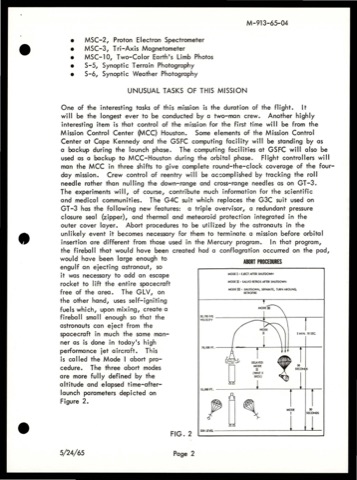
Image from page 12 of NASA-UAP-D018, as released by war.gov
Image from page 12 of the PDF. Open the scan to see the whole page.

Cite this page

National Aeronautics and Space Administration. "Gemini 4 Experiment Debriefing, 1967" (NASA-UAP-D018). PURSUE Release 03, U.S. Department of War, June 12, 2026. https://www.war.gov/medialink/ufo/061226/release_03/documents/NASA-UAP-D018_Gemini-4_Experiment-Debriefing_1967.pdf. Declassified UAP, page 12, https://declassifieduap.org/r/nasa-uap-d018gemini-4-experiment-debriefing-1967/p/12. Accessed November 28, 2026.

This address shows page 12 on its own; /r/nasa-uap-d018gemini-4-experiment-debriefing-1967?page=12 opens the same page in the full reader. Both stay. How to cite.