NASA-UAP-D018

Gemini 4 Experiment Debriefing, 1967, page 11

One page of a U.S. government record released under PURSUE, shown on its own with its text. The record page has the whole document, its catalog details and the scan.

Page
11 of 224
Agency
NASA
Released
Release 03, June 12, 2026

Archive note war.gov's title says 1967, the date of the transcription. Gemini 4 flew June 3-7, 1965, which is the date shown here. See all corrections

Text of page 11

Rendezvous guidance & recovery system Re-entry capsule Adapter section Separation point Oxidizer tank *Equipment bay Fuel tank Stage Il engine thrust chamber 10 Ft 11 Ft 8 Ft 18.6 Ft 27 Ft 108 Ft 70.65 Ft Oxidizer tank Fuel tank Stage I engine gimbal point Stage | engine thrust chambers *Equipment bay contains: • Batteries* • Malfunction detection system (MDS) units • Range safety command control system • Programmer • Three-axis reference system (TARS) • Radio guidance system (RGS) • Autopilot • Instrumentation and telemetry system FIG. 1 5/24/65 M-913-65-04 GENERAL Gemini Flight Number Four (GT-4) is the second manned orbital flight in the Gemini Program and the fourth flight in a series of twelve planned to develop long-duration and rendezvous capability, docking techniques, extra-vehicular activities, and controlled reentry. The first three Gemini flights demonstrated: orbital insertion capability; spacecraft structural integrity; and spacecraft systems performance and crew accommodation qualities, respectively. This GT -4 mission is intended to further demonstrate manned space flight for a period of four days, the longest ever flown by two astronauts. The space vehicle is depicted in Figure 1. MISSION OBJECTIVES PRIMARY • Demonstrate and evaluate the performance of the Gemini spacecraft systems for a period exceeding four days. • Evaluate the effects of prolonged exposure to the space environment on the two-man flight crew in preparation for missions of longer duration. SECONDARY Demonstrate OAMS capability to perform retro fire backup. Demonstrate the capability of the spacecraft and flight crew to make significant in-plane and out-of-plane maneuvers. • Conduct further evaluation of spacecraft systems as outlined below: 1. Structure and thermal protection 2. Environmental Control Systems (ECS) 3. Crew stations 4. Guidance and Control System 5. Orbital Attitude and Maneuver System (OAMS) • Execute the following experiments: • D-1, Basic Object Photography • D-6, Surface Photography • D-8, Radiation in Spacecraft • D-9, Simple Navigation • M-3, In-Flight Exercises • M-4, In-Flight Phonocardiogram • M-6, Bone Demineralization • MSC-1, Electrostatic Charge Page 1

Machine-read (OCR) from the scan by this archive; it can contain errors. The scan is the record.
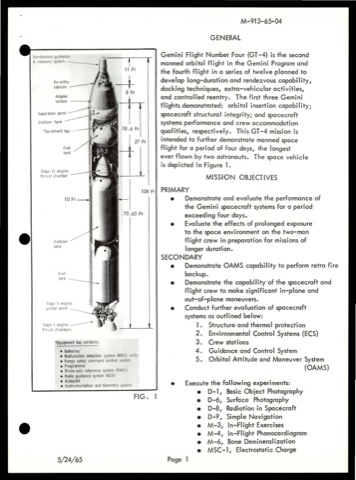
Image from page 11 of NASA-UAP-D018, as released by war.gov
Image from page 11 of the PDF. Open the scan to see the whole page.

Cite this page

National Aeronautics and Space Administration. "Gemini 4 Experiment Debriefing, 1967" (NASA-UAP-D018). PURSUE Release 03, U.S. Department of War, June 12, 2026. https://www.war.gov/medialink/ufo/061226/release_03/documents/NASA-UAP-D018_Gemini-4_Experiment-Debriefing_1967.pdf. Declassified UAP, page 11, https://declassifieduap.org/r/nasa-uap-d018gemini-4-experiment-debriefing-1967/p/11. Accessed November 28, 2026.

This address shows page 11 on its own; /r/nasa-uap-d018gemini-4-experiment-debriefing-1967?page=11 opens the same page in the full reader. Both stay. How to cite.