Text of page 19
UNCLASSIFIED FOR OFFICIAL USE ONLY
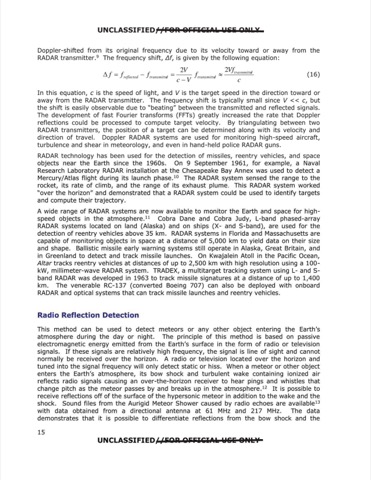
Doppler-shifted from its original frequency due to its velocity toward or away from the
RADAR transmitter.? The frequency shift, 4f, is given by the following equation:
Af = f reflected - fransmitd = -
(16)
In this equation, c is the speed of light, and V is the target speed in the direction toward or
away from the RADAR transmitter.
The frequency shift is typically small since V << c, but
the shift is easily observable due to "beating" between the transmitted and reflected signals.
The development of fast Fourier transforms (FFTs) greatly increased the rate that Doppler
reflections could be processed to compute target velocity. By triangulating between two
RADAR transmitters, the position of a target can be determined along with its velocity and
direction of travel. Doppler RADAR systems are used for monitoring high-speed aircraft,
turbulence and shear in meteorology, and even in hand-held police RADAR guns.
RADAR technology has been used for the detection of missiles, reentry vehicles, and space
objects near the Earth since the 1960s. On 9 September 1961, for example, a Naval
Research Laboratory RADAR installation at the Chesapeake Bay Annex was used to detect a
Mercury/Atlas flight during its launch phase.10 The RADAR system sensed the range to the
rocket, its rate of climb, and the range of its exhaust plume. This RADAR system worked
"over the horizon" and demonstrated that a RADAR system could be used to identify targets
and compute their trajectory.
A wide range of RADAR systems are now available to monitor the Earth and space for high-
speed objects in the atmosphere. 11 Cobra Dane and Cobra Judy, L-band phased-array
RADAR systems located on land (Alaska) and on ships (X- and S-band), are used for the
detection of reentry vehicles above 35 km. RADAR systems in Florida and Massachusetts are
capable of monitoring objects in space at a distance of 5,000 km to yield data on their size
and shape. Ballistic missile early warning systems still operate in Alaska, Great Britain, and
in Greenland to detect and track missile launches. On Kwajalein Atoll in the Pacific Ocean,
Altar tracks reentry vehicles at distances of up to 2,500 km with high resolution using a 100-
KW, millimeter-wave RADAR system. TRADEX, a multitarget tracking system using L- and S-
band RADAR was developed in 1963 to track missile signatures at a distance of up to 1,400
km. The venerable RC-137 (converted Boeing 707) can also be deployed with onboard
RADAR and optical systems that can track missile launches and reentry vehicles.
Radio Reflection Detection
This method can be used to detect meteors or any other object entering the Earth's
atmosphere during the day or night. The principle of this method is based on passive
electromagnetic energy emitted from the Earth's surface in the form of radio or television
signals. If these signals are relatively high frequency, the signal is line of sight and cannot
normally be received over the horizon. A radio or television located over the horizon and
tuned into the signal frequency will only detect static or hiss. When a meteor or other object
enters the Earth's atmosphere, its bow shock and turbulent wake containing ionized air
reflects radio signals causing an over-the-horizon receiver to hear pings and whistles that
change pitch as the meteor passes by and breaks up in the atmosphere. 12 It is possible to
receive reflections off of the surface of the hypersonic meteor in addition to the wake and the
shock. Sound files from the Aurigid Meteor Shower caused by radio echoes are available 13
with data obtained from a directional antenna at 61 MHz and 217 MHz.
The data
demonstrates that it is possible to differentiate reflections from the bow shock and the
15
UNCLASSIFIED H/FOR OFFICI
AL USE ONLY