DOW-UAP-D148

AAWSAP DIRD, Detection and High-Resolution Tracking of Vehicles at Hypersonic Velocities, November 2010, page 20

One page of a U.S. government record released under PURSUE, shown on its own with its text. The record page has the whole document, its catalog details and the scan.

Page
20 of 46
Agency
Department of War
Released
Release 06, September 18, 2026

Text of page 20

UNCLASSIFIED FOR AL USE ONLY ionized wake. This technique for detecting hypersonic meteors is not fully developed and appears to be employed only by hobbyists. Since a receiver can be tuned to a specific over-the-horizon transmitter, it may be possible to develop a network of radio receivers to provide information on high-speed objects in the atmosphere. Multiple stations would allow triangulation of the object to determine velocity and position as a function of time, i.e., tracking and path prediction. The sound files also contain information that could provide information on the hypersonic object. Detection of the shock provides information on the position of the object while the transient "whistles" reflected from the ionized wake may provide information on the Strouhal eddy frequency that could directly infer the object's velocity. This detection technology should be further developed. Hypersonic Aircraft Radio Receiver The radio receiver is not in line-of-sight with the transmitter, yet receives reflected energy from the transmitter by the aircraft. Radio Transmitter Figure 11. Radio Reflection Detector. OPTICAL METHODS Sky Cameras and Photographic Methods A classic example of a hypersonic object passing through the Earth's atmosphere is a meteor. Meteorite hunters and astrophysicists have worked to develop methods to detect these objects as they fall to the Earth. Motion-detection video systems provide information on location and direction of meteors passing through the atmosphere by detecting their visible wake. The El Paso All Sky Camera projecti4 is one example and even provides live streaming video of meteoric events. Photographs of objects in orbit with diameters ranging from 0.1 meter to several meters have been used to determine their expected trajectory as meteors as they entered and fell through the Earth's atmosphere.15 This technique was first used to monitor the Pribram meteorite simultaneously by several observatories in 1959. This technique was even used to locate a 1.75-kg enstatite chondrite meteorite called Neuschwanstein reported in 2003. The 16 UNCLASSIFIED HEOR OFFICIAL USE ONLY

Machine-read (OCR) from the scan by this archive; it can contain errors. The scan is the record.
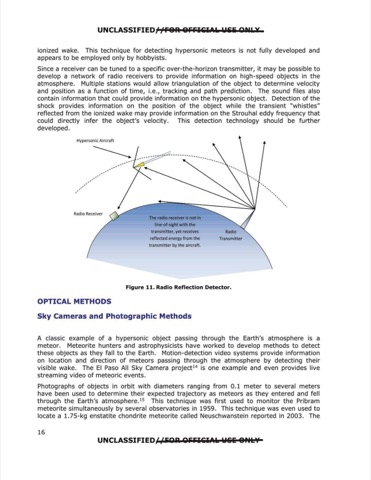
Image from page 20 of DOW-UAP-D148, as released by war.gov
Image from page 20 of the PDF. Open the scan to see the whole page.

Cite this page

U.S. Department of War. "AAWSAP DIRD, Detection and High-Resolution Tracking of Vehicles at Hypersonic Velocities, November 2010" (DOW-UAP-D148). PURSUE Release 06, U.S. Department of War, September 18, 2026. https://www.war.gov/medialink/ufo/sept-18/release-06/assets/DOW-UAP-D148_AAWSAP-DIRD-Detection-and-High-Resolution-Tracking-of-Vehicles-at-Hypersonic-Velocities-November-20-2010.pdf. Declassified UAP, page 20, https://declassifieduap.org/r/dow-uap-d148-aawsap-dird-detection-and-high-resolution-tracking-of-vehicles-at-hypersonic-velocities-november-2010/p/20. Accessed November 28, 2026.

This address shows page 20 on its own; /r/dow-uap-d148-aawsap-dird-detection-and-high-resolution-tracking-of-vehicles-at-hypersonic-velocities-november-2010?page=20 opens the same page in the full reader. Both stay. How to cite.