DOW-UAP-D148

AAWSAP DIRD, Detection and High-Resolution Tracking of Vehicles at Hypersonic Velocities, November 2010, page 18

One page of a U.S. government record released under PURSUE, shown on its own with its text. The record page has the whole document, its catalog details and the scan.

Page
18 of 46
Agency
Department of War
Released
Release 06, September 18, 2026

Text of page 18

UNCLASSIFIED FOR OFFICIAL USE ONLY RADAR systems are widely used for aircraft surveillance and can detect the distance to objects and the position of an object (through triangulation); with Doppler RADAR, the velocity can be directly measured. RADAR does have limitations. While low-frequency RADAR systems are capable of following the curvature of the earth, the long wavelength of this energy makes it difficult to resolve small objects. Higher frequency RADAR tends to be more "line of sight." Since it depends upon reflected energy, several problems are highlighted by the RADAR Equation: Pransmitd G Ao F* received = (15) (4 T)' R, R, In this equation, transmitted represents the transmitted power, Preceived the received power, G the transmitting antenna gain, A the aperture area of the receiving antenna, o the RADAR cross section, F the pattern propagation factor, and Rt and R, are the distance from the transmitter to the target and the target to the receiver, respectively. transmitter and receiver are in the same unit, the power returned as a reflection from a tame unt, the powe If the RADAR target decreases as R4. This means that energy received in reflected energy decreases by 94% every time the distance to the target is doubled. RADAR depends upon the reflection of electromagnetic waves off of a target's surface, thereby making objects with a small RADAR cross section difficult to detect (e.g., stealth aircraft). Atmospheric phenomenon, including inversions and turbulence, can lead to interference with RADAR reflections. Even with these limitations, RADAR is widely used to monitor high-speed aircraft, meteors, and man-made objects reentering the atmosphere from Earth orbit. Velocity Vector Radar Dish Hypersonic Vehicle Radial direction Rotat Pede: Reflected Energy Transmitted Energy R = radial distance Figure 10. Schematic of a RADAR System. Doppler RADAR Doppler RADAR systems yield velocity data for a target. Pulsed RADAR systems send out a short burst of high-frequency radiation that is reflected from a target. The RADAR unit processes the delay time between the transmitted pulse and the received echo to determine the range or distance to the target. The energy reflected from the target is, however, 14 UNCLASSIFIED LEOR OFFICIAL USE ONLY

Machine-read (OCR) from the scan by this archive; it can contain errors. The scan is the record.
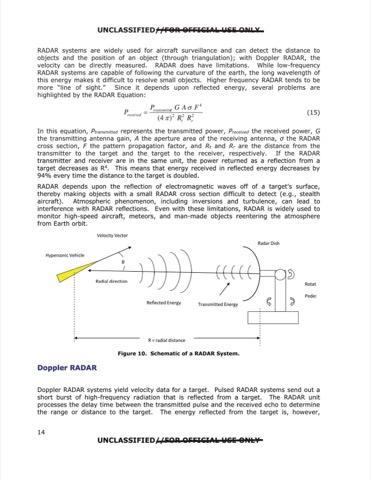
Image from page 18 of DOW-UAP-D148, as released by war.gov
Image from page 18 of the PDF. Open the scan to see the whole page.

Cite this page

U.S. Department of War. "AAWSAP DIRD, Detection and High-Resolution Tracking of Vehicles at Hypersonic Velocities, November 2010" (DOW-UAP-D148). PURSUE Release 06, U.S. Department of War, September 18, 2026. https://www.war.gov/medialink/ufo/sept-18/release-06/assets/DOW-UAP-D148_AAWSAP-DIRD-Detection-and-High-Resolution-Tracking-of-Vehicles-at-Hypersonic-Velocities-November-20-2010.pdf. Declassified UAP, page 18, https://declassifieduap.org/r/dow-uap-d148-aawsap-dird-detection-and-high-resolution-tracking-of-vehicles-at-hypersonic-velocities-november-2010/p/18. Accessed November 28, 2026.

This address shows page 18 on its own; /r/dow-uap-d148-aawsap-dird-detection-and-high-resolution-tracking-of-vehicles-at-hypersonic-velocities-november-2010?page=18 opens the same page in the full reader. Both stay. How to cite.