DOW-UAP-D148

AAWSAP DIRD, Detection and High-Resolution Tracking of Vehicles at Hypersonic Velocities, November 2010, page 17

One page of a U.S. government record released under PURSUE, shown on its own with its text. The record page has the whole document, its catalog details and the scan.

Page
17 of 46
Agency
Department of War
Released
Release 06, September 18, 2026

Text of page 17

UNCLASSIFIED+/FOR OFFICIAL USE ONLY Electromagnetic Spectrum Wavelength Type of Radiation 1 nm x-rays 10 nm 100 nm 1 um 10 um 100 um 1 mm 10 mm 100 mm 1 m Ultraviolet (UV) Visible Light (0.4 to 0.7 um) Near Infrared Thermal Infrared Far Infrared Microwaves Radar Radio Waves 10 m 100 m AM Radio Figure 9. Electromagnetic Spectrum as a Function of Wavelength. ELECTROMAGNETIC METHODS RADAR (Reflected Energy) RADAR, or "radio detection and ranging," has been heavily used since World War II for the detection of aircraft and sea vessels. First patented by Christian Hulsmeyer in 1904, this technique was first demonstrated by Nikola Tesla in 1917; RADAR was exploited in the defense of Britain through the Chain Home RADAR network initiated in the late 1930s.8 RADAR uses an antenna or a dish to transmit pulses of microwaves or radio waves toward a potential target. Energy reflected from the target is collected by the antenna and the time of flight of the transmitted and reflected signals yields the distance to the target. Early RADAR systems emitted radiation in the high-frequency band (HF) from about 10 to 30 MHz. Modern systems can operate well above 300 GHz. As a single pulse travels at the speed of light toward a target, the time delay between the generation of the pulse and the time that its echo is received is 2L/c where L is the distance to the target and c is the speed of light. For a target located 30 km from the source, the time delay is 200 microseconds, an easily measurable delay. By using microwave radiation emitted from a dish, target distance and bearing can both be measured. While it was possible to use low-frequency radio waves (~30 MHz) for RADAR systems in the 1940s, the wavelength of these waves (100 meters) made it difficult to resolve small targets, including aircraft. This made it desirable to develop systems that could operate at higher frequencies. UHF energy (300 to 1,000 GHz, 0.3- to 1-meter wavelength) radiation is used for long-range surveillance, including the detection of intercontinental ballistic missiles. Air traffic control uses the L band (1 to 2 GHz, 0.15- to 0.3-meter wavelength). X-band (8 to 12 GHz, 25- to 37-millimeter wavelength) energy is now used for airport RADAR where the range to aircraft is short. Higher frequency radiation is used for imaging systems and for meteorological data acquisition. 13 UNCLASSIFIED /FOR Al-- AL USE ONLY

Machine-read (OCR) from the scan by this archive; it can contain errors. The scan is the record.
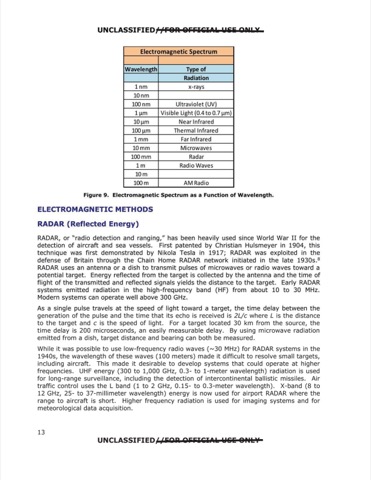
Image from page 17 of DOW-UAP-D148, as released by war.gov
Image from page 17 of the PDF. Open the scan to see the whole page.

Cite this page

U.S. Department of War. "AAWSAP DIRD, Detection and High-Resolution Tracking of Vehicles at Hypersonic Velocities, November 2010" (DOW-UAP-D148). PURSUE Release 06, U.S. Department of War, September 18, 2026. https://www.war.gov/medialink/ufo/sept-18/release-06/assets/DOW-UAP-D148_AAWSAP-DIRD-Detection-and-High-Resolution-Tracking-of-Vehicles-at-Hypersonic-Velocities-November-20-2010.pdf. Declassified UAP, page 17, https://declassifieduap.org/r/dow-uap-d148-aawsap-dird-detection-and-high-resolution-tracking-of-vehicles-at-hypersonic-velocities-november-2010/p/17. Accessed November 28, 2026.

This address shows page 17 on its own; /r/dow-uap-d148-aawsap-dird-detection-and-high-resolution-tracking-of-vehicles-at-hypersonic-velocities-november-2010?page=17 opens the same page in the full reader. Both stay. How to cite.