Text of page 43
UNCLASSIFIED//FOR OFFICIAL USE ONLY
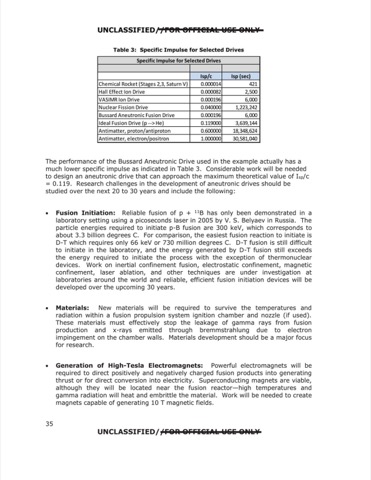
Table 3: Specific Impulse for Selected Drives
Specific Impulse for Selected Drives
Chemical Rocket (Stages 2,3, Saturn V)
Hall Effect lon Drive
VASIMR Ion Drive
Nuclear Fission Drive
Bussard Aneutronic Fusion Drive
Ideal Fusion Drive (p --> He)
Antimatter, proton/antiproton
Antimatter, electron/positron
Isp/c
0.000014
0.000082
0.000196|
0.040000|
0.000196
0.119000
0.600000
1.000000/
Isp (sec)
421
2,500
6,000
1,223,242
6,000
3,639,144
18,348,624
30,581,040
The performance of the Bussard Aneutronic Drive used in the example actually has a
much lower specific impulse as indicated in Table 3. Considerable work will be needed
to design an aneutronic drive that can approach the maximum theoretical value of Isp/c
= 0.119. Research challenges in the development of aneutronic drives should be
studied over the next 20 to 30 years and include the following:
• Fusion Initiation: Reliable fusion of p + 11B has only been demonstrated in a
laboratory setting using a picoseconds laser in 2005 by V. S. Belyaev in Russia. The
particle energies required to initiate p-B fusion are 300 keV, which corresponds to
about 3.3 billion degrees C. For comparison, the easiest fusion reaction to initiate is
D-T which requires only 66 keV or 730 million degrees C. D-T fusion is still difficult
to initiate in the laboratory, and the energy generated by D-T fusion still exceeds
the energy required to initiate the process with the exception of thermonuclear
devices. Work on inertial confinement fusion, electrostatic confinement, magnetic
confinement, laser ablation, and other techniques are under investigation at
laboratories around the world and reliable, efficient fusion initiation devices will be
developed over the upcoming 30 years.
• Materials:
New materials will be required to survive the temperatures and
radiation within a fusion propulsion system ignition chamber and nozzle (if used).
These materials must effectively stop the leakage of gamma rays from fusion
production and
x-rays emitted through bremmstrahlung due to electron
impingement on the chamber walls. Materials development should be a major focus
for research.
• Generation of High-Tesla Electromagnets: Powerful electromagnets will be
required to direct positively and negatively charged fusion products into generating
thrust or for direct conversion into electricity. Superconducting magnets are viable,
although they will be located near the fusion reactor-high temperatures and
gamma radiation will heat and embrittle the material. Work will be needed to create
magnets capable of generating 10 T magnetic fields.
35
UNCLASSIFIED//FOR OFFICIAL USE ONLY