Text of page 42
UNCLASSIFIED/TFOR OFFICIAL USE ONLY
shorter trips to the stars. Figure 14 shows how much time is required for the trip (one
way) based on the required acceleration. These equations are independent of the
specific impulse of the rocket. The mission cannot be less than 4.22 years in duration,
since the spacecraft cannot exceed the speed of light. If a 10-year mission were
chosen, the fuel usage would be tremendous, but the vehicle could attain an
acceleration of 0.20 g. At this acceleration, time on the rocket would pass at 72% of
the rate of time on Earth.
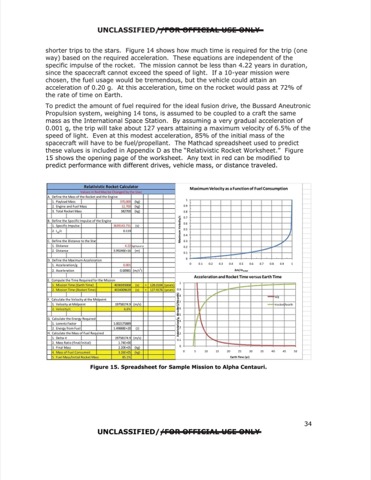
To predict the amount of fuel required for the ideal fusion drive, the Bussard Aneutronic
Propulsion system, weighing 14 tons, is assumed to be coupled to a craft the same
mass as the International Space Station. By assuming a very gradual acceleration of
0.001 g, the trip will take about 127 years attaining a maximum velocity of 6.5% of the
speed of light. Even at this modest acceleration, 85% of the initial mass of the
spacecraft will have to be fuel/propellant. The Mathcad spreadsheet used to predict
these values is included in Appendix D as the "Relativistic Rocket Worksheet." Figure
15 shows the opening page of the worksheet. Any text in red can be modified to
predict performance with different drives, vehicle mass, or distance traveled.
Relativistic Rocket Calculator
Values in Red May be Changed by the User
A. Define the Mass of the Rocket and the Engine
1. Payload Mass
2. Engine and Fuel Mass
3. Total Rocket Mass
370,000
12,700
382700
(kg)
(kg)
(kg)
Maximum Velocity as a Function of Fuel Consumption
0.9
0.8
B. Define the Specific Impulse of the Engine
1. Specific Impulse
3639143.731
0.119
Maximum Velocitv/c
10.7
0.6
0.5
0.4
C. Define the Distance to the Star|
1. Distance
2. Distance
4.22 lightyears)
3.99246+16|
(m)
0.1
D. Define the Maximum Acceleration
1. Acceleration/g
2. Acceleration
0.001
0.00981 (m/s*)
0.2 0.3
0.5
0.6
0.7
0.8
0.9
Am/minitie
Acceleration and Rocket Time versus Earth Time
E. Compute the Time Required for the Mission
1. Mission Time (Earth Time)
2. Mission Time (Rocket Time)
4036935068
4034009639
(s)
(s)
128.0104 (years)
= 127.9176 (years)
F. Calculate the Velocity at the Midpoint
1. Velocity at Midpoint
2. Velocity/c
19758174.9 (m/s)
6.6%
G. Calculate the Energy Required
1. Lorentz Factor
2. Energy from Fuel
H. Calculate the Mass of Fuel Required
1. Delta-V
2. Mass Ratio (final/initial)
3. Final Mass
4. Mass of Fuel Consumed
5. Fuel Mass/Initial Rocket Mass
1.002175889
1.49888E+20
(1)
• Agele ation/& rocket/fearth) g
a/g
trocketearth
19758174.9 (m/s)
1.74E +00
2.20E+05| (kg)
3.26E+05 (kg)
85.1%
15 20
25
Earth Time (yr)
30 35
40
45
Figure 15. Spreadsheet for Sample Mission to Alpha Centauri.
50
34
UNCLASSIFIED//FOR OFFICIAL USE ONLY