DOW-UAP-D145

AAWSAP DIRD, Aneutronic Fusion Propulsion I, November 2010, page 44

One page of a U.S. government record released under PURSUE, shown on its own with its text. The record page has the whole document, its catalog details and the scan.

Page
44 of 50
Agency
Department of War
Released
Release 06, September 18, 2026

Text of page 44

UNCLASSIFIED//FOR OFFICIAL USE ONLY Appendix C: Antimatter Annihilation Rocket ip • *e positron antiproton stable antihydrogen atom Figure 16. Antihydrogen Atom. Using data from Table 3, the only propulsion system that can generate higher Isp than fusion will be due to antimatter annihilation. By using the Relativistic Rocket Worksheet in Appendix D, it is possible to decrease the time to reach Proxima Centauri to only 18.5 years by accelerating at 0.05 g to reach 43% of the speed of light. By using antihydrogen, two annihilation mechanisms are possible: • Electron-positron annihilation releases one energetic gamma ray (1.022 MeV) or, in the presence of a nucleus, two 0.511-MeV gamma rays. There is no effective way to reflect gamma rays, but they can be absorbed with suitable shielding and their energy converted into heat. Research into designs that convert gamma ray heat into propulsion or electrical power should proceed over the next 10 to 20 years. • Proton-antiproton annihilation releases charged and neutral pions, which decay after about 0.026 microseconds into charged muons and neutrinos. The charged pions can be used to directly generate thrust or to make electricity if they are directed by electromagnets. Unfortunately, 40% of the pions will be neutral and quickly decay into gamma radiation, which are lost from the system or absorbed in the rocket chamber wall and generate heat. Muons also decay into charged particles (electrons and positrons), along with neutrinos. Neutrinos and antineutrinos, along with their energy, are lost from the system. Novel rocket designs that capture gamma radiation with a tungsten insert allow the waste heat to be used to accelerate a propellant, such as hydrogen, to generate additional thrust. This system was proposed by Robert Frisbee and Ulrich Walter and deserves further study,24 Efficient ways to redirect the energy of gamma rays into thrust should be a major focus of research. Antimatter propulsion is fairly straightforward since ignition is not a problem. By mixing hydrogen with antihydrogen, annihilation begins immediately. Antimatter 36 UNCLASSIFIED//FOR OFFICIAL USE ONLY

Machine-read (OCR) from the scan by this archive; it can contain errors. The scan is the record.
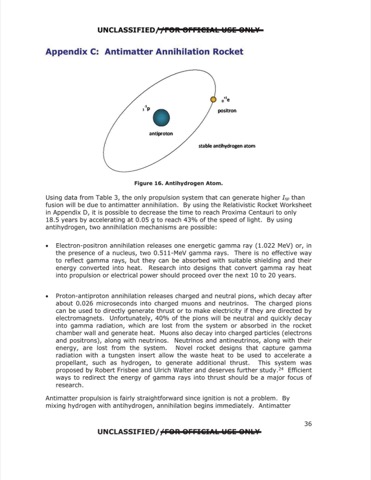
Image from page 44 of DOW-UAP-D145, as released by war.gov
Image from page 44 of the PDF. Open the scan to see the whole page.

Cite this page

U.S. Department of War. "AAWSAP DIRD, Aneutronic Fusion Propulsion I, November 2010" (DOW-UAP-D145). PURSUE Release 06, U.S. Department of War, September 18, 2026. https://www.war.gov/medialink/ufo/sept-18/release-06/assets/DOW-UAP-D145_AAWSAP-DIRD-Aneutronic-Fusion-Propulsion-I-November-1-2010.pdf. Declassified UAP, page 44, https://declassifieduap.org/r/dow-uap-d145-aawsap-dird-aneutronic-fusion-propulsion-i-november-2010/p/44. Accessed November 28, 2026.

This address shows page 44 on its own; /r/dow-uap-d145-aawsap-dird-aneutronic-fusion-propulsion-i-november-2010?page=44 opens the same page in the full reader. Both stay. How to cite.