Text of page 18
UNCLASSIFIED//FOR eFFFErAL USE ONLY
Crew Size Considerations
The last aspect to take into account as a consequence of mixed operational regimes is
that of the crew size. For short-duration missions (less than a few hours), it is
reasonable to conceive of vehicles with only one pilot. For more complex missions,
additional crew will be required, and thus additional displays and controls specific to
their tasks will be required. Finally, for long-duration missions, sufficient crew will be
required to carry out its mission and maintain optimal vehicle performance. These
changes-for accommodating the roles and responsibilities of crew in relation to the
overall mission—are likely to be the same as those distinctions in traditional vehicles
(e.g., cars versus cruise ships). Those changes typically include a hierarchical
organization, which is independent of the issues of propulsion physics.
Essential elements will include monitoring and controlling the 1-g internal life-support
environment as well as ensuring the long-term health of the crew.
Full Span of Speeds
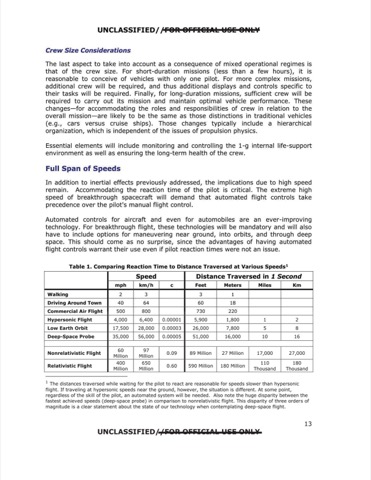
In addition to inertial effects previously addressed, the implications due to high speed
remain.
Accommodating the reaction time of the pilot is critical. The extreme high
speed of breakthrough spacecraft will demand that automated flight controls take
precedence over the pilot's manual flight control.
Automated controls for aircraft and even for automobiles are an ever-improving
technology. For breakthrough flight, these technologies will be mandatory and will also
save This should come as ma surprise, since the advantages or adita auton deed
flight controls warrant their use even if pilot reaction times were not an issue.
Table 1. Comparing Reaction Time to Distance Traversed at Various Speeds
Distance Traversed in 1 Second
Walking
Driving Around Town
Commercial Air Flight
Hypersonic Flight
Low Earth Orbit
Deep-Space Probe
Nonrelativistic Flight
Relativistic Flight
mph
2
40
500
4,000
17,500
35,000
60
Million
400
Million
Speed
km/h
3
64
800
6,400
28,000
56,000
Feet
Meters
Miles
Km
3
60
730
0.00001
0.00003
0.00005
5,900
26,000
51,000
18
220
1,800
7,800
16,000
1
5
10
2
8
16
97
Million
650
Million
0.09
0.60
89 Million
590 Million
27 Million
180 Million
17,000
110
Thousand
27,000
180
Thousand
1 The distances traversed while waiting for the pilot to react are reasonable for speeds slower than hypersonic
flight. If traveling at hypersonic speeds near the ground, however, the situation is different. At some point,
regardless of the skill of the pilot, an automated system will be needed. Also note the huge disparity between the
fastest achieved speeds (deep-space probe) in comparison to nonrelativistic flight. This disparity of three orders of
magnitude is a clear statement about the state of our technology when contemplating deep-space flight.
13
UNCLASSIFIED//FOR OFFICIAL USE OALY