Text of page 17
UNCLASSIFIED//FOR OFFFeTAL USE ONLY
system that conveys the spacecraft's orientation relative to the external space will have
to be clear enough to overcome this prejudicial sense of orientation.
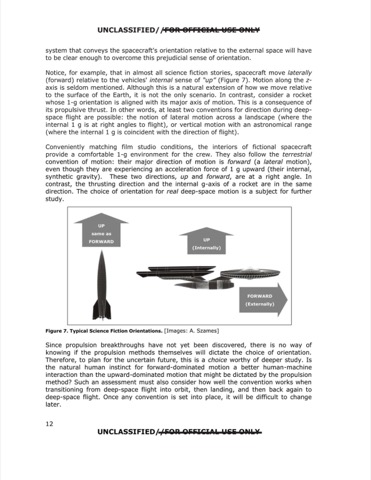
Notice, for example, that in almost all science fiction stories, spacecraft move laterally
(forward) relative to the vehicles' internal sense of "up" (Figure 7). Motion along the z-
axis is seldom mentioned. Although this is a natural extension of how we move relative
to the surface of the Earth, it is not the only scenario. In contrast, consider a rocket
whose 1-g orientation is aligned with its major axis of motion. This is a consequence of
its propulsive thrust. In other words, at least two conventions for direction during deep-
space flight are possible: the notion of lateral motion across a landscape (where the
internal 1 g is at right angles to flight), or vertical motion with an astronomical range
(where the internal 1 g is coincident with the direction of flight).
Conveniently matching film studio conditions, the interiors of fictional spacecraft
provide a comfortable 1-g environment for the crew. They also follow the terrestrial
convention of motion: their major direction of motion is forward (a lateral motion),
even though they are experiencing an acceleration force of 1 g upward (their internal,
synthetic gravity).
These two directions, up and forward, are at a right angle. In
contrast, the thrusting direction and the internal g-axis of a rocket are in the same
direction. The choice of orientation for real deep-space motion is a subject for further
UP
same as
FORWARD
UP
(Internally)
FORWARD
(Externally)
Figure 7. Typical Science Fiction Orientations. [Images: A. Szames]
Since propulsion breakthroughs have not yet been discovered, there is no way of
knowing if the propulsion methods themselves will dictate the choice of orientation.
Therefore, to plan for the uncertain future, this is a choice worthy of deeper study. Is
the natural human instinct for forward-dominated motion a better human-machine
interaction than the upward-dominated motion that might be dictated by the propulsion
method? Such an assessment must also consider how well the convention works when
transitioning from deep-space flight into orbit, then landing, and then back again to
deep-space flight. Once any convention is set into place, it will be difficult to change
later.
12
UNCLASSIFIED//FOR OFFICIAL VISE ONLY