Text of page 19
UNCLASSIFIED//FOR OFFICIAL USE ONLY
Extreme Relativistic
Light Speed
Faster Than Light?
660
Million
670
Million
13
Billion
1.07
Billion
1.08
Billion
22
Billion
0.99
1
20
970 Million
980 Million
270 Million
300 Million
202 Billion
6 Billion
180
Thousand
190
Thousand
4 Million
297
Thousand
300
Thousand
6 Million
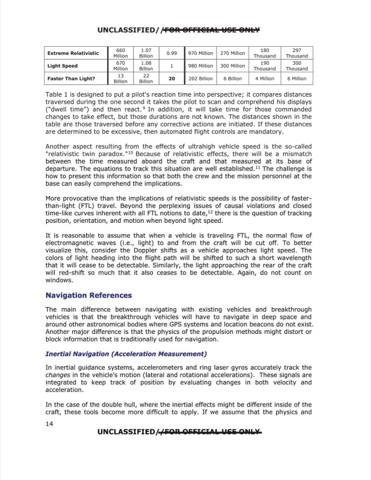
Table 1 is designed to put a pilot's reaction time into perspective; it compares distances
traversed during the one second it takes the pilot to scan and comprehend his displays
("dwell time") and then react. In addition, it will take time for those commanded
changes to take effect, but those durations are not known. The distances shown in the
table are those traversed before any corrective actions are initiated. If these distances
are determined to be excessive, then automated flight controls are mandatory.
Another aspect resulting from the effects of ultrahigh vehicle speed is the so-called
"relativistic twin paradox."10 Because of relativistic effects, there will be a mismatch
between the time measured aboard the craft and that measured at its base of
departure. The equations to track this situation are well established. 11 The challenge is
how to present this information so that both the crew and the mission personnel at the
base can easily comprehend the implications.
More provocative than the implications of relativistic speeds is the possibility of faster-
than-light (FTL) travel. Beyond the perplexing issues of causal violations and closed
time-like curves inherent with all FTL notions to date, 12 there is the question of tracking
position, orientation, and motion when beyond light speed.
It is reasonable to assume that when a vehicle is traveling FTL, the normal flow of
electromagnetic waves (i.e., light) to and from the craft will be cut off. To better
visualize this, consider the Doppler shifts as a vehicle approaches light speed. The
colors of light heading into the flight path will be shifted to such a short wavelength
that it will cease to be detectable. Similarly, the light approaching the rear of the craft
will red-shift so much that it also ceases to be detectable. Again, do not count on
windows.
Navigation References
The main difference between navigating with existing vehicles and breakthrough
vehicles is that the breakthrough vehicles will have to navigate in deep space and
around other astronomical bodies where GPS systems and location beacons do not exist.
Another major difference is that the physics of the propulsion methods might distort or
block information that is traditionally used for navigation.
Inertial Navigation (Acceleration Measurement)
In inertial guidance systems, accelerometers and ring laser gyros accurately track the
changes in the vehicle's motion (lateral and rotational accelerations). These signals are
integrated to keep track of position by evaluating changes in
both velocity and
acceleration.
In the case of the double hull, where the inertial effects might be different inside of the
craft, these tools become more difficult to apply. If we assume that the physics and
14
UNCLASSIFIED//FOR OFFICIAL VISE ONLY