Text of page 28
UNCLASSIFIED/ FOR OFFFETAL USE ONLY
room temperature radiates 460 W. Earth-based powerful mid-infrared sources can be
used for nighttime powering of airborne platforms.
All these applications would benefit from the following components: (a) perfect
absorbers of infrared radiation that can be installed on the receiving platforms, (b)
efficient sources of thermal mid-infrared radiation. These two components are related
to each other. Therefore, developing an ultra-thin perfect absorber of infrared radiation
would be highly desirable. The ultra-thin aspect is important because it enhances the
radiation-to-electricity conversion efficiency. For example, it is well known that carrier
separation-collection efficiency in a solar cell improves as the cell gets thinner. The
9 solar cel im
challenge is to combine this carrier separation-collection efficiency with sufficient
absorption. Unfortunately, the absorption length of many semiconductors in the
infrared is fairly small. Recent experiments provide the new metamaterials-based
concept for increasing the absorptivity of otherwise semi-transparent materials. Below
some of the (still unpublished) experiments and theoretical developments that might
result in new metamaterials-based perfect absorbers are described.
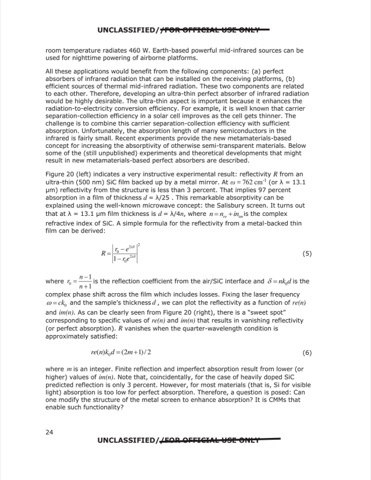
Figure 20 (left) indicates a very instructive experimental result: reflectivity R from an
ultra-thin (500 nm) SiC film backed up by a metal mirror. At a = 762 cm*' (or 1 = 13.1
um) reflectivity from the structure is less than 3 percent. That implies 97 percent
absorption in a film of thickness d = 1/25 . This remarkable absorptivity can be
explained using the well-known microwave concept: the Salisbury screen. It turns out
that at 1 = 13.1 um film thickness is d = 1/4n, where n= n, t in, is the complex
refractive index of SiC. A simple formula for the reflectivity from a metal-backed thin
film can be derived:
R =
- roezis
(5)
where ro =
is the reflection coefficient from the air/SiC interface and 6 = nk d is the
complex phase shift across the film which includes losses. Fixing the laser frequency
∞=ck, and the sample's thicknessd, we can plot the reflectivity as a function of re(n)
and im(n). As can be clearly seen from Figure 20 (right), there is a "sweet spot"
corresponding to specific values of re(n) and im(n) that results in vanishing reflectivity
(or perfect absorption). R vanishes when the quarter-wavelength condition is
approximately satisfied:
re(n)kyd = (2m + 1) / 2
(6)
where m is an integer. Finite reflection and imperfect absorption result from lower (or
higher) values of im(n). Note that, coincidentally, for the case of heavily doped SiC
predicted reflection is only 3 percent. However, for most materials (that is, Si for visible
light) absorption is too low for perfect absorption. Therefore, a question is posed: Can
one modify the structure of the metal screen to enhance absorption? It is CMMs that
enable such functionality?
24
UNCLASSIFIED/EOR OFFICIAL USE ONLY