Text of page 29
UNCLASSIFIED/LEOR OFFICIAL USE ONLY
Specifically, it has been found that by making the mirror slightly leaky, we can actually
increase absorption. If the reflection coefficient of a mirror is given by r, then the
reflection/transmission coefficients r,t through the structure are given by:
r= to + rezis
tote
1+ roselis
(7)
where f2 = 1+ rand to =1+ ro. Note that Equation 7 turns into Equation 6 if
= -1 (perfectly reflecting mirror). From Equation 7 it follows that it may be possible to
engineer the reflectivity r in such a way that minimizes reflection |r| while keeping
transmission | t | small. The remainder of the energy is guaranteed to be absorbed by
the quarter-wavelength thick absorber.
1 г
1
0.8 -
- V
H
- Smooth Au
0.8
Absorption
0.6
0.4
0.6
0.4
0.2
0.2
- V
- H
— Smooth Au
680
700
720
k (cm"')
740
760
680
700
720
k (cm"')
740
760
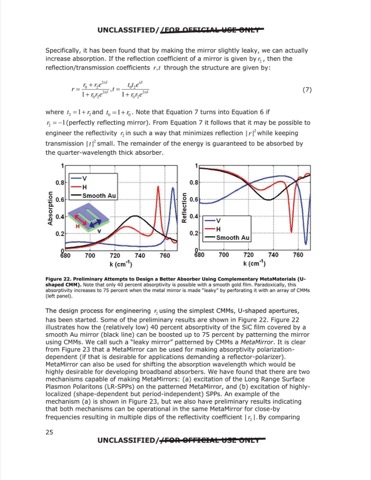
Figure 22. Preliminary Attempts to Design a Better Absorber Using Complementary MetaMaterials (U-
shaped CMM). Note that only 40 percent absorptivity is possible with a smooth gold film. Paradoxically, this
absorptivity increases to 75 percent when the metal mirror is made "leaky" by perforating it with an array of CMMs
(left panel).
The design process for engineering r using the simplest CMMs, U-shaped apertures,
has been started. Some of the preliminary results are shown in Figure 22. Figure 22
illustrates how the (relatively low) 40 percent absorptivity of the SiC film covered by a
smooth Au mirror (black line) can be boosted up to 75 percent by patterning the mirror
using CMMs. We call such a "leaky mirror" patterned by CMMs a MetaMirror. It is clear
from Figure 23 that a MetaMirror can be used for making absorptivity polarization-
dependent (if that is desirable for applications demanding a reflector-polarizer).
MetaMirror can also be used for shifting the absorption wavelength which would be
highly desirable for developing broadband absorbers. We have found that there are two
mechanisms capable of making MetaMirrors: (a) excitation of the Long Range Surface
Plasmon Polaritons (LR-SPPs) on the patterned MetaMirror, and (b) excitation of highly-
localized (shape-dependent but period-independent) SPPs. An example of the
mechanism (a) is shown in Figure 23, but we also have preliminary results indicating
that both mechanisms can be operational in the same MetaMirror for close-by
frequencies resulting in multiple dips of the reflectivity coefficient | KI. By comparing
25
UNCLASSIFIED/+FOR OFFICIAL USE ONLT