Text of page 27
UNCLASSIFIED/ LEOR OFFICIAL USE ONET
prospect is not too farfetched because scattering in mid-infrared by atmospheric gases
is essentially zero. For such a remote powering scenario to be feasible, one would need
a highly efficient absorber at the specific wavelength corresponding to that of the
source. Moreover, as the space platform is moving, it is desirable that the absorption
remain high even for non-normal incidence angles.
The second application is for thermophotovoltaics (TPV) (Reference 35). Some type of
thermophotovoltaic converter will almost undoubtedly be installed on the advanced
aerospace platforms of the future. Presently even advanced (experimental) electric cars
are using TPV cells to convert the heat from their engines into electricity. Such
converters have already been shown to be capable of increasing the range of electric
vehicles by a factor of 3. We believe that metamaterials could play an important role in
developing highly efficient TPV cells. By virtue of Kirchhoff's law, emissivity of a thermal
emitter approaches the blackbody limit only if the absorptivity approaches unity.
Moreover, wavelength-selective radiators can dramatically improve the efficiency of
current generation in a TPV cell if their emission spectrum is matched to the bandgap of
the TPV converter. For example, a typical TPV converter, GaSb, has the bandgap of EG
= 0.7 eV that would be ideally suited to a wavelength-selective radiator operating in
near infrared around A = 1.7 um.
Reflection from SiC on Au
Absorption vs. n, and n for 7=13um (o=760cm*')
2.5
0.9
0.8-
2-
SiC 1d =490nm
0.7 -
0.6-
Reflectivity
0.5
0.4
0.3
0.2
Imag(n)
.5
0.5
0.1 -
600
700
800
900
1000
k (cm"")
*****Theory
Experimental data
1100
1200
6
6.5
7
Real(n)
"sic for ÷ 10cm*'
7.5
8
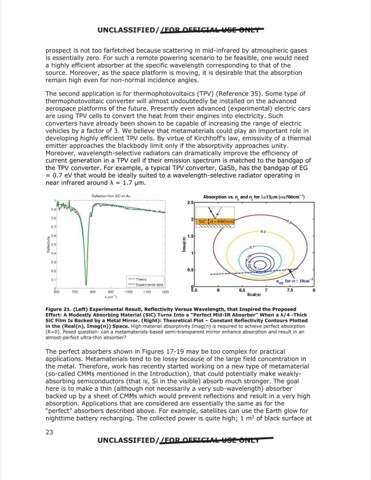
Figure 21. (Left) Experimental Result, Reflectivity Versus Wavelength, that Inspired the Proposed
Effort: A Modestly Absorbing Material (SiC) Turns Into a "Perfect Mid-IR Absorber" When a 1/4 -Thick
SiC Film Is Backed by a Metal Mirror. (Right): Theoretical Plot - Constant Reflectivity Contours Plotted
in the (Real(n), Imag(n)) Space. High material absorptivity Imag(n) is required to achieve perfect absorption
(R=0). Posed question: can a metamaterials-based semi-transparent mirror enhance absorption and result in an
almost-perfect ultra-thin absorber?
The perfect absorbers shown in Figures 17-19 may be too complex for practical
applications. Metamaterials tend to be lossy because of the large field concentration in
the metal. Therefore, work has recently started working on a new type of metamaterial
(so-called CMMs mentioned in the Introduction), that could potentially make weakly-
absorbing semiconductors (that is, Si in the visible) absorb much stronger. The goal
here is to make a thin (although not necessarily a very sub-wavelength) absorber
backed up by a sheet of CMMs which would prevent reflections and result in a very high
absorption. Applications that are considered are essentially the same as for the
"perfect" absorbers described above. For example, satellites can use the Earth glow for
nighttime battery recharging. The collected power is quite high; 1 m? of black surface at
23
UNCLASSIFIED/LEOR DEFICIAL USE ONL