DOW-UAP-D141

AAWSAP DIRD, Metamaterials for Aerospace Applications, April 2010, page 26

One page of a U.S. government record released under PURSUE, shown on its own with its text. The record page has the whole document, its catalog details and the scan.

Page
26 of 38
Agency
Department of War
Released
Release 06, September 18, 2026

Text of page 26

UNCLASSIFIED/ LEOR OFFICIAL USE ONET A = 1 (4) where we ve assumed that, for normal incidence, this metamaterial is impedance- matched: Ey = M22 = -1+ i. Equation 4 can be simplified under the assumption • >> 1, M× =1: A~1-tan*(0/2), implying that A ~ 0.97 even for 0 = 7/6 . The challenge, if course, is to design a true impedance-matched optical metamaterial. Success has been achieved in designing such a metamaterial (Reference 20). The recently published design is shown in Figure 19. The unit cell consists of two layers of plasmonic antennas; the cut-wire antenna that imparts magnetic (as well as some electric) response to this metamaterial, and the continuous-wire antennas that impart a purely electric response. It is found that the wide-angle capability could be very important for several applications. Wide-angle power absorption efficiency is desirable for miniaturizing photodetectors or microbolometers down to the wavelength size. Continuous Silver Wires Control seff 3 2 Impedance Matching, 20 nm 50 nm 80 nm "cut" silver wires control I eff fre = Ere 80 nm -2 -3 1450 Re & Im E - = - Reu Im u 1650 1700 320 nm 1500 1550 1600 Wavelength [nm] 250 nm Figure 20. Specific Design of a Wide-Angle Plasmonic Absorber Based on Negative Index Metamaterial Operating at A=1550 nm. Left panel: Schematic of the silver-based plamonic structure. Right panel: Extracted permittivity and permeability for the normal incidence demonstrate impedance matching: E, = M = -1+ i. (Reference 20) For example, to focus light on a wavelength-sized photodetector or micro-bolometer requires high-NA optics (a NA=0.5 or higher). Therefore, a photodetector should be able to absorb light incident at 30 degree angle. For advanced aerospace platforms it is easy to envision a scenario where an airborne platform is powered by a high-power infrared laser source located on Earth. If the wavelength falls inside the transparency window of the atmosphere (between 3 and 4 um, and also around 10 um), then such a 22 UNCLASSIFIED/ /FOR OFFICIAL USE ONLY

Machine-read (OCR) from the scan by this archive; it can contain errors. The scan is the record.
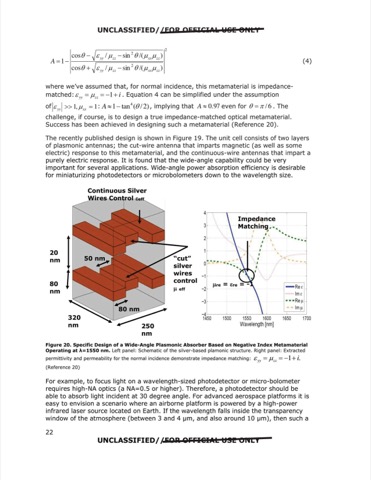
Image from page 26 of DOW-UAP-D141, as released by war.gov
Image from page 26 of the PDF. Open the scan to see the whole page.

Cite this page

U.S. Department of War. "AAWSAP DIRD, Metamaterials for Aerospace Applications, April 2010" (DOW-UAP-D141). PURSUE Release 06, U.S. Department of War, September 18, 2026. https://www.war.gov/medialink/ufo/sept-18/release-06/assets/DOW-UAP-D141_AAWSAP-DIRD-Metamaterials-for-Aerospace-Applications-April-6-2010.pdf. Declassified UAP, page 26, https://declassifieduap.org/r/dow-uap-d141-aawsap-dird-metamaterials-for-aerospace-applications-april-2010/p/26. Accessed November 28, 2026.

This address shows page 26 on its own; /r/dow-uap-d141-aawsap-dird-metamaterials-for-aerospace-applications-april-2010?page=26 opens the same page in the full reader. Both stay. How to cite.