Text of page 35
UNCLASSIFIED// FOR OFFICIAL USE ONLY
3.3.4 The Impact of Frequency Noise Improvements on FDMA and
FHSS
The very low noise frequency standard that would be supplied by an HFGW FTS system
would allow for much more efficient use of reserved frequency bandwidth. Frequency
noise limits the type of modulation and manner of encoding that can be performed in
frequency space, such as Frequency Division Multiple Access (FDMA) or Frequency
Hopping Spread Spectrum (FHSS). HFGW can reduce frequency noise by providing a
frequency reference with outstanding stability. For example, guard bands can be shrunk
in FDMA, and frequency slices can be smaller and more stable in FHSS.
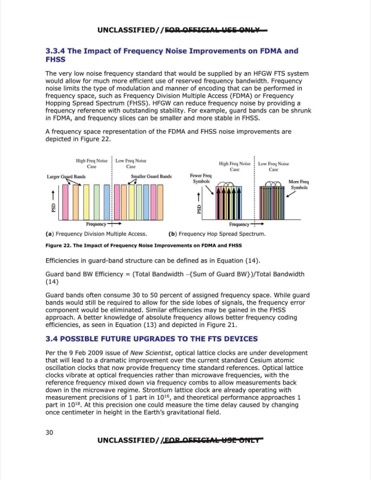
A frequency space representation of the FDMA and FHSS noise improvements are
depicted in Figure 22.
Larger Guard Bands
High Freq Noise Low Freq Noise
Case
Case
Smaller Guard Bands
High Freq Noise Low Frey Noise
Case
Case
Fewer Freq
Symbols
More Freq
Symbols
PSD
Frequency
Frequency
(a) Frequency Division Multiple Access.
(b) Frequency Hop Spread Spectrum.
Figure 22. The Impact of Frequency Noise Improvements on FDMA and FHSS
Efficiencies in guard-band structure can be defined as in Equation (14).
Guard band BW Efficiency = (Total Bandwidth -{Sum of Guard BW})/Total Bandwidth
(14)
Guard bands often consume 30 to 50 percent of assigned frequency space. While guard
bands would still be required to allow for the side lobes of signals, the frequency error
component would be eliminated. Similar efficiencies may be gained in the FHSS
approach. A better knowledge of absolute frequency allows better frequency coding
efficiencies, as seen in Equation (13) and depicted in Figure 21.
3.4 POSSIBLE FUTURE UPGRADES TO THE FTS DEVICES
Per the 9 Feb 2009 issue of New Scientist, optical lattice clocks are under development
that will lead to a dramatic improvement over the current standard Cesium atomic
oscillation clocks that now provide frequency time standard references. Optical lattice
clocks vibrate at optical frequencies rather than microwave frequencies, with the
reference frequency mixed down via frequency combs to allow measurements back
down in the microwave regime. Strontium lattice clock are already operating with
measurement precisions of 1 part in 1016, and theoretical performance approaches 1
part in 1018. At this precision one could measure the time delay caused by changing
once centimeter in height in the Earth's gravitational field.
30
UNCLASSIFIED/ /EOR OFFICIAL USE ONLY