DOW-UAP-D140

AAWSAP DIRD, High-Frequency Gravitational Wave Communications, April 2010, page 34

One page of a U.S. government record released under PURSUE, shown on its own with its text. The record page has the whole document, its catalog details and the scan.

Page
34 of 57
Agency
Department of War
Released
Release 06, September 18, 2026

Text of page 34

UNCLASSIFIED// FOR OFFICIAL USE ONLY section below. For a 5 usec acquire test time, the result is Tacq = 150 x 150 x 16 x 5 usec = 1.8 seconds acquisition time. However, with effectively perfect knowledge of time, frequency, and hence also phase, there will only be one case to check, so result is Taca = 1 × 1 x 1 x 5 usec = 5 usec acquisition time. This is essentially instantaneous for applications such as TCP/IP or VoIP. This will favorably impact the overall TDMA efficiency in that it speeds the claiming process to the point where an "always on" link can be replaced by a "link on demand." This is a savings of 25 to 50 percent in channel usage for VoIP and TCP/IP sessions over "always on." 3.3.3 The Impact of Phase Noise Improvements on Phase Shift Encoding The use of a universal HFGW FTS would also benefit the relative phase noise of all terminals, allowing for finer phase encoding. Phase noise limits the type of modulation and manner of encoding that can be performed in phase space, commonly used for over the air telecommunication systems. An HFGW FTS system could reduce phase noise by providing a frequency reference with outstanding stability. For example, moving from QPSK to 8PSK or 16-PSK improves bandwidth efficiency by a factor of 2 to 4. The phase space improvement is summarized in Figure 21. (a) QPSK (b) Low Noise QPSK (c) Low Noise 8PSK Figure 21. The Impact of Phase Noise Improvements on Phase Shift Encoding (d) Low Noise 16-PSK In the example of Figure 21 nominal performance allows only QPSK, but improved phase noise would allow higher density phase encoding. Data rate will scale linearly with encoding efficiency as shown in Equation (13): Data Rate = (BW/2) × (Coding Efficiency) × (FEC Rate) / (PN Spreading Factor) (13) Coding efficiency will be a factor of 2 better when moving from QPSK to 8PSK, or a factor of 4 better when moving from QPSK to 16-PSK. This will translate directly into a linear increase in the allowable data rate that a given bandwidth can support. Put another way, a universal frequency time standard could quadruple over the air bandwidth efficiencies just by improving phase noise alone. Phase noise improvements would be limited only by the slight variations induced in the HFGW signal passing through the earth as described in Baker (2007). 29 UNCLASSIFIED/ /EOR OFFICIAL USE ONLT

Machine-read (OCR) from the scan by this archive; it can contain errors. The scan is the record.
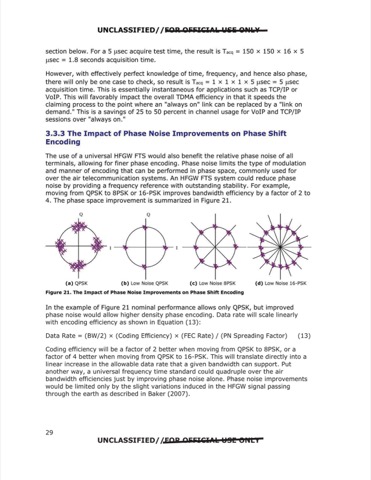
Image from page 34 of DOW-UAP-D140, as released by war.gov
Image from page 34 of the PDF. Open the scan to see the whole page.

Cite this page

U.S. Department of War. "AAWSAP DIRD, High-Frequency Gravitational Wave Communications, April 2010" (DOW-UAP-D140). PURSUE Release 06, U.S. Department of War, September 18, 2026. https://www.war.gov/medialink/ufo/sept-18/release-06/assets/DOW-UAP-D140_AAWSAP-DIRD-High-Frequency-Gravitational-Wave-Communications-April-6-2010.pdf. Declassified UAP, page 34, https://declassifieduap.org/r/dow-uap-d140-aawsap-dird-high-frequency-gravitational-wave-communications-april-2010/p/34. Accessed November 28, 2026.

This address shows page 34 on its own; /r/dow-uap-d140-aawsap-dird-high-frequency-gravitational-wave-communications-april-2010?page=34 opens the same page in the full reader. Both stay. How to cite.