DOW-UAP-D140

AAWSAP DIRD, High-Frequency Gravitational Wave Communications, April 2010, page 36

One page of a U.S. government record released under PURSUE, shown on its own with its text. The record page has the whole document, its catalog details and the scan.

Page
36 of 57
Agency
Department of War
Released
Release 06, September 18, 2026

Text of page 36

UNCLASSIFIED// FOR OFFICIAL USE ONLY 3.4.1 Propagating Signals From Optical Lattice Clocks for Timing The 1 part in 1018 measurement precision of optical lattice clocks will be affected by general relativity effects, in other words propagation delays due to gravitational field gradients will be readily measureable. "It will make us think a little harder about what we really mean by time," Kleppner (2008). In effect, measuring the propagation delays at this level allows very fine measurement of the "geoids," or surfaces of constant gravity, surrounding planets and inhabiting interplanetary and interstellar space. The delay experienced by RF waves could therefore be precisely compared with the propagation delay experienced by gravitational waves, which are not as strongly affected by the presence of mass. Such a differential propagation delay comparison (between RF & GW) could lead to an important new technology in the mapping of geoids, which could for instance be applied to the problem of mapping the positions of the Lagrangian points, which vary slightly over time. 3.4.2 In Navigating and Mapping Interplanetary Geoids The importance of locating and navigating to Lagrangian points is well established (Baker, 1967). See Figure 23 for a depiction of the Earth's Lagrangian points and their uses. Gravity holes The Earth and sun's gravitational fields balance at five Lagrangian points, L1 to LS. Later this year the STEREO A and B spacecraft will explore the L4 and L5 regions for the first time NOT TO SCALE EARTH ORBIT L3: Highly unstable due to gravitational pull of other planets GRAVITATIONAL FIELD CONTOURS ISTEREO A ORBIT (Due to reach L4 September 2009) L4: Stable. May contain dust and rocks from the early solar system • 14 SUN 11 A DIRECTION OF MOTION EARTH L1: 1.5 million km from Earth. Ideal location for monitoring the sun. Home to NASA'S ACE, SOHO and WIND satellites L5: Stable. May contain dust and rocks from the early solar system 12 L2: 1.5 million km from Earth. Permanently shielded from the sun. Home to NASAS WMAP satellite. The Planck satellite, Herschel and james Webb space telescopes will all sit here STEREO B ORBIT (Due to reach L5 October 2009) Figure 23. The Earth's Associated Lagrangian Points [New Scientist, 9Feb09 and Baker (1967), p.128, Figure 31 UNCLASSIFIED/ /EOR OFFICIAL USE ONLY

Machine-read (OCR) from the scan by this archive; it can contain errors. The scan is the record.
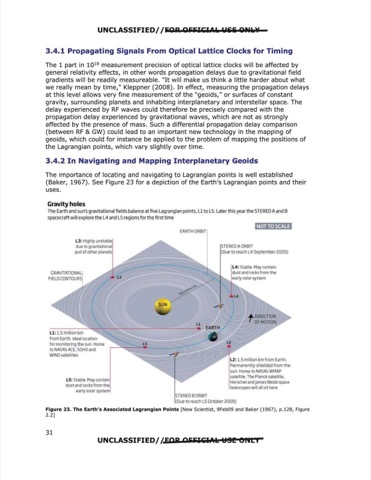
Image from page 36 of DOW-UAP-D140, as released by war.gov
Image from page 36 of the PDF. Open the scan to see the whole page.

Cite this page

U.S. Department of War. "AAWSAP DIRD, High-Frequency Gravitational Wave Communications, April 2010" (DOW-UAP-D140). PURSUE Release 06, U.S. Department of War, September 18, 2026. https://www.war.gov/medialink/ufo/sept-18/release-06/assets/DOW-UAP-D140_AAWSAP-DIRD-High-Frequency-Gravitational-Wave-Communications-April-6-2010.pdf. Declassified UAP, page 36, https://declassifieduap.org/r/dow-uap-d140-aawsap-dird-high-frequency-gravitational-wave-communications-april-2010/p/36. Accessed November 28, 2026.

This address shows page 36 on its own; /r/dow-uap-d140-aawsap-dird-high-frequency-gravitational-wave-communications-april-2010?page=36 opens the same page in the full reader. Both stay. How to cite.