DOW-UAP-D136

AAWSAP DIRD, Biosensors and BioMEMS: A Survey of the Present Field, March 2010, page 28

One page of a U.S. government record released under PURSUE, shown on its own with its text. The record page has the whole document, its catalog details and the scan.

Page
28 of 45
Agency
Department of War
Released
Release 06, September 18, 2026

Text of page 28

UNCLASSIFIED//TOR OFFH USE ONLY Bionics and Neurointerfaces Neuroprosthetics (also called neural prosthetics) is a discipline related to neuroscience and biomedical engineering concerned with developing neural prostheses. Neural prostheses are devices that attempt to substitute for a motor, sensory or cognitive modality that might have been damaged as a result of an injury or a disease. Bionics and neurointerfacing are relatively new concepts. A neurointerface is a combination of software and hardware that translates electrode signals to something which is understood by an electronic system. The term bionics is used when we connect organic matter with something artificial (human-made). The design and development of neural interface electrodes to the brain or peripheral nerve has been going on for more than twenty years. Figure 19 shows a mockup of a neuroprosthetic Figure 19. A Neuroprosthetic Interface. Adapted to electrode system for the human brain the needs of a quadriplegic for control of his environments (Duke University) that is meant to tap into brain signals and then through the use of a computer allow a quadriplegic to control his environment. BIOELECTRODES AND BIOMEMS Electrodes that interface to the brain or nervous system are the most important components of neuroprosthetic systems. There are basically of two classes of electrodes. One class does recording of bioelectric events and the other provides current to stimulate bioelectrical responses. Both classes of electrodes need to be designed to be very robust for long term survival in the hostile environment of the human body. For this reason only the noble metals of platinum, iridium, gold, and to some extent the resistant metal tungsten are used for electrodes. Nearly all other metals would corrode in the warm saline environment of living tissues. Electronic exchange reactions occur at the electrode surfaces in both recording and stimulation modes. Many bioelectrodes are nothing more than fine wires insulated down their length and then exposed at a needle tip where an electrical contact exists to tissue. These are usually used in research for trying to understand brain function. Sometimes a single electrode performs both recordina as well as stimulation but more freauently the electrode size and material is optimized to do one function or the other. 22 UNCLASSIFIED / LEOR OFFICIAL USE ONLY

Machine-read (OCR) from the scan by this archive; it can contain errors. The scan is the record.
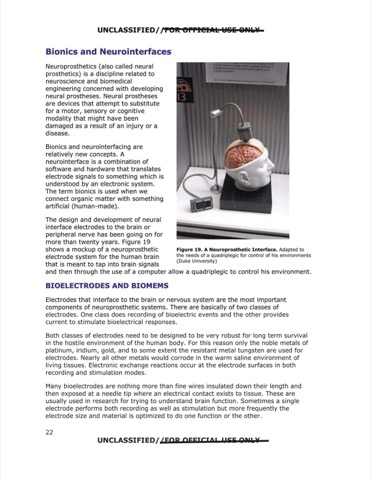
Image from page 28 of DOW-UAP-D136, as released by war.gov
Image from page 28 of the PDF. Open the scan to see the whole page.

Cite this page

U.S. Department of War. "AAWSAP DIRD, Biosensors and BioMEMS: A Survey of the Present Field, March 2010" (DOW-UAP-D136). PURSUE Release 06, U.S. Department of War, September 18, 2026. https://www.war.gov/medialink/ufo/sept-18/release-06/assets/DOW-UAP-D136_AAWSAP-DIRD-Biosensors-and-BioMEMS-A-Survey-of-the-Present-Field-March-31-2010.pdf. Declassified UAP, page 28, https://declassifieduap.org/r/dow-uap-d136-aawsap-dird-biosensors-and-biomems-a-survey-of-the-present-field-march-2010/p/28. Accessed November 28, 2026.

This address shows page 28 on its own; /r/dow-uap-d136-aawsap-dird-biosensors-and-biomems-a-survey-of-the-present-field-march-2010?page=28 opens the same page in the full reader. Both stay. How to cite.