DOW-UAP-D136

AAWSAP DIRD, Biosensors and BioMEMS: A Survey of the Present Field, March 2010, page 29

One page of a U.S. government record released under PURSUE, shown on its own with its text. The record page has the whole document, its catalog details and the scan.

Page
29 of 45
Agency
Department of War
Released
Release 06, September 18, 2026

Text of page 29

UNCLASSIFIED//TOR OFT TETAL USE ONLY Electrode arrays are sometimes used, such as in the case of deep brain stimulation for late-stage Parkinson's disease, which is characterized by tremors of hands. There is a "brain pacemaker" that sends electrical impulses to specific parts of the patient's brain via permanently inserted electrodes. This can stop the tremors for reasons that are not exactly known and for which the best location in a given patient to place the electrode is also not known beforehand. Thus introducing multiple electrodes and stimulating each one in-turn until the best result is found allows a greater degree of possible effectiveness and therapeutic result. MEMS techniques are being employed in this application to permit a greater number of contacts and to reduce the size of the lead wire on the electrodes. MEMS multichannel electrode stimulating and recording electrode systems are also used in brain interface applications to record or stimulate the activity of many neural circuits. Such electrodes allow ability to record or stimulate complex muscle movements associated with the limb such as in walking or in grasping objects with the hands. Figure 20 shows an electrode system looking much like a bed of nails. 200Lm Figure 20. Scanning Electron Micrograph of a Brain Electrode Array Manufactured From Titanium and Produced by a Process of Electrodischarge Machining ("Electrical Discharge Machining and Chemical Etching", Fofonoff*, Martel, Hatsopoulos, Donoghue, Hunter) All muscles of the body are activated by nerves that route to the brain. It is known from careful studies conducted by many investigators over the years that there is a wiring and physical mapping of the muscles to certain clusters of specialized cells in the motor cortex of the brain. It is also known that when a person plans or strongly imagines moving part of his body, there is a complex electrical activation of the corresponding regions of the brain involving many cells over a local area. 23 UNCLASSIFIED/ LEOR OFFICIAL USE ONLY

Machine-read (OCR) from the scan by this archive; it can contain errors. The scan is the record.
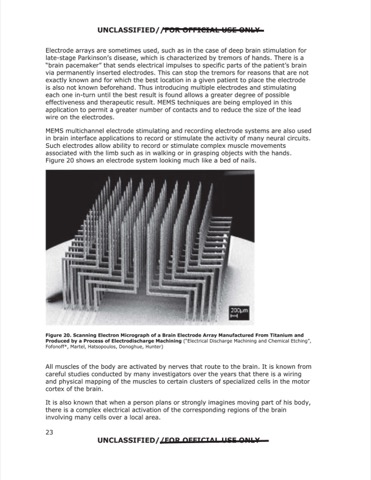
Image from page 29 of DOW-UAP-D136, as released by war.gov
Image from page 29 of the PDF. Open the scan to see the whole page.

Cite this page

U.S. Department of War. "AAWSAP DIRD, Biosensors and BioMEMS: A Survey of the Present Field, March 2010" (DOW-UAP-D136). PURSUE Release 06, U.S. Department of War, September 18, 2026. https://www.war.gov/medialink/ufo/sept-18/release-06/assets/DOW-UAP-D136_AAWSAP-DIRD-Biosensors-and-BioMEMS-A-Survey-of-the-Present-Field-March-31-2010.pdf. Declassified UAP, page 29, https://declassifieduap.org/r/dow-uap-d136-aawsap-dird-biosensors-and-biomems-a-survey-of-the-present-field-march-2010/p/29. Accessed November 28, 2026.

This address shows page 29 on its own; /r/dow-uap-d136-aawsap-dird-biosensors-and-biomems-a-survey-of-the-present-field-march-2010?page=29 opens the same page in the full reader. Both stay. How to cite.