DOW-UAP-D136

AAWSAP DIRD, Biosensors and BioMEMS: A Survey of the Present Field, March 2010, page 27

One page of a U.S. government record released under PURSUE, shown on its own with its text. The record page has the whole document, its catalog details and the scan.

Page
27 of 45
Agency
Department of War
Released
Release 06, September 18, 2026

Text of page 27

UNCLASSIFIED//TOR OTTH AL USE ONLY Bioelectrical events are generated in tissues when there is an electrochemical change in the membranes of specialized cells of the brain and nervous systems. Neuroelectrical devices interface to the brain and nervous systems through electrodes that touch excitable cell membrane and convert ionic current flows to electron flow in a wire. Conversely current flows in a wire are converted by electrodes to ionic flows in tissue. The function of the entire human body is under control of the brain and the nervous system. So the use of electrodes of various types as a method of monitoring and controlling the function of the nervous system through bioelectrical currents and electrodes is potentially a very powerful method of treating in therapeutic ways. Figure 18 suggests the idea of an excitable cell of the brain having many tendrils or dendrites that extend outward to interconnect with other cells. Essentially these cells are the relay points of the bioelectrical wiring of the human body. JEFF JOHNSON BIOLOGICAL & MEC Figure 18. A Neural Cell Showing Dendritic Inter-Connections That are Electrically Active With Other Cells (artist's illustration) An electrical interface to body tissues typically occurs through the use of microelectrode systems. These electrodes are often on the order of tens of microns to millimeter-order in sizes depending on their function. For example electrodes that simply measure bioelectrical activity of the nervous system can resemble needles insulated along their length having micron order tips both because they carry only small electrical currents and also because they need to be placed in very specific places and they contact just a single or few cells that control specific functions. 21 UNCLASSIFIED/ LEOR OFFICIAL USE ONLY

Machine-read (OCR) from the scan by this archive; it can contain errors. The scan is the record.
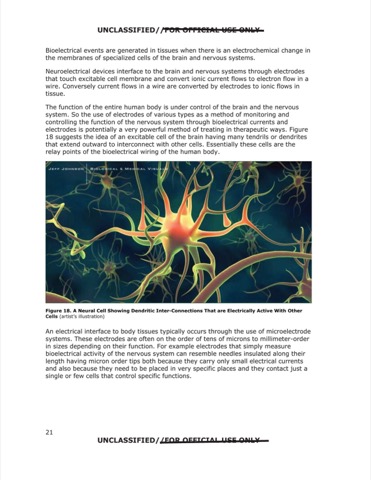
Image from page 27 of DOW-UAP-D136, as released by war.gov
Image from page 27 of the PDF. Open the scan to see the whole page.

Cite this page

U.S. Department of War. "AAWSAP DIRD, Biosensors and BioMEMS: A Survey of the Present Field, March 2010" (DOW-UAP-D136). PURSUE Release 06, U.S. Department of War, September 18, 2026. https://www.war.gov/medialink/ufo/sept-18/release-06/assets/DOW-UAP-D136_AAWSAP-DIRD-Biosensors-and-BioMEMS-A-Survey-of-the-Present-Field-March-31-2010.pdf. Declassified UAP, page 27, https://declassifieduap.org/r/dow-uap-d136-aawsap-dird-biosensors-and-biomems-a-survey-of-the-present-field-march-2010/p/27. Accessed November 28, 2026.

This address shows page 27 on its own; /r/dow-uap-d136-aawsap-dird-biosensors-and-biomems-a-survey-of-the-present-field-march-2010?page=27 opens the same page in the full reader. Both stay. How to cite.