DOW-UAP-D136

AAWSAP DIRD, Biosensors and BioMEMS: A Survey of the Present Field, March 2010, page 26

One page of a U.S. government record released under PURSUE, shown on its own with its text. The record page has the whole document, its catalog details and the scan.

Page
26 of 45
Agency
Department of War
Released
Release 06, September 18, 2026

Text of page 26

UNCLASSIFIED//Tor OFfTErAL GSE ONLY thermoelectric sensors have improved reproducibility of the sensors, but there has only been limited success in applications of implantation into the body. Neuroengineering by BioMEMS BioMEMS types of devices, as we understand them today, were used first in neuroscience. There has been a long history of the study of the electrical nature of body tissue dating back to the days of Galvani and Volta. Frog nerves were found to be electrically stimulatable and the first recordings of bioelectrical events were accomplished very early with the invention of the string galvanometer. More recently, pointed wires inserted into muscle, nerve and brain have given way to MEMS electrode systems that are made on silicon supporting substrates and the processes of photolithography used to define electrical current pathways. Figure 17 shows a modern electrode system for detecting and recording electrical signals from living things. Each of the square regions is an exposed film of platinum while the thinner conductors that contact the pads are insulated by a thin layer of a plastic and conduct the detected electrical signals to a connector system (not shown). Figure 17. A MEMS Biopotential Electrode System. It is approximately 100 microns in width. Each square pad is an electrically sensitive region. (Wikipedia) BIOELECTRIC EVENTS The living processes of biology can in some ways be likened to that of a battery. The metabolism of life produces the charging of the battery while it discharges through a myriad of bioelectrical events that produce movement, thought, and cognition. The transfer of electrical charge in the form of ions, mostly sodium, potassium and chloride is initiated by bioelectrically excitable cells of the nerves, muscles, and neurons of the brain. Collectively they constitute the wiring of the body. These ions result from the salts that are part of the composition of living things that have evolved from the sea. The movements of these ions constitutes the flow of an electrical current in tissues and are called bioelectrical currents. These currents give rise to electrical potentials that can be detected from the skin or by biopotential electrodes inserted into organs or muscle. 20 UNCLASSIFIED/ LEOR OFFICIAL LISE ONLY

Machine-read (OCR) from the scan by this archive; it can contain errors. The scan is the record.
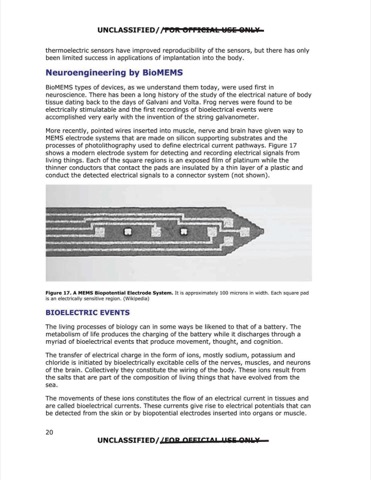
Image from page 26 of DOW-UAP-D136, as released by war.gov
Image from page 26 of the PDF. Open the scan to see the whole page.

Cite this page

U.S. Department of War. "AAWSAP DIRD, Biosensors and BioMEMS: A Survey of the Present Field, March 2010" (DOW-UAP-D136). PURSUE Release 06, U.S. Department of War, September 18, 2026. https://www.war.gov/medialink/ufo/sept-18/release-06/assets/DOW-UAP-D136_AAWSAP-DIRD-Biosensors-and-BioMEMS-A-Survey-of-the-Present-Field-March-31-2010.pdf. Declassified UAP, page 26, https://declassifieduap.org/r/dow-uap-d136-aawsap-dird-biosensors-and-biomems-a-survey-of-the-present-field-march-2010/p/26. Accessed November 28, 2026.

This address shows page 26 on its own; /r/dow-uap-d136-aawsap-dird-biosensors-and-biomems-a-survey-of-the-present-field-march-2010?page=26 opens the same page in the full reader. Both stay. How to cite.