DOW-UAP-D136

AAWSAP DIRD, Biosensors and BioMEMS: A Survey of the Present Field, March 2010, page 25

One page of a U.S. government record released under PURSUE, shown on its own with its text. The record page has the whole document, its catalog details and the scan.

Page
25 of 45
Agency
Department of War
Released
Release 06, September 18, 2026

Text of page 25

UNCLASSIFIED//TOR OFF AL USE ONLY Antimony Thin Mylar Substrate Bismuth Reference Junctions Measuring Junctions Reference Junctjons Figure 15. Thermopile Glucose Sensor (left) With Functional Illustration (right) are Made Using Photolithographic Techniques. This larger device is about 8 mm in length but has approximately 50 micron minimum geometries. (Towe et al.) At ASU the glucose sensor has been constructed on a thin mylar plastic substrate and so can be curved into a cylinder to form a small tube. This tube is then sensitive to glucose concentrations on its outside exposure to the blood stream. Figure 16 shows a photograph and an illustration of a glucose sensor implemented in the form of a catheter. The electrical output signal is routed by wires down the length of the catheter for a remote readout. The device was implanted in a pig over a short duration and the decrease in blood glucose concentrations in response to administration of insulin were recorded and are shown in the right hand panel of Figure 16. Glucose Catheter Sensor Polyethylene tube Thermopile: Enzyme Coating Insulin Ероху Rolled Mylar with ovure mane Concentration, mg% Time 10 min Figure 16. Photograph and Illustration of the Thermopile Glucose Sensor in a Catheter. Its configuration is shown (left) and its response in detecting changes in blood glucose in a pig as a result of insulin administration to the animal. (ASU research.) Towe et al. This glucose sensor approach has been found to have limitations in stability when introduced into tissue or blood. Primarily the problems, as with many sensors, arise from the system chemistry and not as much from the electronic portion of the sensor. The glucose oxidase enzyme slowly decays over time and thus the sensor sensitivity and calibration drifts making it eventually unusable. These problems have no easy solution. Investigators have been working with various forms of blood chemistry sensors for forty years or more. Microfabricated 19 UNCLASSIFIED/ LEOR OFFICIAL LISE ONLY

Machine-read (OCR) from the scan by this archive; it can contain errors. The scan is the record.
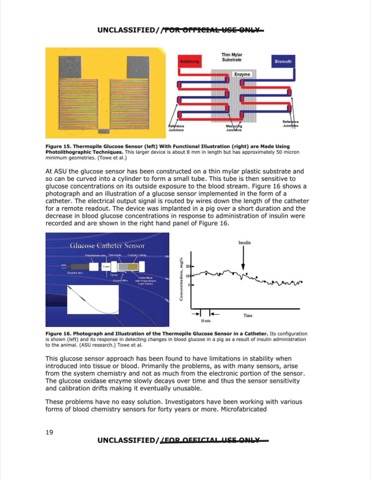
Image from page 25 of DOW-UAP-D136, as released by war.gov
Image from page 25 of the PDF. Open the scan to see the whole page.

Cite this page

U.S. Department of War. "AAWSAP DIRD, Biosensors and BioMEMS: A Survey of the Present Field, March 2010" (DOW-UAP-D136). PURSUE Release 06, U.S. Department of War, September 18, 2026. https://www.war.gov/medialink/ufo/sept-18/release-06/assets/DOW-UAP-D136_AAWSAP-DIRD-Biosensors-and-BioMEMS-A-Survey-of-the-Present-Field-March-31-2010.pdf. Declassified UAP, page 25, https://declassifieduap.org/r/dow-uap-d136-aawsap-dird-biosensors-and-biomems-a-survey-of-the-present-field-march-2010/p/25. Accessed November 28, 2026.

This address shows page 25 on its own; /r/dow-uap-d136-aawsap-dird-biosensors-and-biomems-a-survey-of-the-present-field-march-2010?page=25 opens the same page in the full reader. Both stay. How to cite.