Text of page 20
UNCLASSIFIED//TOR OFfTETAL USE ONLY
COMMERCIAL BLOOD GLUCOSE SENSORS
The present method of blood glucose monitoring depends on a needle puncture of the
skin to withdraw a drop of blood to place on a color changing test strip. The test strip is
read by a small handheld reader. Glucose test strips do not have to necessarily be
small, but by making the sensor very small the amount of blood required for the test is
reduced. The sensors often are made by techniques of photolithography or in some
cases by microscale screen printing in order to achieve reproducibility.
The skin-puncture test is painful and time consuming, and thus noninvasiveness is the
key desired characteristic of glucose sensors. Research is being directed at a
noninvasive glucose sensor that is accurate enough to work external to the body and
through the skin. Short term (a few days) wearable needle glucose sensors are
available from major companies like Medtronic Inc. but fall short of the convenience of
a noninvasive sensor.
ENZYME-BASED BIOSENSORS
The key component in most biosensors
is a reactive chemistry on the sensor
surface. The sensor chemistry is chosen
to give it specificity to only one analyte
(such as glucose). The concentration of
the analyte is determined by a sensor
that can directly measure the analyte
reaction products reacting with the
sensor surface. For example sensor
chemistries to measure glucose are
often based on glucose oxidase enzyme
which promotes a chemical reaction at
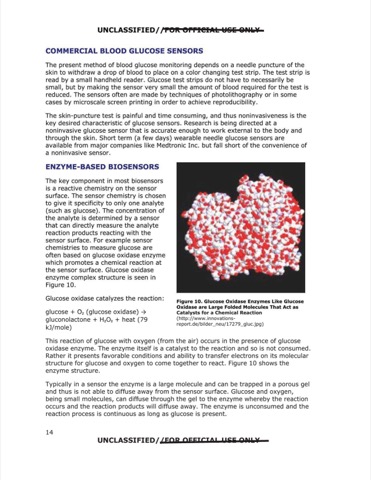
the sensor surface. Glucose oxidase
enzyme complex structure is seen in
Figure 10.
Glucose oxidase catalyzes the reaction:
Figure 10. Glucose Oxidase Enzymes Like Glucose
Oxidase are Large Folded Molecules That Act as
glucose + 02 (glucose oxidase) →
gluconolactone + H202 + heat (79
kJ/mole)
Catalysts for a Chemical Reaction
(http://www.innovations-
report.de/bilder_neu/17279_gluc.jpg)
This reaction of glucose with oxygen (from the air) occurs in the presence of glucose
oxidase enzyme. The enzyme itself is a catalyst to the reaction and so is not consumed.
Rather it presents favorable conditions and ability to transfer electrons on its molecular
structure for glucose and oxygen to come together to react. Figure 10 shows the
enzyme structure.
cable to diruse away from the sensor surface. Glucose and oxygenus ge
being small molecules, can diffuse through the gel to the enzyme whereby the reaction
occurs and the reaction products will diffuse away. The enzyme is unconsumed and the
reaction process is continuous as long as glucose is present.
14
UNCLASSIFIED/ LEOR OFFICIAL LISE ONLY