Text of page 19
UNCLASSIFIED//TOR OFfTErAL USE ONLY
So far, despite decades of work, no continuous monitoring sensor that is self contained
and implantable has been successful for long term usage. The human body is an
exceptionally hostile environment for foreign materials. Even our most advanced
biosensors fail over a period of days or weeks if continuously exposed to the body
environment. This failure is mostly due to the sensor chemistry wearing out in one way
or another or attack of the sensor interface by the body's immune system. Failure is not
generally attributed to the materials of which the sensor is made.
MEMS Blood Glucose Sensors
Diabetes is an enormous world problem. A significant fraction of the annual world
health care expenditures can be traced back to diabetes, and its cousin, obesity.
Measurement of blood glucose on a regular basis, usually 3-4 times a day, allows a
diabetic to regulate his diet and insulin dose to achieve normal glucose levels.
Perhaps one of the most needed biosensors is that for an in-vivo blood glucose sensor.
These could be used to automatically control of the output of an insulin-delivery pump.
This would constitute a major improvement in the treatment of diabetes by
automatically using blood glucose concentration feedback to stabilize the blood glucose
levels with the exact level of needed insulin. This kind of system is sometimes called an
artificial endocrine pancreas since it mimics the normal function of the pancreas in
regulating insulin release.
There are several attempts at using MEMS devices to produce indwelling glucose
sensors. These are presently on the market, but currently the sensors have relatively
short lifetimes, are disposable, and require replacement every few days.
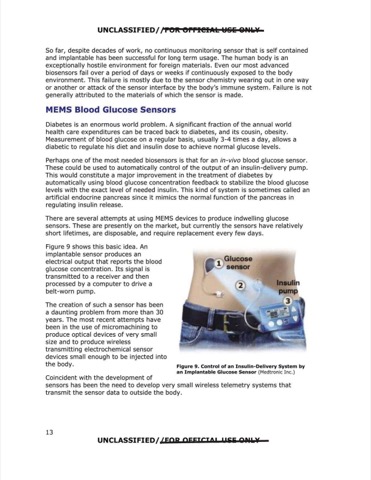
Figure 9 shows this basic idea. An
implantable sensor produces an
electrical output that reports the blood
glucose concentration. Its signal is
Glucose
1
sensor
transmitted to a receiver and then
processed by a computer to drive a
belt-worn pump.
Insulin
pump
The creation of such a sensor has been
a daunting problem from more than 30
years. The most recent attempts have
been in the use of micromachining to
produce optical devices of very small
size and to produce wireless
transmitting electrochemical sensor
devices small enough to be injected into
the body.
Figure 9. Control of an Insulin-Delivery System by
an Implantable Glucose Sensor (Medtronic Inc.)
Coincident with the development of
sensors has been the need to develop very small wireless telemetry systems that
transmit the sensor data to outside the body.
13
UNCLASSIFIED/ LEOR OFFICIAL LISE ONLY