DOW-UAP-D136

AAWSAP DIRD, Biosensors and BioMEMS: A Survey of the Present Field, March 2010, page 18

One page of a U.S. government record released under PURSUE, shown on its own with its text. The record page has the whole document, its catalog details and the scan.

Page
18 of 45
Agency
Department of War
Released
Release 06, September 18, 2026

Text of page 18

UNCLASSIFIED//TOR drift and offset in the reading and so shifting the calibration. Depending on its exact construction some versions however can be effective for as much as a few days. Figure 8 shows the latest in microdevice oxygen sensors. (This particular version is not specifically a MEMS device since it is not made by photolithography and it is neither electrical nor mechanical in nature.) It represents however the trend in oxygen sensors towards optical measurement techniques that are evolving towards optical systems based on MEMS. These sensors can be implemented in small sizes with optical fibers that transmit and receive light from the sensor surface at the tip. Variations on this basic principle are used for indwelling blood oxygen catheters during surgery. fiber optics silicone cover prism silicone carrier Figure 8. A Fiber Optical Oxygen Sensor Showing Two Optical Fibers Mated to Plastic Prisms That are Coated With an Oxygen-Sensor Coating, Usually a Fluorescent Ruthenium Compound (http://www.imtek.de/content/projekte_en.php?ls=11) The oxygen sensors respond to changes in absorption of oxygen into the special coating at the tip, or in some versions, they respond to fluorescence of a thin oxygen-sensitive coating placed on the prism surface. The secret to good performance lies in the proprietary selection of the specific chemical species selected for the coating. Blue light is usually transmitted down the optical fiber and the coating glows orange in proportion to the amount of oxygen present. The light from the glow is conducted back toward the supporting instrumentation system. The intensity of the orange light then indicates oxygen levels in the solution. The particular sensor shown in Figure 8 uses two optical fibers. The one on the left side is not sensitive to oxygen, but rather acts as a reference system that is used to compensate for changes temperature, ambient light, and other system variables. 12 UNCLASSIFIED / LEOR OFFICIAL USE ONLY

Machine-read (OCR) from the scan by this archive; it can contain errors. The scan is the record.
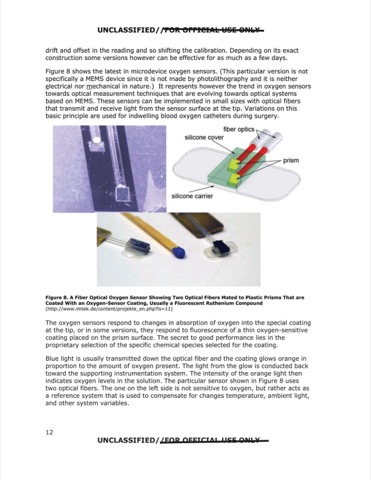
Image from page 18 of DOW-UAP-D136, as released by war.gov
Image from page 18 of the PDF. Open the scan to see the whole page.

Cite this page

U.S. Department of War. "AAWSAP DIRD, Biosensors and BioMEMS: A Survey of the Present Field, March 2010" (DOW-UAP-D136). PURSUE Release 06, U.S. Department of War, September 18, 2026. https://www.war.gov/medialink/ufo/sept-18/release-06/assets/DOW-UAP-D136_AAWSAP-DIRD-Biosensors-and-BioMEMS-A-Survey-of-the-Present-Field-March-31-2010.pdf. Declassified UAP, page 18, https://declassifieduap.org/r/dow-uap-d136-aawsap-dird-biosensors-and-biomems-a-survey-of-the-present-field-march-2010/p/18. Accessed November 28, 2026.

This address shows page 18 on its own; /r/dow-uap-d136-aawsap-dird-biosensors-and-biomems-a-survey-of-the-present-field-march-2010?page=18 opens the same page in the full reader. Both stay. How to cite.