DOW-UAP-D136

AAWSAP DIRD, Biosensors and BioMEMS: A Survey of the Present Field, March 2010, page 17

One page of a U.S. government record released under PURSUE, shown on its own with its text. The record page has the whole document, its catalog details and the scan.

Page
17 of 45
Agency
Department of War
Released
Release 06, September 18, 2026

Text of page 17

UNCLASSIFIED//TOR OI AL USE ONLY 1: reference 2: gate oxide 3: insulating resin 4: channel S: source D: drain B: bulk b) Vgs * solution Vgs. SITO • В var MOSFET • B Vdr ISFET Figure 7. An ISFET (Ion Sensitive Field Effect Transistor) Needle-Type pH Sensor for Monitoring Tissue Physiologic Status (http://www.ee.seikei.ac.jp/~seiichi/lecture/Biomedical/09/09-biosensor.html) The sensor element is an ion sensitive field effect transistor (ISFET). This device is micromachined from silicon by using standard semiconductor photolithography processes. The actual active sensor surface is near the tip of the device where there is a thin film of silicon nitride covering the gate region of the transistor. The gate is sensitive to very small changes in electric field, and these in turn cause relatively large changes (or gain) in the current flow through the transistor. At the center in Figure 7 is a standard transistor diagram showing the gate and its relation to the other contacts. On the right is shown the pH sensitive ISFET system that measures an electric field change across the nitride membrane. The membrane is placed directly in contact with the liquid to be measured. It is not known the exact process that occurs at the membrane that gives rise to electric field shifts on the gate. Presumably hydrogen ions reversibly adsorb onto the interface between the nitride membrane and the solution causing local electric field changes on the gate. This device is not meant for permanent implantation but rather short term applications in research or medical surgery where the sensor is used over just a few hours. Proteins and other biological molecules adhere to the gate region of the ISFET and cause a slow 11 UNCLASSIFIED/ LEOR OFFICIAL USE ONLY

Machine-read (OCR) from the scan by this archive; it can contain errors. The scan is the record.
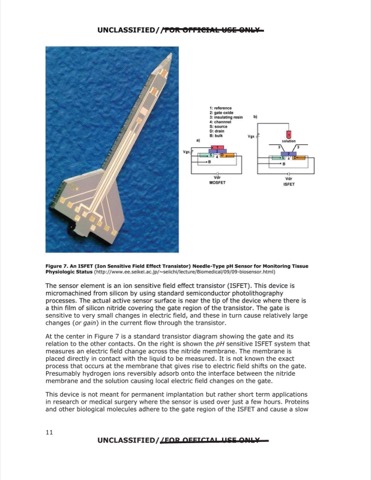
Image from page 17 of DOW-UAP-D136, as released by war.gov
Image from page 17 of the PDF. Open the scan to see the whole page.

Cite this page

U.S. Department of War. "AAWSAP DIRD, Biosensors and BioMEMS: A Survey of the Present Field, March 2010" (DOW-UAP-D136). PURSUE Release 06, U.S. Department of War, September 18, 2026. https://www.war.gov/medialink/ufo/sept-18/release-06/assets/DOW-UAP-D136_AAWSAP-DIRD-Biosensors-and-BioMEMS-A-Survey-of-the-Present-Field-March-31-2010.pdf. Declassified UAP, page 17, https://declassifieduap.org/r/dow-uap-d136-aawsap-dird-biosensors-and-biomems-a-survey-of-the-present-field-march-2010/p/17. Accessed November 28, 2026.

This address shows page 17 on its own; /r/dow-uap-d136-aawsap-dird-biosensors-and-biomems-a-survey-of-the-present-field-march-2010?page=17 opens the same page in the full reader. Both stay. How to cite.