DOW-UAP-D132

AAWSAP DIRD, Advanced Space Propulsion Based on Vacuum (Spacetime Metric) Engineering, March 2010, page 10

One page of a U.S. government record released under PURSUE, shown on its own with its text. The record page has the whole document, its catalog details and the scan.

Page
10 of 17
Agency
Department of War
Released
Release 06, September 18, 2026

Text of page 10

UNCLASSIFIED/ FOR OFFICIAL USE ONLY From a viewpoint exterior to the region, however, from the above one finds that the remotely observed coordinate ratio measurement yields a different value dr g00 c di V- 8u (7) Therever in ath exteria reference trame emitte frys a mass speaks rids sowing down" on a radial approach to the mass owing to the ratio 800/-81 < 1. Conversely, under (metric engineering) conditions for which 80/-8 > 1, the velocity of light-and exotic-technology craft velocities that obey similar formulas-would appear superluminal in the exterior frame. This gives our fifth entry for the table of physical effects. Refractive Index Modeling Given that velocity-of-light effects in a spacetime-altered region, as viewed from an external frame, are governed by Equation (7), it is seen that the effect of spacetime alteration on light propagation can be expressed in terms of an optical refractive index n, defined by n = -811 800 (8) where n is an effective refractive index of the (spacetime-altered) vacuum. This widely known result has resulted in the development of refractive index models for GR (References 14-17) that have found application in problems such as gravitational lensing (Reference 18). The estimated electric or magnetic field strengths required to generate a given refractive index change given by standard GR theory (the Levi-Civita Effect) can be found in (Reference 19). In engineering terms, the velocity of light c is given by the expression c = 1/ VM,60 , where M, and & are the magnetic permeability and dielectric permittivity of undistorted vacuum space (M, = 47×10- H/m and e, = 8.854×10⁻¹² F/m). The generation of an effective refractive index n = J- 811/800 # 1 by technological means can from an engineering viewpoint be interpreted as manipulation of the vacuum parameters M, and 8o. In GR theory, such variations in Mo, &, and hence the velocity of light, c, are often treated in terms of a "THey" formalism used in comparative studies of gravitational theories (Reference 20). As discussed below, a number of striking effects can be anticipated in certain engineered spacetime regions. 5 UNCLASSIFIED// FOR OFFICIAL USE ONLY

Machine-read (OCR) from the scan by this archive; it can contain errors. The scan is the record.
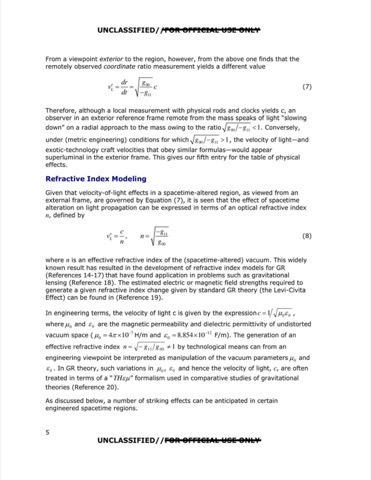
Image from page 10 of DOW-UAP-D132, as released by war.gov
Image from page 10 of the PDF. Open the scan to see the whole page.

Cite this page

U.S. Department of War. "AAWSAP DIRD, Advanced Space Propulsion Based on Vacuum (Spacetime Metric) Engineering, March 2010" (DOW-UAP-D132). PURSUE Release 06, U.S. Department of War, September 18, 2026. https://www.war.gov/medialink/ufo/sept-18/release-06/assets/DOW-UAP-D132_AAWSAP-DIRD-Advanced-Space-Propulsion-Based-on-Vacuum-Spacetime%20Metric-Engineering-March-29-2010.pdf. Declassified UAP, page 10, https://declassifieduap.org/r/dow-uap-d132-aawsap-dird-advanced-space-propulsion-based-on-vacuum-spacetime-metric-engineering-march-2010/p/10. Accessed November 28, 2026.

This address shows page 10 on its own; /r/dow-uap-d132-aawsap-dird-advanced-space-propulsion-based-on-vacuum-spacetime-metric-engineering-march-2010?page=10 opens the same page in the full reader. Both stay. How to cite.