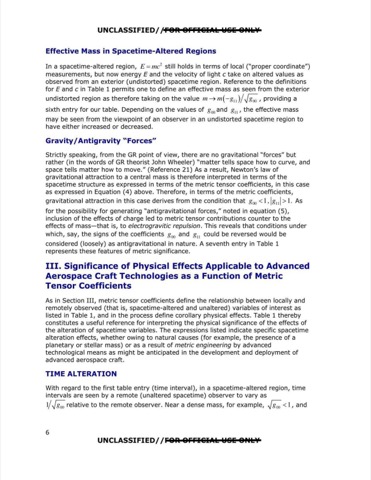
Text of page 11
UNCLASSIFIED//FOR eFFICI
AL USE ONLY
Effective Mass in Spacetime-Altered Regions
In a spacetime-altered region, E = mc* still holds in terms of local ("proper coordinate")
measurements, but now energy E and the velocity of light c take on altered values as
observed from an exterior (undistorted) spacetime region. Reference to the definitions
for E and c in Table 1 permits one to define an effective mass as seen from the exterior
undistorted region as therefore taking on the value m → m (-8)/ V80 , providing a
sixth entry for our table. Depending on the values of go and gi, the effective mass
may be seen from the viewpoint of an observer in an undistorted spacetime region to
have either increased or decreased.
Gravity / Antigravity "Forces"
Strictly speaking, from the GR point of view, there are no gravitational "forces" but
rather (in the words of GR theorist John Wheeler) "matter tells space how to curve, and
space tells matter how to move." (Reference 21) As a result, Newton's law of
gravitational attraction to a central mass is therefore interpreted in terms of the
spacetime structure as expressed in terms of the metric tensor coefficients, in this case
as expressed in Equation (4) above. Therefore, in terms of the metric coefficients,
gravitational attraction in this case derives from the condition that 800 < 1, g, > 1. As
for the possibility for generating "antigravitational forces," noted in equation (5),
inclusion of the effects of charge led to metric tensor contributions counter to the
effects of mass-that is, to electrogravitic repulsion. This reveals that conditions under
which, say, the signs of the coefficients go and gi could be reversed would be
considered (loosely) as antigravitational in nature. A seventh entry in Table 1
represents these features of metric significance.
III. Significance of Physical Effects Applicable to Advanced
Aerospace Craft Technologies as a Function of Metric
Tensor Coefficients
As in Section III, metric tensor coefficients define the relationship between locally and
remotely observed (that is, spacetime-altered and unaltered) variables of interest as
listed in Table 1, and in the process define corollary physical effects. Table 1 thereby
constitutes a useful reference for interpreting the physical significance of the effects of
the alteration of spacetime variables. The expressions listed indicate specific spacetime
alteration effects, whether owing to natural causes (for example, the presence of a
planetary or stellar mass) or as a result of metric engineering by advanced
technological means as might be anticipated in the development and deployment of
advanced aerospace craft.
TIME ALTERATION
With regard to the first table entry (time interval), in a spacetime-altered region, time
intervals are seen by a remote (unaltered spacetime) observer to vary as
1/ V80 relative to the remote observer. Near a dense mass, for example, 80 < 1, and
6
UNCLASSIFIED// FOR OFFICIAL USE ONLY