DOW-UAP-D132

AAWSAP DIRD, Advanced Space Propulsion Based on Vacuum (Spacetime Metric) Engineering, March 2010, page 9

One page of a U.S. government record released under PURSUE, shown on its own with its text. The record page has the whole document, its catalog details and the scan.

Page
9 of 17
Agency
Department of War
Released
Release 06, September 18, 2026

Text of page 9

UNCLASSIFIED//FOR eFFrEIAL USE ONLY Table 1. Metric Effects on Physical Processes in an Altered Spacetime as Interpreted by a Remote (Unaltered Spacetime) Observer Variable Typical Stellar Mass (80 <1, 8m >1) Time Interval At → At/ V800 Frequency ∞ → 0/800 Energy E → E/$00 Spatial Ar → Ar/V-81 Velocity V, =C → C/800/-81 Mass m= E/c* → (-81/ 1 8 00 Gravitational "force" f (800 > 811) Processes (for example, clocks) run slower Redshift toward lower frequencies Energy states lowered Objects (for example, rulers) shrink Effective V, < C Effective mass increases Spacetime-Engineered Metric (800 > 1, |8|<1) Processes (for example, clocks) run faster Blueshift toward higher frequencies Energy states raised Objects (for example, rulers) expand Effective v, > C Effective mass decreases "Gravitational" "Antigravitational" Spatial Interval Again, by considering the case typical for an altered spacetime metric in the vicinity of, say, a stellar mass, then V-8 > 1 for the radial dimension x' = r, as expressed by the second term in Equation (4). Therefore, local measurements with physical rulers within the altered spacetime yield a spatial interval -8, dr > dr; thus a spatial interval di between two locations in an undistorted spacetime-say, remote from the mass-would be judged by local (proper) measurement from within the altered spacetime to be greater. From this one can rightly infer that, relatively speaking, rulers (atomic spacings and so forth) within the altered spacetime are shrunken relative to their values in unaltered spacetime. Given this result, a physical object (for example, atomic orbit) that possesses a measure Ar in unaltered spacetime shrinks to Ar → Ar/V-81 when placed within the altered spacetime. Conversely, under conditions for which V-8, <1, objects would expand-thus the fourth entry for the table of physical effects. Velocity of Light in Spacetime-Altered Regions Interior to a spacetime region altered by, say, a dense mass (for example, a black hole), the locally measured velocity of light c in, say, the x' =r direction is given by the ratio of locally measured (proper) distance/time intervals for a propagating light signal (Reference 13). V, = 8,, dr = C V800 di (6) 4 UNCLASSIFIED//FOR OFFICIAL USE ONLY

Machine-read (OCR) from the scan by this archive; it can contain errors. The scan is the record.
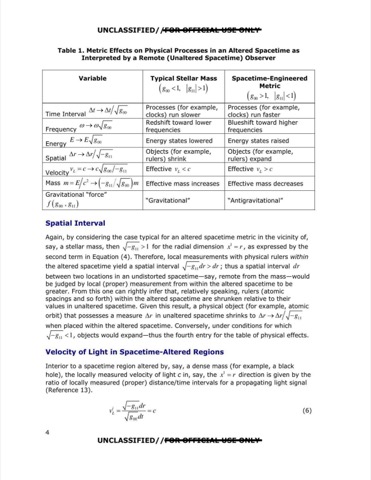
Image from page 9 of DOW-UAP-D132, as released by war.gov
Image from page 9 of the PDF. Open the scan to see the whole page.

Cite this page

U.S. Department of War. "AAWSAP DIRD, Advanced Space Propulsion Based on Vacuum (Spacetime Metric) Engineering, March 2010" (DOW-UAP-D132). PURSUE Release 06, U.S. Department of War, September 18, 2026. https://www.war.gov/medialink/ufo/sept-18/release-06/assets/DOW-UAP-D132_AAWSAP-DIRD-Advanced-Space-Propulsion-Based-on-Vacuum-Spacetime%20Metric-Engineering-March-29-2010.pdf. Declassified UAP, page 9, https://declassifieduap.org/r/dow-uap-d132-aawsap-dird-advanced-space-propulsion-based-on-vacuum-spacetime-metric-engineering-march-2010/p/9. Accessed November 28, 2026.

This address shows page 9 on its own; /r/dow-uap-d132-aawsap-dird-advanced-space-propulsion-based-on-vacuum-spacetime-metric-engineering-march-2010?page=9 opens the same page in the full reader. Both stay. How to cite.