DOW-UAP-D127

AAWSAP DIRD, An Introduction to the Statistical Drake Equation, March 2010, page 6

One page of a U.S. government record released under PURSUE, shown on its own with its text. The record page has the whole document, its catalog details and the scan.

Page
6 of 55
Agency
Department of War
Released
Release 06, September 18, 2026

Text of page 6

UNCLASSIFIED/ /FeR OFFICIAL USE ONLY 36 Rialam h ET_Distance(N) = 3/N where the positive constant C is defined by C= 36 Rialaxy hGalaxy & 28845 light years. Equations (5) and (6) are the starting point to understand the origin of the Drake equation that we discuss in detail in Section 3 of this paper. Let us just complete this section by pointing out three different numerical cases of the distance law (5): • We know that we exist, so N may not be smaller than 1, i.e., N≥1. Suppose then that we are alone in the galaxy, i.e., that N=1. Then the distance law (5) yields as distance to the nearest civilization from us just the constant C, i.e., 28,845 light years. This is about the distance in between ourselves and the center of the galaxy (i.e. the Galactic Bulge). Thus, this result seems to suggest that, if we do not find any extraterrestrial civilization around us in these outskirts of the galaxy where we live, we should look around the Galactic Center first. And this is indeed what is happening, i.e., many SETI searches are actually pointing the antennas towards the Galactic Center, looking for beacons (see, for instance ref. [1]). • Suppose next that N=1000, i.e. there are about a thousand extraterrestrial communicating civilizations in the whole galaxy right now. Then the distance law (5) yields an average distance of 2,885 light years. This is a distance that most radiotelescopes in Earth may not reach for SETI searches right now: hence the need to build larger radiotelescopes, like ALMA, LOFAR and the SKA. • Suppose finally that N=1000000, i.e., there are a million communicating civilizations now in the galaxy. Then the distance law (5) yields an average distance of 288 light years. This is within the (upper) range of distances that our current radiotelescopes may reach for SETI searches, and that justifies all SETI searches that have been done so far in the first fifty years of SETI (1960-2010). In conclusion, interpolating the above three special cases of N, we may say that the distance law (5) yields the following key diagram of the average ET distance vs. the assumed number of communicating civilizations, N, in the galaxy right now (Figure 1): (5) (6) 6 UNCLASSIFIED/ FOR OFFICIAL USE ONLY

Machine-read (OCR) from the scan by this archive; it can contain errors. The scan is the record.
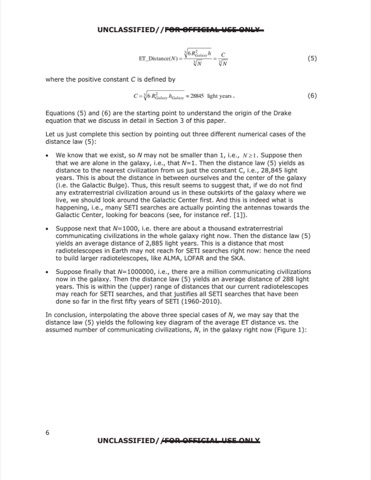
Image from page 6 of DOW-UAP-D127, as released by war.gov
Image from page 6 of the PDF. Open the scan to see the whole page.

Cite this page

U.S. Department of War. "AAWSAP DIRD, An Introduction to the Statistical Drake Equation, March 2010" (DOW-UAP-D127). PURSUE Release 06, U.S. Department of War, September 18, 2026. https://www.war.gov/medialink/ufo/sept-18/release-06/assets/DOW-UAP-D127_AAWSAP-DIRD-An-Introduction-to-the-Statistical-Drake-Equation-March-11-2010.pdf. Declassified UAP, page 6, https://declassifieduap.org/r/dow-uap-d127-aawsap-dird-an-introduction-to-the-statistical-drake-equation-march-2010/p/6. Accessed November 28, 2026.

This address shows page 6 on its own; /r/dow-uap-d127-aawsap-dird-an-introduction-to-the-statistical-drake-equation-march-2010?page=6 opens the same page in the full reader. Both stay. How to cite.