DOW-UAP-D127

AAWSAP DIRD, An Introduction to the Statistical Drake Equation, March 2010, page 5

One page of a U.S. government record released under PURSUE, shown on its own with its text. The record page has the whole document, its catalog details and the scan.

Page
5 of 55
Agency
Department of War
Released
Release 06, September 18, 2026

Text of page 5

UNCLASSIFIED/ /FeR OFFICIAL USE ONLY The thickness of the Galactic Disk at half-way from its center, hGalaxy, is about 16,000 ly. The volume of the galaxy may then be approximated as the volume of the corresponding cylinder, i.e. (1) Now consider the sphere around us having a radius r. The volume of such a sphere is Vour_Sphere = = * (ET Distance )" In the last equation, we had to divide the distance "ET_Distance" between ourselves and the nearest ET civilization by 2 because we are now going to make the unwarranted assumption that all ET civilizations are equally spaced from each other in the galaxy! This is a crazy assumption, clearly, and should be replaced by more scientifically-grounded assumptions as soon as we know more about our Galactic Neighborhood. At the moment, however, this is the best guess that we can make, and so we shall take it for granted, although we are aware that this is a weak point in the reasoning. Furthermore, let us denote by N the total number of civilizations now living in the galaxy, including ourselves. Of course, this number N is unknown. We only know that N ≥1 since one civilization does at least exist! Having thus assumed that ET civilizations are UNIFORMLY SPACED IN THE GALAXY, we can then write down the proportion: V Galaxy = Your _Sphere . That is, upon replacing both (1) and (2) into (3): i Realash N - IT ET Distance * 1 The last equation contains two unknowns: N and ET_Distance, and so we don't know which one it is better to solve for. However, we may suppose that, by resorting to the (rather uncertain) knowledge that we have about the Evolution of the galaxy through the last 10 billion years or so, we might somehow compute an approximate value for N. Then, we may solve (4) for ET_Distance thus obtaining the (AVERAGE) DISTANCE BETWEEN ANY PAIR OF NEIGHBORING CIVILIZATIONS IN THE GALAXY (DISTANCE LAW) (2) (3) (4) 5 UNCLASSIFIED/ FOR OFFICIAL USE ONLY

Machine-read (OCR) from the scan by this archive; it can contain errors. The scan is the record.
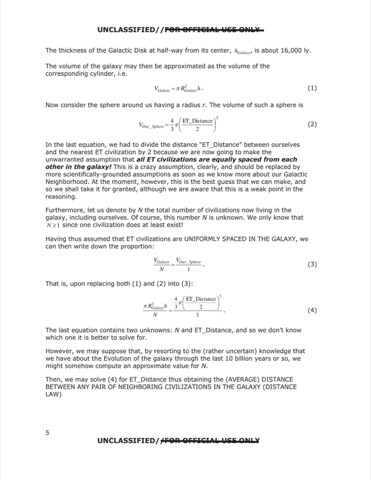
Image from page 5 of DOW-UAP-D127, as released by war.gov
Image from page 5 of the PDF. Open the scan to see the whole page.

Cite this page

U.S. Department of War. "AAWSAP DIRD, An Introduction to the Statistical Drake Equation, March 2010" (DOW-UAP-D127). PURSUE Release 06, U.S. Department of War, September 18, 2026. https://www.war.gov/medialink/ufo/sept-18/release-06/assets/DOW-UAP-D127_AAWSAP-DIRD-An-Introduction-to-the-Statistical-Drake-Equation-March-11-2010.pdf. Declassified UAP, page 5, https://declassifieduap.org/r/dow-uap-d127-aawsap-dird-an-introduction-to-the-statistical-drake-equation-march-2010/p/5. Accessed November 28, 2026.

This address shows page 5 on its own; /r/dow-uap-d127-aawsap-dird-an-introduction-to-the-statistical-drake-equation-march-2010?page=5 opens the same page in the full reader. Both stay. How to cite.