DOW-UAP-D127

AAWSAP DIRD, An Introduction to the Statistical Drake Equation, March 2010, page 7

One page of a U.S. government record released under PURSUE, shown on its own with its text. The record page has the whole document, its catalog details and the scan.

Page
7 of 55
Agency
Department of War
Released
Release 06, September 18, 2026

Text of page 7

UNCLASSIFIED/ /FeR OFFICIAL USE ONLY Average DISTANCE of the civilization nearest to us in LIGHT YEARS Average DISTANCE of the nearest ET civilization vs. the ASSUMED NUMBER of ET civilizations in the Gala 2000- 1750 1500- 1250- 1000- 750- 500 250- 100000 200000 300000 400000 500000 600000 700000 800000 900000 1000000 ASSUMED NUMBER of civilizations in the Galaxy (that is, N in the Drake equation) Figure 1. DISTANCE LAW; i.e., the Average Distance (plot along the vertical axis in light years) Versus the NUMBER of Communicating Civilizations ASSUMED to Exist in the Galaxy Right Now 3. Computing N By Virtue of the Drake Equation (1961) In the previous section, the problem of finding how close the nearest ET civilization may be was "solved" by reducing it to the computation of N, the total number of extraterrestrial civilizations now existing in this galaxy. In this section the famous Drake equation is described, that was proposed back in 1961 by Frank Donald Drake (born 1930) to estimate the numerical value of N. We believe that no better introductory description of the Drake equations exists other than the one given by Carl Sagan in his 1983 book "Cosmos" (ref. [2]), in its turn based on the famous TV series "Cosmos." So, in this paragraph we report Carl Sagan's description of the Drake equation unabridged. "But is there anyone out there to talk to? With a third or a half a trillion stars in our Milky Way galaxy alone, could ours be the only one accompanied by an inhabited planet? How much more likely it is that technical civilizations are a cosmic commonplace, that the galaxy is pulsing and humming with advanced societies, and, therefore, that the nearest such culture is not so very far away - perhaps transmitting from antennas established on a planet of a naked-eye star just next door. Perhaps when we look up at the sky at night, near one of those faint pinpoints of light is a world on which someone quite different from us is then glancing idly at a star we call the Sun and entertaining, for just a moment, an outrageous speculation. 7 UNCLASSIFIED FOR OFFICIAL USE ONLY

Machine-read (OCR) from the scan by this archive; it can contain errors. The scan is the record.
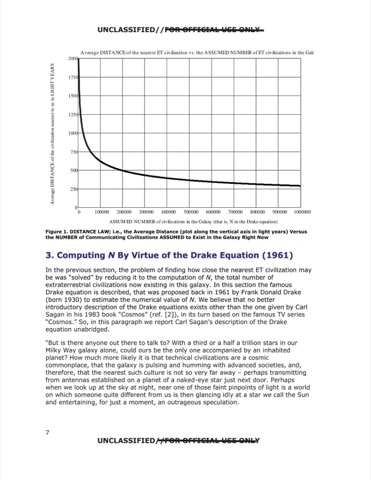
Image from page 7 of DOW-UAP-D127, as released by war.gov
Image from page 7 of the PDF. Open the scan to see the whole page.

Cite this page

U.S. Department of War. "AAWSAP DIRD, An Introduction to the Statistical Drake Equation, March 2010" (DOW-UAP-D127). PURSUE Release 06, U.S. Department of War, September 18, 2026. https://www.war.gov/medialink/ufo/sept-18/release-06/assets/DOW-UAP-D127_AAWSAP-DIRD-An-Introduction-to-the-Statistical-Drake-Equation-March-11-2010.pdf. Declassified UAP, page 7, https://declassifieduap.org/r/dow-uap-d127-aawsap-dird-an-introduction-to-the-statistical-drake-equation-march-2010/p/7. Accessed November 28, 2026.

This address shows page 7 on its own; /r/dow-uap-d127-aawsap-dird-an-introduction-to-the-statistical-drake-equation-march-2010?page=7 opens the same page in the full reader. Both stay. How to cite.