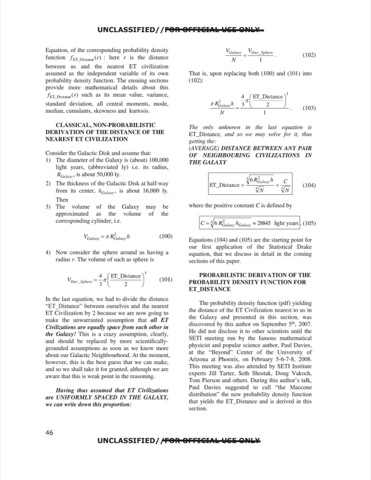
Text of page 46
UNCLASSIFIED/ /FeR OFFICIAL USE ONLY
Equation, of the corresponding probability density
function fET Distane (r) : here r is the distance
between us
and the nearest ET civilization
assumed as the independent variable of its own
probability density function. The ensuing sections
provide more mathematical details about this
fET_ Distance (r) such as its mean value, variance,
standard deviation, all central moments, mode,
median, cumulants, skewness and kurtosis.
CLASSICAL, NON-PROBABILISTIC
DERIVATION OF THE DISTANCE OF THE
NEAREST ET CIVILIZATION
Consider the Galactic Disk and assume that:
1) The diameter of the Galaxy is (about) 100,000
light years, (abbreviated ly) i.e. its radius,
RGalary, is about 50,000 ly.
2) The thickness of the Galactic Disk at half-way
from its center, Galaxy, is about 16,000 ly.
Then
3)
The volume
of the Galaxy may be
approximated
as
the volume of the
corresponding cylinder, i.e.
Galaxy = r Rialsyh
(100)
4) Now consider the sphere around us having a
radius r. The volume of such as sphere is
4
Your _Sphere =
3
ET_Distance
2
(101)
In the last equation, we had to divide the distance
"ET Distance" between ourselves and the nearest
ET Civilization by 2 because we are now going to
make the unwarranted assumption that all ET
Civilizations are equally space from each other in
the Galaxy! This is a crazy assumption, clearly,
and should be replaced by more scientifically-
grounded assumptions as soon as we know more
about our Galactic Neighbourhood. At the moment,
however, this is the best guess that we can make,
and so we shall take it for granted, although we are
aware that this is weak point in the reasoning.
Having thus assumed that ET Civilizations
are UNIFORMLY SPACED IN THE GALAXY,
we can write down this proportion:
V Galaxy =
VOur_ Sphere
N
1
(102)
That is, upon replacing both (100) and (101) into
(102):
r Realanh
N
4
3
ET_Distance
2
(103)
The only unknown in the last equation is
ET_Distance, and so we may solve for it, thus
getting the:
(AVERAGE) DISTANCE BETWEEN ANY PAIR
OF NEIGHBOURING CIVILIZATIONS IN
THE GALAXY
36 Realaryh
C
ET_Distance =
=
VN
(104)
where the positive constant C is defined by
C=36 Rialay hGalaxy & 28845 light years . (105)
Equations (104) and (105) are the starting point for
our first application of the Statistical Drake
equation, that we discuss in detail in the coming
sections of this paper.
PROBABILISTIC DERIVATION OF THE
PROBABILITY DENSITY FUNCTION FOR
ET_DISTANCE
The probability density function (pdf) yielding
the distance of the ET Civilization nearest to us in
the Galaxy and presented in this section, was
discovered by this author on September 5th, 2007.
He did not disclose it to other scientists until the
SETI meeting run by the famous mathematical
physicist and popular science author, Paul Davies,
at the "Beyond" Center of the University of
Arizona at Phoenix, on February 5-6-7-8, 2008.
This meeting was also attended by SETI Institute
experts Jill Tarter, Seth Shostak, Doug Vakoch,
Tom Pierson and others. During this author's talk,
Paul Davies suggested to call "the Maccone
distribution" the new probability density function
that yields the ET_Distance and is derived in this
section.
46
UNCLASSIFIED/ /FOR OFFICI
L USE ONLY