DOW-UAP-D127

AAWSAP DIRD, An Introduction to the Statistical Drake Equation, March 2010, page 45

One page of a U.S. government record released under PURSUE, shown on its own with its text. The record page has the whole document, its catalog details and the scan.

Page
45 of 55
Agency
Department of War
Released
Release 06, September 18, 2026

Text of page 45

UNCLASSIFIED/ /FeR eFFICIAL USE ONLY PROBABILITY DENSITY FUNCTION OF N 6•104 75.10% function 4•104 3•104 isity $ 2•104 0 1000 2000 3000 N = Number of ET Civilizations in Galaxy 4000 Figure 4. Comparing the two probability density functions of the random variable N found: At the end of Section 3.3. in a purely numeric way and without resorting to the CLT at all (thick curve) and Analytically by using the CLT and the relevant lognormal approximation (thin curve). PROBABILITY DENSITY FUNCTION OF Y=In(N) 0.5 Probability density function of 0.4 0.3 0.2 0.1| 0 1 2 3 4 5 7 8 9 10 11 12 Independent variable Y = In(N) Figure 5. Comparing the two probability density functions of the random variable Y=In(N) found: 1) At the end of Section 3.3. in a purely numeric way and without resorting to the CLT at all (thick curve) and 2) Analytically by using the CLT and the relevant normal (Gaussian) approximation (thin Gaussian curve). 8. DISTANCE OF THE NEAREST EXTRATERRESTRIAL CIVILIZATION AS A PROBABILITY DISTRIBUTION As an application of the Statistical Drake Equation developed in the previous sections of this paper, we now want to consider the problem of estimating the distance of the ExtraTerrestrial Civilization nearest to us in the Galaxy. In all Astrobiology textbooks (see, for instance, ref. [10]) and in several web sites, the solution to this problem is reported with only slight differences in the mathematical proofs among the various authors. In the first of the coming two sections (section 7.1) we derive the expression for this "ET_ Distance" (as we like to denote it) in the classical, non- probabilistic way: in other words, this is the classical, deterministic derivation. In the second section (7.2) we provide the probabilistic derivation, arising from our Statistical Drake 45 UNCLASSIFIED H/FOR OFFICIAL USE ONLY

Machine-read (OCR) from the scan by this archive; it can contain errors. The scan is the record.
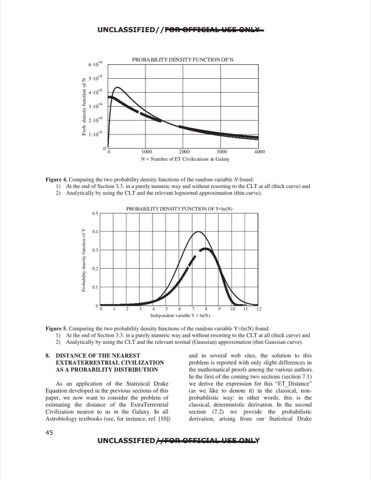
Image from page 45 of DOW-UAP-D127, as released by war.gov
Image from page 45 of the PDF. Open the scan to see the whole page.

Cite this page

U.S. Department of War. "AAWSAP DIRD, An Introduction to the Statistical Drake Equation, March 2010" (DOW-UAP-D127). PURSUE Release 06, U.S. Department of War, September 18, 2026. https://www.war.gov/medialink/ufo/sept-18/release-06/assets/DOW-UAP-D127_AAWSAP-DIRD-An-Introduction-to-the-Statistical-Drake-Equation-March-11-2010.pdf. Declassified UAP, page 45, https://declassifieduap.org/r/dow-uap-d127-aawsap-dird-an-introduction-to-the-statistical-drake-equation-march-2010/p/45. Accessed November 28, 2026.

This address shows page 45 on its own; /r/dow-uap-d127-aawsap-dird-an-introduction-to-the-statistical-drake-equation-march-2010?page=45 opens the same page in the full reader. Both stay. How to cite.