DOW-UAP-D127

AAWSAP DIRD, An Introduction to the Statistical Drake Equation, March 2010, page 47

One page of a U.S. government record released under PURSUE, shown on its own with its text. The record page has the whole document, its catalog details and the scan.

Page
47 of 55
Agency
Department of War
Released
Release 06, September 18, 2026

Text of page 47

UNCLASSIFIED/ /FeR eFFICI AL UCE ONLY Let us go back to equation (104). Since N is now a random variable (obeying the lognormal distribution), it follows that the ET_Distance must be a random variable as well. Hence it must have some unknown probability density function that we denote by fET Distance (r) (106) where r is the new independent variable of such a probability distribution (it is denoted by r to remind the reader that it expresses the three- dimensional radial distance separating us from the nearest ET civilization in a full spherical symmetry of the space around us). The question then is: what is the unknown probability distribution (106) of the ET _Distance? We can answer this question upon making the two formal substitutions N → x ET_distance → y (107) into the transformation law (8) for random variables. As a consequence, (104) takes form y = g(x) = C- x (108) In order to find the unknown probability density fET Distane (r), we now to apply the rule (9) to (108). First, notice that (108), when inverted to yield the various roots x,(y), yields a single real root only x, (x) = - C (109) Then, the summation in (9) reduces to one term only. Second, differentiating (108) one finds 8 (x) = C (110) Thus, the relevant absolute value reads 47 18 (x) = • x 3 C 3 (111) Upon replacing (111) into (9), we then find 8 (x;) C •x 3 C + 17 3 C*• ...(112) This is the denominator of (9). The numerator simply is the lognormal probability density function (56) where the old independent variable x must now be re-written in terms of the new independent variable y by virtue of (109). By doing so, we finally arrive at the new probability density function fr (y) fr (1) = 3C3 - C3 1 • e V2 O 20* Rearranging and replacing y by r, the final form is: JET dissane (+) = 3 - 20 -• e (113) Now, just replace C in (113) by virtue of (105). Then: Mechan We have discovered the probability density function yielding the probability of finding the nearest ExtraTerrestrial Civilization in the Galaxy in the spherical shell between the distances r and r+dr from Earth: In 6 Roulan Maday 2đ fET Distance (r) = 3 1 • e r V2n0 (114) holding for r ≥0. STATISTICAL PROPERTIES OF THIS DISTRIBUTION UNCLASSIFIED/ FOR OFFICIAL USE ONLY

Machine-read (OCR) from the scan by this archive; it can contain errors. The scan is the record.
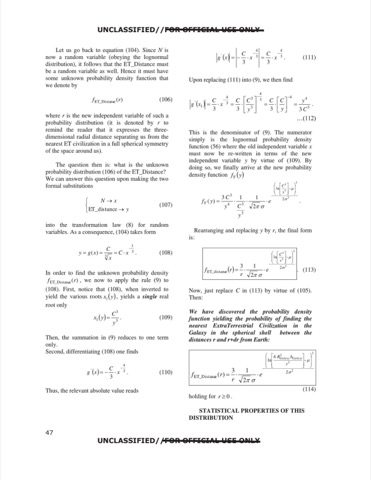
Image from page 47 of DOW-UAP-D127, as released by war.gov
Image from page 47 of the PDF. Open the scan to see the whole page.

Cite this page

U.S. Department of War. "AAWSAP DIRD, An Introduction to the Statistical Drake Equation, March 2010" (DOW-UAP-D127). PURSUE Release 06, U.S. Department of War, September 18, 2026. https://www.war.gov/medialink/ufo/sept-18/release-06/assets/DOW-UAP-D127_AAWSAP-DIRD-An-Introduction-to-the-Statistical-Drake-Equation-March-11-2010.pdf. Declassified UAP, page 47, https://declassifieduap.org/r/dow-uap-d127-aawsap-dird-an-introduction-to-the-statistical-drake-equation-march-2010/p/47. Accessed November 28, 2026.

This address shows page 47 on its own; /r/dow-uap-d127-aawsap-dird-an-introduction-to-the-statistical-drake-equation-march-2010?page=47 opens the same page in the full reader. Both stay. How to cite.