DOW-UAP-D126

AAWSAP DIRD, Advanced Nuclear Propulsion for Manned Deep Space Missions, March 2010, page 15

One page of a U.S. government record released under PURSUE, shown on its own with its text. The record page has the whole document, its catalog details and the scan.

Page
15 of 37
Agency
Department of War
Released
Release 06, September 18, 2026

Text of page 15

UNCLASSIFIED / FOR OFFICIAL USE ONLY If the charged fusion products are entrapped within the deuterium cylinder, and if the condition pz > 10g/cm is satisfied, and finally, if the beam energy is large enough that a length z > (10/p) cm of the cylinder is heated to a temperature of 10º K, a thermonuclear detonation wave can propagate down the cylinder. This then leads to large fusion gains. The stopping length of single GeV protons in dense deuterium is much too large to fulfill inequality (Reference 16). But this is different for an intense beam of protons, where the stopping length is determined by the electrostatic proton-deuteron two-stream instability (Reference 14). In the presence of a strong azimuthal magnetic field, the beam dissipation is enhanced by the formation of a collisionless shock (Reference 15) with the thickness of the shock by order of magnitude equal to the Larmor radius of the deuterium ions at a temperature of 109 K, which for a magnetic field on the order of 107 G is on the order of 10-2 cm. For the two-stream instability alone, the stopping length is given by 1.4c 2= - (17) where c is the velocity of light, wi the proton ion plasma frequency, and & = n, n, with n the deuterium target number density and nb = 2x10'6 cm-3, the proton number density in the beam. For a hundredfold compressed deuterium rod, one has n = 5x10²* cm-3, with co, =2x10'% s*1. One finds that & = 4x10-' and 2 = 1.2x10⁻³ cm. This short length, together with the formation of the collisionless magneto-hydrodynamic shock, ensures the dissipation of the beam energy into a small volume at the end of the deuterium rod. For a deuterium number density n= 5x10²* cm-3, one has p = 17g/cm3, and to have pz > 10 g/cm? requires that z ≥ 0.6 cm. With 2 < z, the condition for the ignition of a thermonuclear detonation wave is satisfied. The ignition energy is given by Eign ~ 3nkTr z (18) where T ~ 109 K. For hundredfold compressed deuterium, one has tr? = 10- cm?, where initially it was tr? =10-' cm2. With 7a? = 10-3 cm and z = 0.6 cm, one finds that Eign ≤ 10' erg or ≤ energy is 10 times less. In hitting the target, a fraction of the proton beam energy is dissipated into X-rays by entering and bombarding the high Z material cone, focusing the proton beam onto the deuterium cylinder. The X-rays released fill the hohlraum surrounding the deuterium 9 UNCLASSIFIED//FOR OFFICIAL USE ONLY

Machine-read (OCR) from the scan by this archive; it can contain errors. The scan is the record.
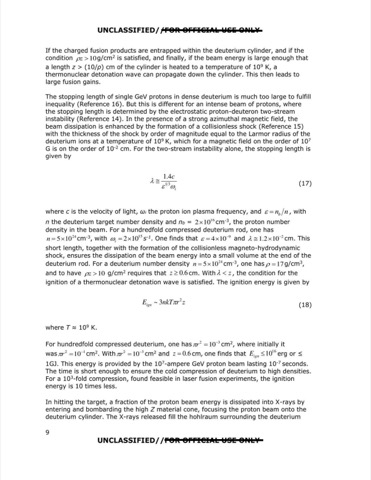
Image from page 15 of DOW-UAP-D126, as released by war.gov
Image from page 15 of the PDF. Open the scan to see the whole page.

Cite this page

U.S. Department of War. "AAWSAP DIRD, Advanced Nuclear Propulsion for Manned Deep Space Missions, March 2010" (DOW-UAP-D126). PURSUE Release 06, U.S. Department of War, September 18, 2026. https://www.war.gov/medialink/ufo/sept-18/release-06/assets/DOW-UAP-D126_AAWSAP-DIRD-Advanced-Nuclear-Propulsion-for-Manned-Deep-Space-Missions-March-11-2010.pdf. Declassified UAP, page 15, https://declassifieduap.org/r/dow-uap-d126-aawsap-dird-advanced-nuclear-propulsion-for-manned-deep-space-missions-march-2010/p/15. Accessed November 28, 2026.

This address shows page 15 on its own; /r/dow-uap-d126-aawsap-dird-advanced-nuclear-propulsion-for-manned-deep-space-missions-march-2010?page=15 opens the same page in the full reader. Both stay. How to cite.