DOW-UAP-D126

AAWSAP DIRD, Advanced Nuclear Propulsion for Manned Deep Space Missions, March 2010, page 14

One page of a U.S. government record released under PURSUE, shown on its own with its text. The record page has the whole document, its catalog details and the scan.

Page
14 of 37
Agency
Department of War
Released
Release 06, September 18, 2026

Text of page 14

UNCLASSIFIED/ /FOR OFFICIAL USE ONLY I > Ic (15) where Ic = 5a. In Table 2, the values for a and Ic for all the charged fusion products of the DD reaction are compiled. For all of them, the critical current is below 1c = 3.84 × 10⁶ A. Therefore, with the choice I ~ 10' A, all the charged fusion products are entrapped inside the deuterium cylinder. Reaction DT DD DD DD DHể® DHể Table 2. Critical Ignition Currents for Thermonuclear Reactions Fusion Product Het Hẻ' T H H He* Energy [MeV] 3.6 0.8 1.0 3.0 14.65 3.66 a [G cm] 2.7 × 10⁵ 1.12× 10⁵ 2.5 × 10' 2.5 × 10° 5.56 × 10⁵ 2.78× 10' Ic [A] 1.35 × 10% 5.6× 10' 1.25 × 10⁶ 1.25 × 10% 3.84 × 10% 1.39 × 10% For the argon ion laser configuration proposed for the launch into Earth orbit, where a small amount of DT serves as a trigger for the ignition of a larger amount of deuterium, the ignition of a magnetic field supported detonation wave in deuterium is possible there with an auxiliary high-explosive-driven megampere current generator, setting up an axial magnetic field, by an azimuthal current around the rod. The charged fusion products there are spiraling down the rod. The current needed to entrap the charged fusion products are there on the same order of magnitude; that is, ~ 107 A. For the deuterium-tritium thermonuclear reaction, the condition for a propagating burn in a sphere of radius r and density p, heated to a temperature of 108 K, is given by pr ≥1 g/cm?. This requires energy of about 1 megajoule (M]). For the deuterium reaction, this condition is pr ≥ 10 g/cm?, with an ignition temperature about 10 times larger. That a thermonuclear detonation in deuterium is possible at all is due to the secondary combustion of the T and He3 DD fusion reaction products (Reference 8). The energy required would be about 104 times larger, or about 104 MJ-for all practical purposes out of reach for nonfission ignition. However, if the ignition and burn are along a deuterium cylinder, where the charged fusion products are entrapped by a magnetic field within the cylinder, the condition pr ≥ 10 g/cm? is replaced by pz ≥ 10 g/cm? (16) where z is the length of the cylinder. 8 UNCLASSIFIED//FOR OFFICIAL USE ONLY

Machine-read (OCR) from the scan by this archive; it can contain errors. The scan is the record.
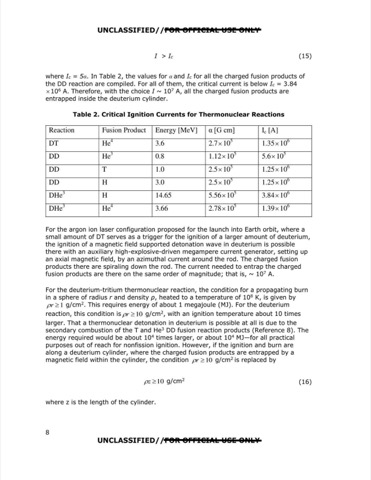
Image from page 14 of DOW-UAP-D126, as released by war.gov
Image from page 14 of the PDF. Open the scan to see the whole page.

Cite this page

U.S. Department of War. "AAWSAP DIRD, Advanced Nuclear Propulsion for Manned Deep Space Missions, March 2010" (DOW-UAP-D126). PURSUE Release 06, U.S. Department of War, September 18, 2026. https://www.war.gov/medialink/ufo/sept-18/release-06/assets/DOW-UAP-D126_AAWSAP-DIRD-Advanced-Nuclear-Propulsion-for-Manned-Deep-Space-Missions-March-11-2010.pdf. Declassified UAP, page 14, https://declassifieduap.org/r/dow-uap-d126-aawsap-dird-advanced-nuclear-propulsion-for-manned-deep-space-missions-march-2010/p/14. Accessed November 28, 2026.

This address shows page 14 on its own; /r/dow-uap-d126-aawsap-dird-advanced-nuclear-propulsion-for-manned-deep-space-missions-march-2010?page=14 opens the same page in the full reader. Both stay. How to cite.