DOW-UAP-D126

AAWSAP DIRD, Advanced Nuclear Propulsion for Manned Deep Space Missions, March 2010, page 16

One page of a U.S. government record released under PURSUE, shown on its own with its text. The record page has the whole document, its catalog details and the scan.

Page
16 of 37
Agency
Department of War
Released
Release 06, September 18, 2026

Text of page 16

UNCLASSIFIED//FOR eFFreI AL USE ONLY cylinder, compressing it to high densities, while the bulk of the proton beam energy heats and ignites the deuterium cylinder at its end, launching in it a detonation wave. If the GeV -107-ampere proton beam passes through background hydrogen plasma with a particle number density n, it induces in the plasma a return current carried by its electrons, where the electrons move in the same direction as the protons. But because the current of the proton beam and the return current of the plasma electrons are in opposite directions, they repel each other. Since the stagnation pressure of the GeV - 107-ampere proton beam is much larger than that of the electron return current, the return current electrons will be repelled from the proton beam toward the surface of the proton beam. The stagnation pressure of a GeV proton beam is (Me proton mass) P, = p,c* = n,M,c* (19) For n, = 2x10"cm-3, one obtains p, = 3x10'* dyn/cm3. For the electron return current, one has m electron mass) P, = n,mv- (20) With the return current condition n.ev, = n,ev,, where for GeV protons v, c, one has (21) Taking the value n, = 5x103 cm-3, valid for uncompressed solid deuterium, one obtains v, = 10* cm/s and hence p. = 5x10* dyn/cm?. This is negligible against pi, even if ne is 103 times larger, as in highly compressed deuterium. The assumption that the magnetic field of the proton beam is sufficiently strong to entrap the charged fusion products within the deuterium cylinder is therefore well justified. Solution in Between Two Extremes With chemical propulsion, manned space flight to the Moon is barely possible and only with massive multistage rockets. For manned space flight beyond the Moon, nuclear propulsion is indispensible. Nuclear thermal propulsion is really not much better than advanced chemical propulsion. Ion propulsion, using a nuclear reactor to drive an electric generator, has a much higher specific impulse but not enough thrust for short interplanetary transit times needed for manned missions. This leaves propulsion by a chain of fission bombs (or fission-triggered fusion bombs) as the only credible option. There the thrust and specific impulse are comparatively huge, but a comparatively small explosive yield is desirable. Making the yield too small, the bombs become 10 UNCLASSIFIED//FOR OFFICIAL USE ONLY

Machine-read (OCR) from the scan by this archive; it can contain errors. The scan is the record.
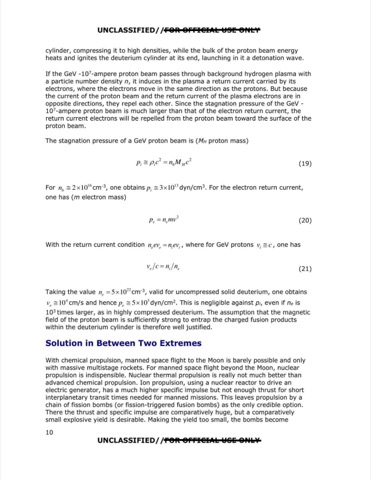
Image from page 16 of DOW-UAP-D126, as released by war.gov
Image from page 16 of the PDF. Open the scan to see the whole page.

Cite this page

U.S. Department of War. "AAWSAP DIRD, Advanced Nuclear Propulsion for Manned Deep Space Missions, March 2010" (DOW-UAP-D126). PURSUE Release 06, U.S. Department of War, September 18, 2026. https://www.war.gov/medialink/ufo/sept-18/release-06/assets/DOW-UAP-D126_AAWSAP-DIRD-Advanced-Nuclear-Propulsion-for-Manned-Deep-Space-Missions-March-11-2010.pdf. Declassified UAP, page 16, https://declassifieduap.org/r/dow-uap-d126-aawsap-dird-advanced-nuclear-propulsion-for-manned-deep-space-missions-march-2010/p/16. Accessed November 28, 2026.

This address shows page 16 on its own; /r/dow-uap-d126-aawsap-dird-advanced-nuclear-propulsion-for-manned-deep-space-missions-march-2010?page=16 opens the same page in the full reader. Both stay. How to cite.