DOW-UAP-D125

AAWSAP DIRD, Inertial Electrostatic Confinement Fusion, March 2010, page 38

One page of a U.S. government record released under PURSUE, shown on its own with its text. The record page has the whole document, its catalog details and the scan.

Page
38 of 72
Agency
Department of War
Released
Release 06, September 18, 2026

Text of page 38

UNCLASSIFIED//FOR OFFFErAL USE ONLY region is essential to decrease the center potential and consequently allow incoming beam ions to penetrate into the core region. In the DalEC, it is possible to assist this effect by an external control of the centerline potential by applying a bias voltage to the dipole coil. In the UIUC experiment this was done by applying a voltage to a small copper ring inserted in the core of the dipole magnet. The increase in the electron density with a small center line bias applied was about 30 percent while the applied voltage to the dipole structure was ~3 percent of the discharge voltage. The present setup prevented the use of larger applied voltages which could further improve neutralization, but these results still demonstrate the basic concept of dipole focusing with coil bias control. Figure 3.6 shows how the electron density changes with increasing magnetic field measured at various coil biases in the current experiment. It is found that electron density increases about 17 times more than that of non-magnetic field measurement. So far, this increase is very close to our theoretical estimations. Electron density vs B-field 25mTorr 1.00E+10 Electron density(cm-3 1.00E+09 1.00E+08 0 100 B-field strength (Gauss) 200 300 400 500 Ground —— Ve=-100V 600 - 700 • Ve=+100V 800 Figure 3.6. Electron Density vs. Dipole Magnet Field Strength at 25mTorr, 20mA The next section turns to some very interesting diagnostic studies of IEC devices, including a jet thruster configuration, done by Joe Khachan's group at the University of Sydney, Australia. KHACHAN'S STUDIES AT U OF SYDNEY Joe Khachan's IEC research at the University of Sydney has stressed studies of optical emission spectroscopy of gridded IEC devices (Reference 3.11, 3.12). Using Doppler spectroscopy of the Hydrogen Ha line they have shown that the micro-channels in an IEC discharge operating in the units at tens of morr pressure range (for voltages less than 30 kV) are mostly composed of molecular ions with approximately 20 percent atomic hydrogen. They have also developed a spectroscopic model based on collisional radioactive modeling to spectroscopically measure ion densities, electron energies and 31 UNCLASSIFIED/ /FOR OFFICIAL LISE ONLY

Machine-read (OCR) from the scan by this archive; it can contain errors. The scan is the record.
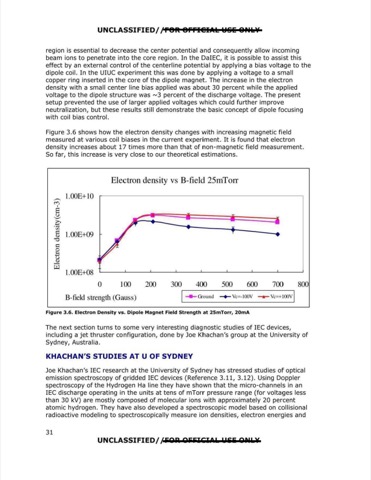
Image from page 38 of DOW-UAP-D125, as released by war.gov
Image from page 38 of the PDF. Open the scan to see the whole page.

Cite this page

U.S. Department of War. "AAWSAP DIRD, Inertial Electrostatic Confinement Fusion, March 2010" (DOW-UAP-D125). PURSUE Release 06, U.S. Department of War, September 18, 2026. https://www.war.gov/medialink/ufo/sept-18/release-06/assets/DOW-UAP-D125_AAWSA-DIRD-Inertial-Electrostatic-Confinement-Fusion-March-10-2010.pdf. Declassified UAP, page 38, https://declassifieduap.org/r/dow-uap-d125-aawsap-dird-inertial-electrostatic-confinement-fusion-march-2010/p/38. Accessed November 28, 2026.

This address shows page 38 on its own; /r/dow-uap-d125-aawsap-dird-inertial-electrostatic-confinement-fusion-march-2010?page=38 opens the same page in the full reader. Both stay. How to cite.