DOW-UAP-D125

AAWSAP DIRD, Inertial Electrostatic Confinement Fusion, March 2010, page 37

One page of a U.S. government record released under PURSUE, shown on its own with its text. The record page has the whole document, its catalog details and the scan.

Page
37 of 72
Agency
Department of War
Released
Release 06, September 18, 2026

Text of page 37

UNCLASSIFIED//FOR OFFErAL USE ONLY There are several advantages of the dipole-assisted TEC. By applying the desired voltage to the cathode grid, high-energy lons are easily obtained, hence plasma heating is straightforward. Indeed in this case fusion is dominated by beam-beam (non- Maxwellian reactions). Also, the dipole magnet at the center of the device produces field lines that trap ions and compresses them within the inner radius of the dipole. Thus, a very high ion density can be achieved leading to high reaction rates via beam- beam fusion. Biasing the dipole magnet to the same potential as the cathode grid solves the problem of space charge build-up due to the high ion density at the center of DalEC. DAIEC EXPERIMENTS The purpose of current experiments is to investigate the focusing effect of a dipole magnetic field in a spherical IEC. In particular, the primary goal is to measure the increase in plasma densities achieved by a dipole-assisted IEC. In theory, the introduction of a current ring or dipole coil into the base configuration would focus particles into the center of the dipole, increasing the plasma density at the core of the device. A schematic of the current experimental setup is shown in Figure 3.5. 10cm distance - 15 cm 10cm Figure 3.5. (a) Dipole Magnetic Field and (b) Layout of Devices This experiment employs two split spherical grids as shown in Figure 3.5. Ions are created in the discharge between these grids and the vessel wall. They are extracted and accelerated by the grid potential so they pass through the dipole field of Figure 3.5a. Experiments have confirmed that an order of magnitude density increase (vs. no dipole present) can be achieved in the center region. A double Langmuir probe is inserted at various positions throughout the center region. The use of a bias on the dipole magnet structure to control space charge build-up was also studied. In an ion-injected IEC partial space-charge neutralization at the core 30 UNCLASSIFIED//FO AL USE ONLY

Machine-read (OCR) from the scan by this archive; it can contain errors. The scan is the record.
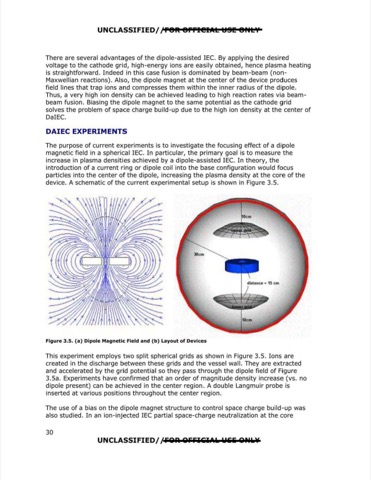
Image from page 37 of DOW-UAP-D125, as released by war.gov
Image from page 37 of the PDF. Open the scan to see the whole page.

Cite this page

U.S. Department of War. "AAWSAP DIRD, Inertial Electrostatic Confinement Fusion, March 2010" (DOW-UAP-D125). PURSUE Release 06, U.S. Department of War, September 18, 2026. https://www.war.gov/medialink/ufo/sept-18/release-06/assets/DOW-UAP-D125_AAWSA-DIRD-Inertial-Electrostatic-Confinement-Fusion-March-10-2010.pdf. Declassified UAP, page 37, https://declassifieduap.org/r/dow-uap-d125-aawsap-dird-inertial-electrostatic-confinement-fusion-march-2010/p/37. Accessed November 28, 2026.

This address shows page 37 on its own; /r/dow-uap-d125-aawsap-dird-inertial-electrostatic-confinement-fusion-march-2010?page=37 opens the same page in the full reader. Both stay. How to cite.