Text of page 39
UNCLASSIFIED/ /FOR OFFICIAL USE OAKY
predict fusion rates. This latter achievement makes spectroscopic measurements
simpler to carry out since hydrogen can be used to predict these fusion rates, which
excludes the radiation hazard in a laboratory situation where shielding is not possible.
In follow-on work, they simplified the modeling of charge exchange with an analytical
approach to charge exchange modeling based on Markov chain theory.
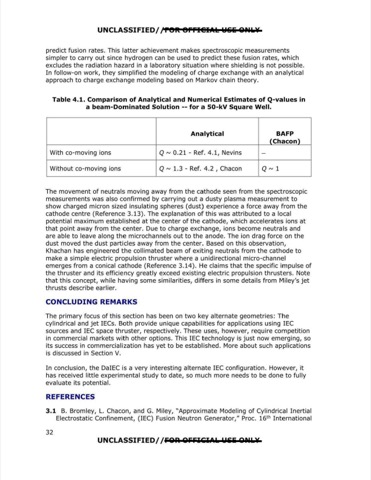
Table 4.1. Comprisomon tea oical an - Numerical timate of - values in
Analytical
BAFP
(Chacon)
With co-moving ions
Q ~ 0.21 - Ref. 4.1, Nevins
-
Without co-moving ions
Q ~ 1.3 - Ref. 4.2, Chacon
Q ~ 1
The movement of neutrals moving away from the cathode seen from the spectroscopic
measurements was also confirmed by carrying out a dusty plasma measurement to
show charged micron sized insulating spheres (dust) experience a force away from the
cathode centre (Reference 3.13). The explanation of this was attributed to a local
potential maximum established at the center of the cathode, which accelerates ions at
that point away from the center. Due to charge exchange, ions become neutrals and
are able to leave along the microchannels out to the anode. The ion drag force on the
dust moved the dust particles away from the center. Based on this observation,
Khachan has engineered the collimated beam of exiting neutrals from the cathode to
make a simple electric propulsion thruster where a unidirectional micro-channel
emerges from a conical cathode (Reference 3.14). He claims that the specific impulse of
the thruster and its efficiency greatly exceed existing electric propulsion thrusters. Note
that this concept, while having some similarities, differs in some details from Miley's jet
thrusts describe earlier.
CONCLUDING REMARKS
The primary focus of this section has been on two key alternate geometries: The
cylindrical and jet IECs. Both provide unique capabilities for applications using IEC
sources and IC space thruster, respectively. These uses, however, require competition
in commercial markets with other options. This IEC technology is just now emerging, so
its success in commercialization has yet to be established. More about such applications
is discussed in Section V.
In conclusion, the DaleC is a very interesting alternate lEe configuration. However, it
has received little experimental study to date, so much more needs to be done to fully
evaluate its potential.
REFERENCES
3.1 B. Bromley, L. Chacon, and G. Miley, "Approximate Modeling of Cylindrical Inertial
Electrostatic Confinement, (IEC) Fusion Neutron Generator," Proc. 16th International
32
UNCLASSIFIED//FOR OFFICIAL USE ONLY