DOW-UAP-D124

AAWSAP DIRD, Space Access: Where We’ve Been and Where We Could Go, March 2010, page 7

One page of a U.S. government record released under PURSUE, shown on its own with its text. The record page has the whole document, its catalog details and the scan.

Page
7 of 56
Agency
Department of War
Released
Release 06, September 18, 2026

Text of page 7

UNCLASSIFIED/ FOR OFFICIAL USE ONLY responsibility for space access, that Air Force's focus switched to surveillance, communication, and Global Positioning System satellites. In the late 1950s, there existed a predisposition- forced by the military competition between the United States and the former Soviet Union-to use rockets derived from military ballistic missiles. That decision curtailed efforts to develop alternatives to chemical rockets together with practical commercial developments. With the orbiting of Sputnik, the aircraft path to space, as represented by the X series of planes, ended with the X-15. With the X-15's demise, all efforts to fly aircraft to space ended, replaced by the more familiar (but less practical) strategy of loudly blasting to space with expendable rockets derived from undertested ballistic missile hardware, as documented in early failures. Like their ballistic missile progenitors, current expendable rockets can be launched only once. With the exception of the experimental Delta Clipper developed and operated by William Gaubatz and the late Pete Conrad, no operational launcher has ever successfully aborted. In this context, a reusable launcher is simply an expendable with some parts reused a few times. Thus, neither the United States nor the Soviet Union/ Russia has ever realized a truly commercial approach to space travel, although the Soviets came close to taking the first step with the since-terminated Energia/Buran system. Both the United States and the Soviet Union/ Russia historically have generated a large number of concepts that could fly directly to space and return on a sustained, frequent, scheduled basis. An all-up air breather such as the NASP was to solve that problem and fly directly to space and return. Developing an operational mach 12 to 14 aircraft with air-breathing propulsion presents a serious design, engineering, and fabrication challenge analogous to the SR-71 Blackbird. vii UNCLASSIFIED/ FOR OFFICIAL USE ONLY

Machine-read (OCR) from the scan by this archive; it can contain errors. The scan is the record.
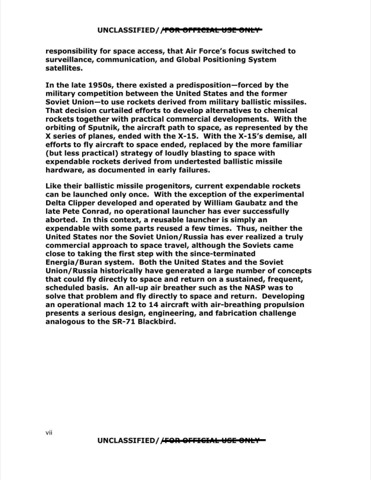
Image from page 7 of DOW-UAP-D124, as released by war.gov
Image from page 7 of the PDF. Open the scan to see the whole page.

Cite this page

U.S. Department of War. "AAWSAP DIRD, Space Access: Where We’ve Been and Where We Could Go, March 2010" (DOW-UAP-D124). PURSUE Release 06, U.S. Department of War, September 18, 2026. https://www.war.gov/medialink/ufo/sept-18/release-06/assets/DOW-UAP-D124_AAWSAP-DIRD-Space%20Access-Where-Weve-Been-and-Where-We-Could-Go-March-8-2010.pdf. Declassified UAP, page 7, https://declassifieduap.org/r/dow-uap-d124-aawsap-dird-space-access-where-weve-been-and-where-we-could-go-march-2010/p/7. Accessed November 28, 2026.

This address shows page 7 on its own; /r/dow-uap-d124-aawsap-dird-space-access-where-weve-been-and-where-we-could-go-march-2010?page=7 opens the same page in the full reader. Both stay. How to cite.