DOW-UAP-D124

AAWSAP DIRD, Space Access: Where We’ve Been and Where We Could Go, March 2010, page 6

One page of a U.S. government record released under PURSUE, shown on its own with its text. The record page has the whole document, its catalog details and the scan.

Page
6 of 56
Agency
Department of War
Released
Release 06, September 18, 2026

Text of page 6

UNCLASSIFIED//FOR OFFICIAL USE ONLY veterans responded, "It was not a technology issue; it was a hardware issue." In a keynote address to the Aeronautical Revolutionary Concepts Workshop sponsored by the Vehicle Applications Panel of the National Research Council and held at NASA Ames in July 1984, then-Assistant Secretary of Commerce for Productivity, Technology, and Innovation Dr. D. Bruce Merrifield identified the problem of translating ideas into products as preparing technology for product manufacture. Dr. Merrifield drew an analogy between this step and Major League Baseball's farm system, which prepares skilled but untrained players for the major leagues. The United States assigns projects to accomplish technology tasks so the flow of production- ready hardware is always improving and is not fixed (see Figure 1). Innovation Focus: Preparation of Technology for Application - 7 to 10 years Idea Generation Invention Technology Feasibility Product Develooment Prototype and Pilot Plant Translation 90% Cost Manulacture Commercialization RDLP 10% Cost Gap in effective preparation for application in United States 1983 Innovation in Aeronautics Workshop, NASA AMES 'ERTA No Gap in transformation to production Dr.D. Bruce Merrifield Assistant Secretary lor Productivity. Technology and Innovation Figure 1. Hardware Flow Saturn I and Saturn V could be readied for a moon flight in such a short time because most of their hardware was based on a frozen design, proven production processes, and adaptation of existing hardware. Using a similar approach, current industrial capabilities can create the next practical system for accessing space. In the late 1950s and early 1960s, the U.S. Air Force was working toward an operational capability analogous to its B-52 fleets: flight operations when required or "on demand." After NASA was assigned vi UNCLASSIFIED//FOR OFFICIAL USE ONLY

Machine-read (OCR) from the scan by this archive; it can contain errors. The scan is the record.
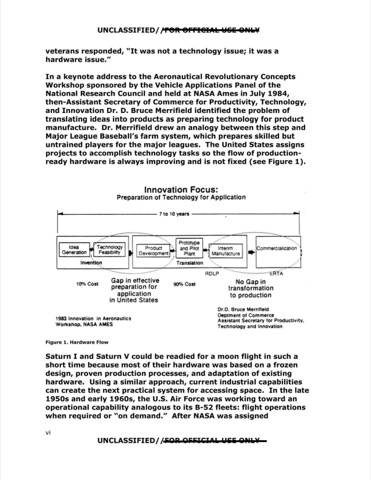
Image from page 6 of DOW-UAP-D124, as released by war.gov
Image from page 6 of the PDF. Open the scan to see the whole page.

Cite this page

U.S. Department of War. "AAWSAP DIRD, Space Access: Where We’ve Been and Where We Could Go, March 2010" (DOW-UAP-D124). PURSUE Release 06, U.S. Department of War, September 18, 2026. https://www.war.gov/medialink/ufo/sept-18/release-06/assets/DOW-UAP-D124_AAWSAP-DIRD-Space%20Access-Where-Weve-Been-and-Where-We-Could-Go-March-8-2010.pdf. Declassified UAP, page 6, https://declassifieduap.org/r/dow-uap-d124-aawsap-dird-space-access-where-weve-been-and-where-we-could-go-march-2010/p/6. Accessed November 28, 2026.

This address shows page 6 on its own; /r/dow-uap-d124-aawsap-dird-space-access-where-weve-been-and-where-we-could-go-march-2010?page=6 opens the same page in the full reader. Both stay. How to cite.