Text of page 8
UNCLASSIFIED/ TOR OFFre
AL USE ONLY
Propulsion Perspective
In exiting Earth's atmosphere, the propulsion system and configuration are inexorably
linked. A hypersonic glider exits the atmosphere on either a rocket booster or a first
stage of a two-stage-to-orbit aircraft. As such, it usually exits the atmosphere quickly,
and the key exit design considerations are the high transonic aerodynamic and the
mechanical loads encountered in the exit trajectory. Whether for a new rocket launcher
or the U.S. space shuttle, the phenomenon is the same: the peak mechanical loads
occur during exit. In this case, the exit aerodynamics are important but not vital. The
vital aerodynamics and thermodynamics (aerothermodynamics) are in the entry glide,
where thermal loads are maximal and must be controlled. The vehicle must always be
controlled in flight so its attitude and direction are within limits set by the
aerothermodynamics. The angle-of-attack limits are very close for high-performance
hypersonic gliders, as their glide angle of attack is 11 to 15 degrees, not the 45 degrees
of the space shuttle. Even the Russian Buran had a lower glide angle of attack than the
shuttle; a TsAGI report given to the author by Vladimir Neyland shows it to have been
about 30 to 35 degrees.? Like the Buran, the high-performance glider is best controlled
by an automatic integrated flight control system that monitors the thermodynamic state
of the vehicle, as well as its aerodynamic and trajectory states. The sensor array
provides real-time information to the control system that can maintain the correct
attitude in a manner a human controller could not accomplish. So it is this phase of the
flight that designs the hypersonic glider.
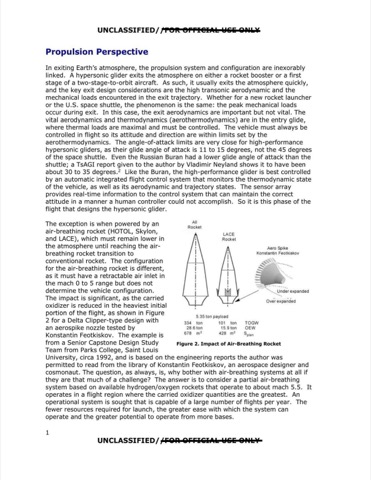
The exception is when powered by an
All
Rocket
air-breathing rocket (HOTOL, Skylon,
and LACE), which must remain lower in
LACE
Rocket
the atmosphere until reaching the air-
breathing rocket transition to
Aero Spike
Konstantin Feotkiskov
conventional rocket. The configuration
for the air-breathing rocket is different,
as it must have a retractable air inlet in
the mach 0 to 5 range but does not
determine the vehicle configuration.
The impact is significant, as the carried
Under expanded
Over expanded
oxidizer is reduced in the heaviest initial
portion of the flight, as shown in Figure
2 for a Delta Clipper-type design with
an aerospike nozzle tested by
Konstantin Feotkiskov. The example is
5.35 ton payload
334
ton
101
ton TOGW
28.6 ton
15.9 ton
OEW
678
m?
428 m?
Splan
from a Senior Capstone Design Study
Figure 2. Impact of Air-Breathing Rocket
Team from Parks College, Saint Louis
University, circa 1992, and is based on the engineering reports the author was
permitted to read from the library of Konstantin Feotkiskov, an aerospace designer and
cosmonaut. The question, as always, is, why bother with air-breathing systems at all if
they are that much of a challenge? The answer is to consider a partial air-breathing
system based on available hydrogen/oxygen rockets that operate to about mach 5.5. It
operates in a flight region where the carried oxidizer quantities are the greatest. An
operational system is sought that is capable of a large number of flights per year. The
fewer resources required for launch, the greater ease with which the system can
operate and the greater potential to operate from more bases.
1
UNCLASSIFIED/ FOR OFFICI
AL USE ONLY