DOW-UAP-D124

AAWSAP DIRD, Space Access: Where We’ve Been and Where We Could Go, March 2010, page 30

One page of a U.S. government record released under PURSUE, shown on its own with its text. The record page has the whole document, its catalog details and the scan.

Page
30 of 56
Agency
Department of War
Released
Release 06, September 18, 2026

Text of page 30

UNCLASSIFIED//FOR OFFI AL USE ONLY The Qu Tube In the 1990s, a colleague, Ying-Ming Lee, who then worked at MSE in Butte, Montana, showed the author a copper tube about a foot long that was a heat pipe from his colleague in Taiwan. If the tip was put into a cup of hot water, the other end almost instantly was too hot to hold. If it was quickly put into a glass of cold water, that tip just as quickly became ice cold. As documented in the excerpted page below from the University of Alabama, Huntsville, Annual Report, the apparent conductivity is greater than copper and could not be melted, as the thermal energy would be removed so fast that a significant temperature rise could not be attained. This could have significant industrial application for the United States. The late Clark Hawk had obtained a 10- foot-long Qu tube and tested it in his laboratory. The results were published in the University of Alabama, Huntsville, Annual Report. However, as Clark Hawk discovered, the Chinese team associated with Professor Qu in mainland China was not about to let this discovery into American hands. Plus his team was composed of a number of young, ambitious technocrats who thought they knew how to make their fortune. So both Ying-Ming's and Clark's attempts to advance beyond a demonstration tube ended in frustration. Any attempt to open the tube results in failure, as whatever is in the tube reacts into an inert powder. The author has two smaller tubes in his possession. With applications including hypersonic vehicles, nuclear power plants, and electronic cooling, these devices would lead to an economic breakthrough in practical thermal control. 23 UNCLASSIFIED// FOR OFFICIAL USE NLY

Machine-read (OCR) from the scan by this archive; it can contain errors. The scan is the record.
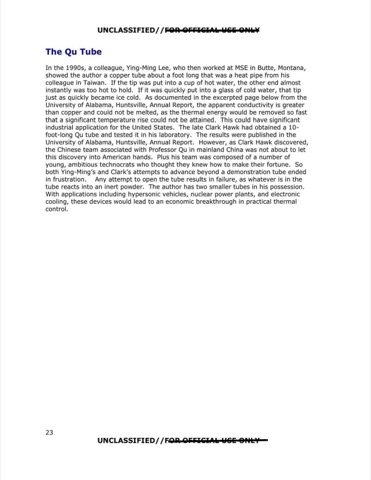
Image from page 30 of DOW-UAP-D124, as released by war.gov
Image from page 30 of the PDF. Open the scan to see the whole page.

Cite this page

U.S. Department of War. "AAWSAP DIRD, Space Access: Where We’ve Been and Where We Could Go, March 2010" (DOW-UAP-D124). PURSUE Release 06, U.S. Department of War, September 18, 2026. https://www.war.gov/medialink/ufo/sept-18/release-06/assets/DOW-UAP-D124_AAWSAP-DIRD-Space%20Access-Where-Weve-Been-and-Where-We-Could-Go-March-8-2010.pdf. Declassified UAP, page 30, https://declassifieduap.org/r/dow-uap-d124-aawsap-dird-space-access-where-weve-been-and-where-we-could-go-march-2010/p/30. Accessed November 28, 2026.

This address shows page 30 on its own; /r/dow-uap-d124-aawsap-dird-space-access-where-weve-been-and-where-we-could-go-march-2010?page=30 opens the same page in the full reader. Both stay. How to cite.